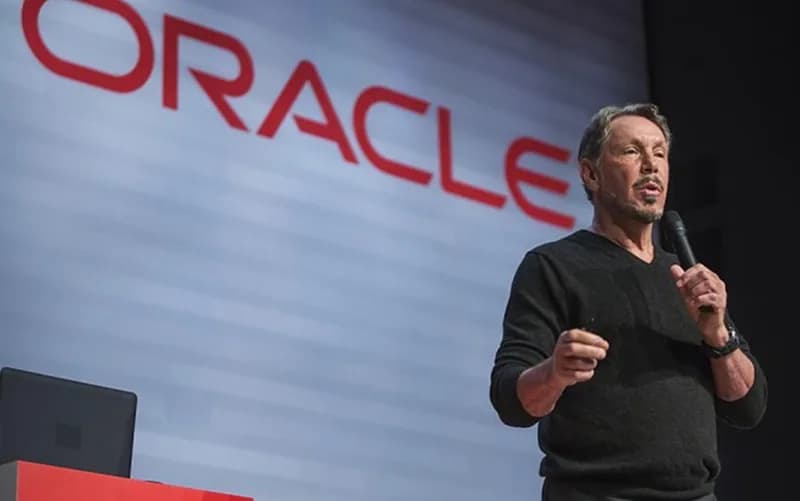
Oracle co-founder and Chief Technology Officer Larry Ellison has made a striking claim about the company's internal software development process: AI is now writing Oracle's code.
In a recent statement, Ellison described a shift from traditional programming to a declarative, intent-based approach powered by AI. "We just tell the model what we want the program to do, and then the AI comes up with a step-by-step process to actually do it," Ellison said. "We don't write the procedure, we declare our intent."
Key Takeaways
- Oracle co-founder Larry Ellison stated the company now uses AI to generate code.
- Engineers declare their intent, and the AI produces the step-by-step procedure.
What Happened
The statement, shared via social media, outlines a fundamental change in how one of the world's largest enterprise software companies approaches code creation. Instead of engineers manually writing lines of code in languages like Java, SQL, or C++, they now describe the desired outcome or function to an AI model. The model then generates the necessary procedural code to implement that intent.
This represents a move from imperative programming (specifying how to achieve a goal) to declarative programming (specifying what the goal is), with an AI acting as the compiler that bridges the gap between intent and execution.
Context
Oracle is a $340+ billion enterprise software giant whose products—database systems, cloud infrastructure, and enterprise applications—run critical operations for thousands of global businesses. The company has been aggressively integrating AI across its stack, most notably with its Oracle Cloud Infrastructure (OCI) Generative AI service, which offers access to models like Cohere's Command R+ and Meta's Llama 2.
Ellison's claim aligns with a broader industry trend toward AI-assisted development. GitHub Copilot, launched in 2021, popularized AI pair programming. Amazon Q Developer, Google's Gemini Code Assist, and various open-source code generation models have since entered the space. However, Ellison's description suggests Oracle may be applying this technology at an unprecedented scale for internal core development, not just as an assistant for individual developers.
Technical Implications
While Ellison did not specify which AI model Oracle uses, the company's deep partnership with Cohere and its OCI Generative AI service makes Cohere's models a likely candidate. Cohere's Command R+ is specifically optimized for enterprise Retrieval-Augmented Generation (RAG) and tool use, capabilities well-suited for generating code that interacts with existing APIs, databases, and internal systems.
The claim "AI is now writing Oracle's code" likely refers to a significant portion of new development, particularly for business logic, data pipelines, and API integrations, where intent can be clearly specified. It is less likely to apply to low-level systems programming, kernel development, or performance-critical database engine code, where precise manual control remains essential.
What This Means in Practice

For Oracle's engineering teams, this shift could dramatically alter workflows. The developer's role evolves from coder to specifier and validator. The primary tasks become:
- Clearly defining the intent and requirements for a software component.
- Reviewing, testing, and refining the AI-generated code.
- Integrating the validated code into the larger codebase.
This has the potential to increase development velocity and allow engineers to focus on higher-level architecture and problem-solving. However, it also introduces new challenges around code quality, security auditing, and maintaining a deep understanding of the systems being built.
gentic.news Analysis
Ellison's statement is a significant data point in the enterprise adoption of generative AI. It signals that AI code generation has moved beyond a productivity tool for individual developers and is being operationalized at the core of a major software company's production pipeline. This follows Oracle's strategic partnership with Cohere, announced in 2023, which positioned OCI as Cohere's primary cloud provider and integrated Cohere's models deeply into Oracle's services.
The move is also a competitive shot across the bow of cloud rivals Microsoft (GitHub Copilot) and Amazon (Amazon Q). By claiming AI writes its own code, Oracle is marketing its deep, firsthand experience with the technology it sells. This aligns with a pattern we've noted: enterprise vendors are increasingly using their own AI tools internally as both a development accelerator and a proof point for customers.
However, practitioners should parse Ellison's claim carefully. "Writing code" encompasses a vast spectrum. Generating a microservice from a spec is different from maintaining a legacy, billion-line codebase. The real test will be whether this approach scales to Oracle's entire, complex software portfolio and survives long-term maintenance cycles. If successful, it could set a new standard for enterprise software development, pushing the industry further toward a future where AI is the primary engine of code creation.
Frequently Asked Questions
What AI model does Oracle use to write code?
Larry Ellison did not specify the exact model. Given Oracle's deep partnership with Cohere and the fact that Cohere's Command R+ models are hosted on Oracle Cloud Infrastructure (OCI) and optimized for RAG and tool use, they are the most likely candidate. Oracle may also be using a fine-tuned or proprietary variant.
Is Oracle no longer hiring software engineers?
No. The role of the software engineer is evolving, not disappearing. Engineers are still needed to define intent, validate AI output, design systems, ensure security, and manage integration. The skill set may shift toward higher-level design, prompt engineering, and AI system oversight.
Can this approach work for all types of programming?
Unlikely. Declarative, intent-based AI code generation is most effective for well-defined business logic, standard data transformations, and API integrations. It is less suited for novel algorithm development, low-level systems programming, or optimizing performance-critical sections where precise control is necessary.
How does this compare to GitHub Copilot?
GitHub Copilot is an AI pair programmer that suggests code completions and snippets within an IDE. Ellison describes a more systemic, pipeline-level approach where the AI generates entire procedures from a specification. This suggests a deeper integration into Oracle's software development lifecycle (SDLC), potentially automating larger units of work.