Lilian Weng, co-founder of Thinking Machines Lab, published a blog post arguing that recursive self-improvement (RSI) begins with the 'harness.' The post, shared by Sakana AI Labs, positions harness design as a practical path forward, citing three Sakana AI papers including The AI Scientist in Nature 2026.
Key facts
- The AI Scientist published in Nature 2026.
- ShinkaEvolve improves sample efficiency in LLM evolution.
- Darwin Gödel Machine rewrites its own harness code.
- Three challenges: evaluation, diversity collapse, reward hacking.
Lilian Weng, co-founder of Thinking Machines Lab and former OpenAI researcher, published a blog post according to @sakanaailabs arguing that recursive self-improvement (RSI) for AI systems should start with designing the 'harness'—the execution environment around a model—rather than directly rewriting model weights. The post, shared by Sakana AI Labs, provides a structured survey of RSI research and identifies three concrete projects from Sakana AI as case studies.
The Three Case Studies
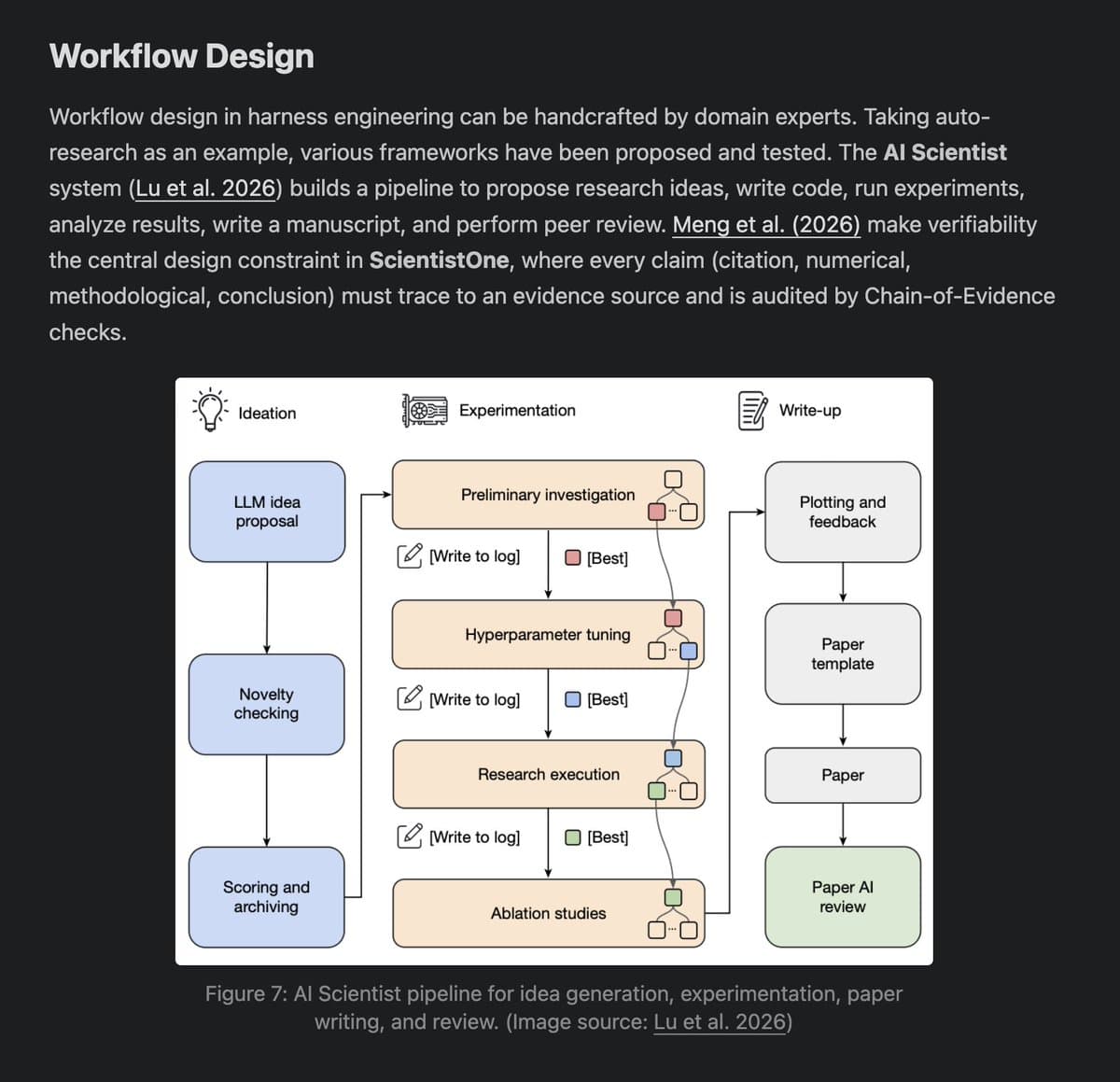
Sakana AI's The AI Scientist, published in Nature in 2026, autonomously proposes research ideas, runs experiments, writes papers, and reviews them—a full research pipeline. ShinkaEvolve introduces mechanisms to significantly improve sample efficiency in LLM-based program evolution. Darwin Gödel Machine is a coding agent that rewrites its own harness code, enabling self-improvement at the system level rather than the model level.
Structural Challenges
Weng also flags structural challenges inherent in self-improvement loops: evaluation difficulty, diversity collapse, and reward hacking. These issues, she notes, must be addressed for RSI to scale beyond toy settings. The post does not provide specific performance numbers for these challenges, but the framing shifts RSI from a model-centric to a system-centric problem.
The Unique Take
Weng's argument inverts the dominant RSI narrative. Most discussions focus on models rewriting their own weights—a hard problem with limited progress. By focusing on the harness, she suggests a more tractable starting point: optimizing the environment in which models operate, which can be iterated on independently of model architecture. This mirrors the shift from model-only scaling to system-level scaling seen in other AI domains.
What to watch

Watch for Sakana AI's RSI Lab to release performance benchmarks on Darwin Gödel Machine, particularly how its harness-rewriting approach compares to model-weight updating in coding tasks. Also track whether other labs adopt harness-centric RSI as a research direction.