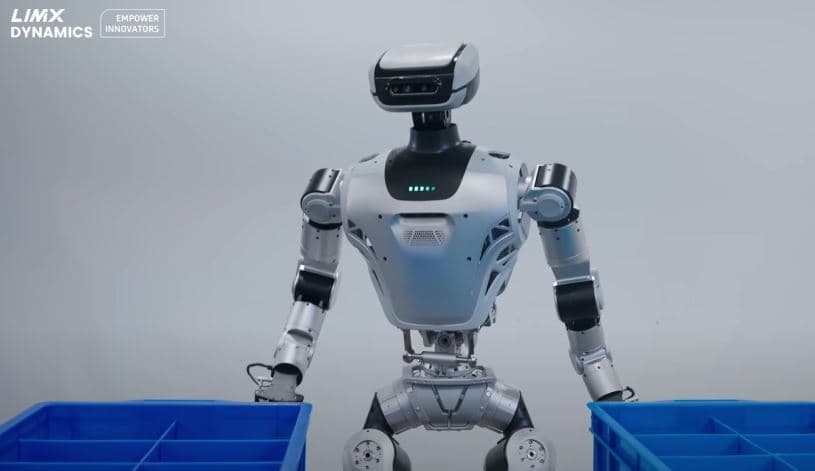
A brief demonstration video shared by AI researcher Rohan Paul shows a significant step in robotic autonomy. The video, originally posted by LimX, features their "Oli" robot performing an end-to-end startup sequence without human intervention.
What Happened
The robot, contained within a standard shipping crate, autonomously navigated out of the container. Upon exiting, it initiated a power-up sequence for its 31-degree-of-freedom (DoF) actuation system. Once powered, the robot began moving under its own control. The demonstration appears to be a single, continuous take, suggesting the process from unboxing to locomotion is handled by the robot's onboard systems.
Context
LimX is a robotics company focused on developing highly articulated, humanoid or human-centric robotic systems. A 31-DoF design indicates a complex robot with many independently controllable joints, likely aimed at achieving dexterous, human-like movement. The ability to self-deploy from shipping packaging addresses a practical hurdle in commercial and industrial robotics: the need for technical staff to unbox, assemble, and initialize systems on-site.
This demonstration fits into a broader industry trend toward "out-of-the-box" functionality. For robots to be deployed at scale—in warehouses, retail environments, or disaster response—reducing setup complexity and time is critical. An autonomous boot sequence that includes physical navigation out of confinement is a non-trivial integration challenge, combining perception, planning, and whole-body control.
gentic.news Analysis
This demonstration from LimX, while light on technical specifics, points to a maturation focus in robotics beyond pure capability and toward deployability. The core challenge isn't just building a robot that can perform tasks, but one that can transition from a shipped state to an operational state with minimal external support. This requires robust sensor fusion (to understand the confined environment of a shipping container), safe planning algorithms (to navigate out without damaging itself or surroundings), and reliable system checks for a 31-DoF powertrain.
The emphasis on a high degree-of-freedom system (31 DoF) is notable. For context, many popular bipedal research robots have 20-30 DoF. This places Oli in the category of a fully articulated humanoid or advanced mobile manipulator, capable of complex whole-body motion. The choice to showcase deployment logistics rather than a dynamic task like running or grasping suggests LimX is targeting practical adoption scenarios where ease of setup is a key purchasing factor.
This move aligns with a broader industry push we've covered, such as Figure AI's integration of OpenAI models for natural language control and Boston Dynamics' shift toward commercial logistics with Stretch. The race is no longer just about who has the most dynamic robot, but who can build a robot that works reliably in real environments with minimal fuss. If LimX can pair this deployment autonomy with competitive task performance, it could carve out a niche in markets where rapid, technician-free setup provides a tangible ROI.
Frequently Asked Questions
What is a 31-DoF system in robotics?
DoF stands for "degrees of freedom," essentially the number of independent ways a robot can move its joints. A 31-DoF system is highly complex, comparable to a humanoid robot with articulated fingers, wrists, elbows, shoulders, neck, waist, hips, knees, and ankles. Each DoF requires an actuator (like a motor), control software, and power, making system integration and coordination a significant engineering challenge.
Why is autonomous unboxing important for robots?
For robots to be deployed at scale in warehouses, factories, or retail spaces, the cost and time of setup by trained technicians becomes a major barrier. A robot that can remove itself from shipping packaging, power on, and perform self-checks reduces deployment overhead, lowers operational costs, and allows for faster scaling. It's a step toward treating robots more like appliances that are "plug and play."
Who is LimX?
LimX is a robotics company developing advanced robotic systems. While details are sparse from public sources, the demonstration of the Oli robot with 31 DoF suggests a focus on highly dexterous, human-centric robots capable of complex manipulation and mobility tasks. The company appears to be emphasizing full-system integration and practical deployment readiness.
How does this compare to robots from Boston Dynamics or Tesla?
Boston Dynamics' Spot and Atlas robots are renowned for dynamic mobility but often require careful setup and operator control. Tesla's Optimus is presented as a general-purpose humanoid but has not demonstrated similar autonomous deployment logistics. LimX's Oli demo focuses on a different part of the value chain: the transition from shipped product to working asset. It's a complementary advancement rather than a direct performance comparison on tasks like walking or grasping.