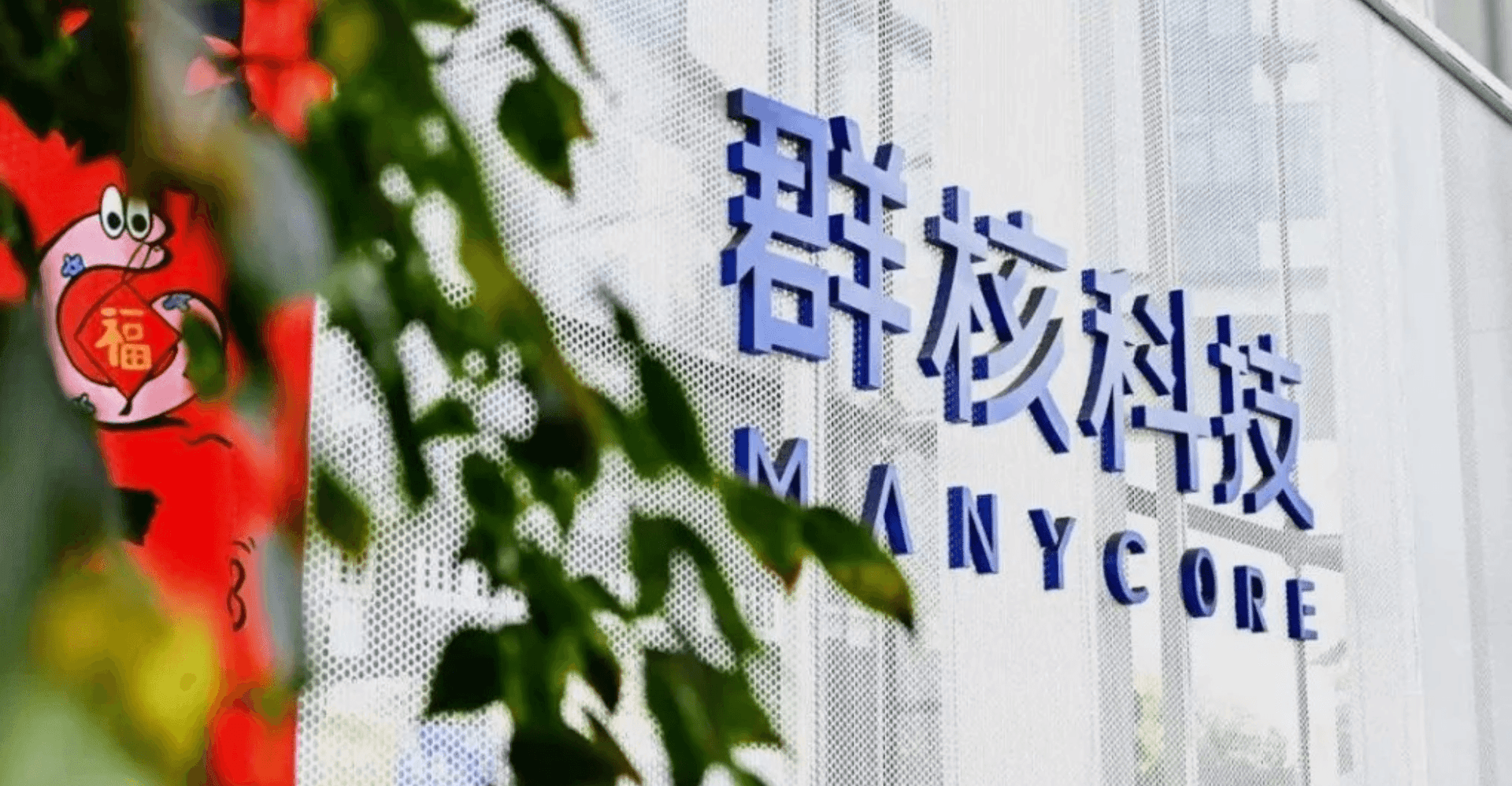
Chinese AI chip startup Manycore Tech has formally launched its initial public offering (IPO) on the Hong Kong Stock Exchange, securing HKD 455 million (approximately USD 58.2 million) in cornerstone backing from a group of institutional investors. The move positions the company to become the first publicly listed firm among Hangzhou's "Six Little Dragons"—a colloquial term for six prominent, venture-backed AI companies based in the eastern Chinese city.
The Deal
The cornerstone investors, who have committed to subscribe for shares worth HKD 455 million, include NIO Capital, Harvest Fund Management, and a fund managed by China Asset Management (Hong Kong) Limited. The funds raised from the IPO will be used primarily for research and development of the company's next-generation AI chips, expansion of its software ecosystem, and general working capital.
While the final IPO price and total fundraising amount are still being determined through the book-building process, the strong cornerstone backing signals institutional confidence in the company's trajectory within the competitive AI semiconductor market.
What the Company Does
Manycore Tech designs and develops specialized AI accelerator chips, known as neural processing units (NPUs), for data center and edge computing applications. The company's architecture focuses on high parallelism and energy efficiency for running large-scale machine learning inference and training workloads. Its products are positioned as alternatives to GPUs from NVIDIA and other AI accelerators from both international and domestic Chinese players.
Hangzhou, the capital of Zhejiang province, has emerged as a significant hub for China's AI industry, partly due to the presence of e-commerce giant Alibaba. The "Six Little Dragons" refers to a group of well-funded AI startups in the region, with Manycore Tech being the first from this cohort to attempt a public listing.
Market Context
The IPO comes amid intense global competition in the AI chip sector and ongoing efforts by Chinese companies to build a domestic semiconductor supply chain. While companies like Huawei's HiSilicon and Cambricon are also key players, the market for specialized AI accelerators remains fragmented, with significant demand from cloud service providers and enterprises deploying AI models.
A successful listing for Manycore Tech could pave the way for other Chinese AI hardware and software startups to access public capital markets, particularly in Hong Kong. However, the company will face immediate pressure to demonstrate commercial traction and technological differentiation against established incumbents and a growing field of well-funded private competitors.
gentic.news Analysis
Manycore Tech's IPO attempt is a significant bellwether for the Chinese AI hardware ecosystem. While the narrative of "domestic substitution" in semiconductors is powerful, commercial success requires more than geopolitical tailwinds. The company must prove its chips deliver compelling performance-per-watt and a viable software stack for developers—the same challenges faced by every AI accelerator startup globally.
This financial move occurs against a backdrop of intense focus on the infrastructure layer of AI. As covered extensively in our pages, the industry is grappling with how to efficiently run increasingly large and complex models. While much of the recent discourse has centered on Retrieval-Augmented Generation (RAG) and agent architectures—with some, like Ethan Mollick, even declaring the end of the 'RAG era' as a dominant paradigm—the foundational compute layer remains a critical bottleneck. The performance of RAG systems, fine-tuned models, and AI agents all ultimately depends on the underlying hardware they run on. A successful, performant domestic AI chip industry in China could influence the global cost structure and accessibility of running these advanced AI workloads.
The cornerstone investment from NIO Capital, the venture arm of electric vehicle maker NIO, is particularly noteworthy. It suggests a strategic alignment for in-vehicle AI and autonomous driving compute, a massive potential market. If Manycore Tech can secure design wins in adjacent verticals like automotive, it may find a more defensible niche than competing head-on with NVIDIA in general-purpose data centers.
Frequently Asked Questions
What are the 'Hangzhou Six Little Dragons'?
The "Hangzhou Six Little Dragons" is an informal term referring to six prominent, venture-backed artificial intelligence startups based in Hangzhou, China. The group is seen as emblematic of the city's growing AI ecosystem. Manycore Tech is reportedly the first from this group to launch an initial public offering.
Who are the cornerstone investors in Manycore Tech's IPO?
The cornerstone investors committing HKD 455 million include NIO Capital (the venture arm of electric vehicle maker NIO), Harvest Fund Management, and a fund managed by China Asset Management (Hong Kong) Limited. These are institutional investors who agree to buy a fixed amount of shares before the IPO's final pricing, providing stability and confidence to the offering.
What does Manycore Tech manufacture?
Manycore Tech designs and develops specialized AI accelerator chips, or neural processing units (NPUs). These are semiconductors optimized for the parallel computations required for machine learning inference and training, aiming to provide an alternative to GPUs for AI workloads in data centers and at the edge.
Why is a Hong Kong listing significant for a Chinese AI chip company?
A Hong Kong listing allows a Chinese company to access international capital while remaining closer to home compared to a US listing like NASDAQ. Given current geopolitical tensions and US restrictions on semiconductor technology transfers, listing in Hong Kong is seen as a strategic choice for Chinese tech firms seeking foreign investment without the regulatory complexities of a US exchange.