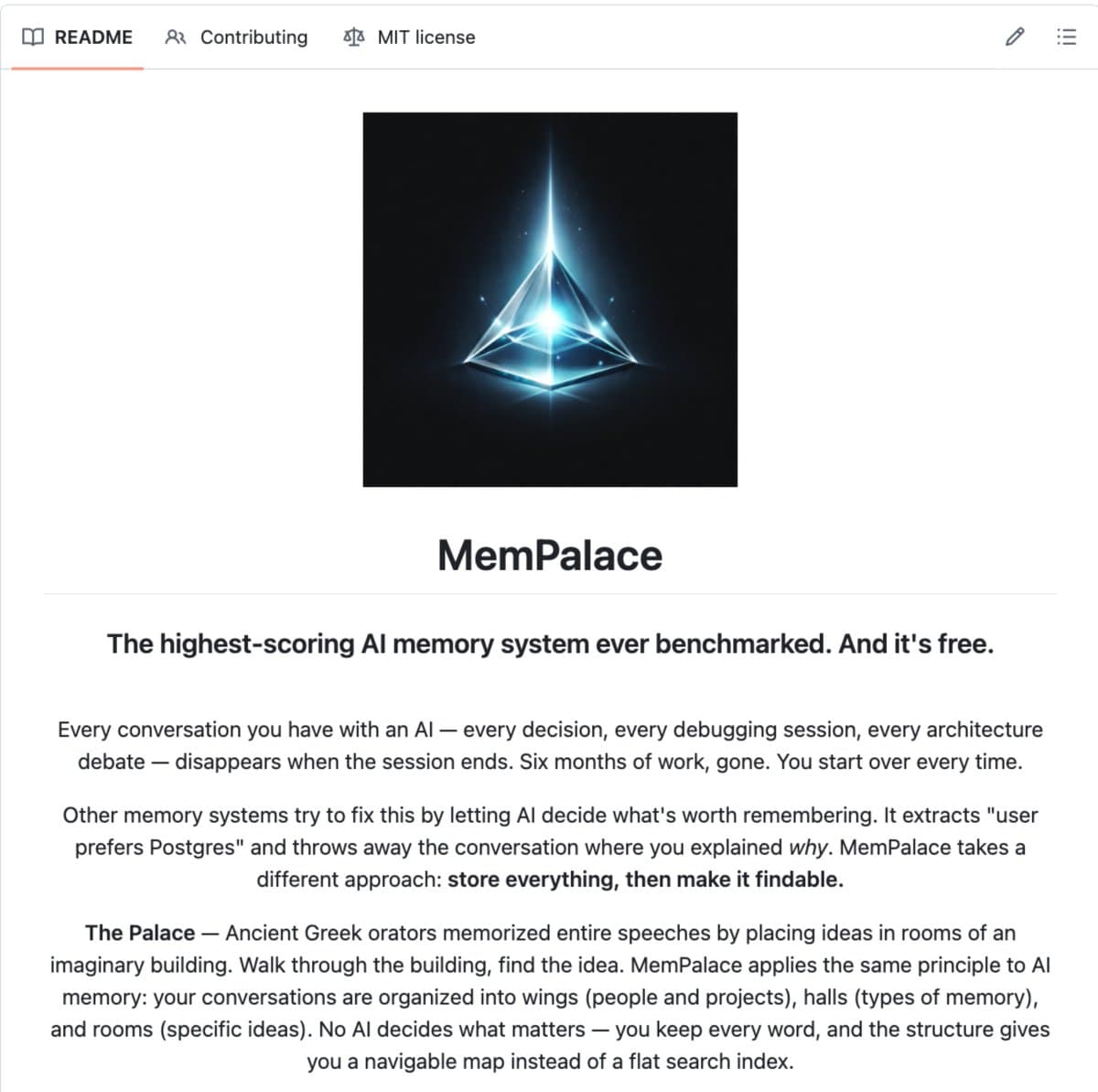
An open-source AI memory system called MemPalace has achieved what established commercial services have struggled to deliver: persistent, accurate memory for AI conversations without cloud dependencies or subscription fees. Built by Resident Evil actress Milla Jovovich and developer Ben Sigman using Claude Code, the project reached 35,000 GitHub stars in five days and delivers state-of-the-art performance on memory benchmarks while running entirely locally.
What MemPalace Actually Does

MemPalace solves a fundamental frustration with current AI tools: every conversation disappears when the session ends. Months of debugging sessions, architecture decisions, and project context vanish, forcing users to repeatedly re-explain context. Jovovich reportedly built MemPalace after growing frustrated that AI tools kept forgetting her.
The system implements a digital version of the ancient memory palace technique—a mnemonic strategy used by memory champions to remember vast amounts of information. Every project gets a "wing," every topic gets a "room," and every idea gets a "drawer." This organizational structure alone improves retrieval accuracy by 34% over flat search, according to the developers.
Technical Architecture
MemPalace stores all conversations verbatim in ChromaDB with no summarization or extraction, ensuring nothing is lost. The system features:
- 4-layer memory system with a 170-token wake-up cost (your AI loads months of memory in 170 tokens)
- Knowledge graph with temporal validity where facts have expiry dates—the system knows what was true then versus what's true now
- Auto-save every 15 messages so nothing disappears into chat history
- 19 MCP tools for compatibility with Claude Code, ChatGPT, Cursor, and Gemini CLI
- AAAK compression dialect providing 30x lossless shorthand that works with any LLM
- Automatic cross-references between projects, enabling AI to connect dots users might miss
Installation requires one command: pip install mempalace.
Benchmark Performance: 96.6% on LongMemEval
The most striking claim is MemPalace's performance on the LongMemEval benchmark: 96.6% accuracy on 500 questions with zero API calls, no cloud dependency, and no subscription. According to the developers, this score was independently verified by community members running on an M2 Ultra in under five minutes.
This represents the highest local-only score ever published—free or paid. For comparison:
MemPalace 96.6% Free, open-source Local, verbatim storage Mem0 ~85% $19-$249/month Cloud, AI-filtered Zep ~85% $25/month Cloud, AI-filteredBoth Mem0 and Zep use AI to decide what to remember, which inevitably leads to information loss. MemPalace's approach of storing everything verbatim combined with its memory palace organizational structure appears to deliver superior retrieval accuracy.
The Development Story

What makes this story unusual is its origin: a Hollywood actress partnering with a developer to build a technical solution using Claude Code. Milla Jovovich's frustration with AI tools forgetting her led to months of collaboration with Ben Sigman, resulting in a fully open-sourced solution under the MIT License.
The project's rapid GitHub traction—35,300 stars and 4,400 forks in its first week—suggests it addresses a widespread pain point among developers and AI practitioners.
gentic.news Analysis
MemPalace arrives at a critical inflection point in the AI memory landscape. For years, the dominant approach has been cloud-based services that use AI to filter and summarize memories—an approach that inevitably loses information and creates vendor lock-in. MemPalace's local-first, verbatim-storage architecture represents a fundamentally different paradigm that prioritizes completeness over efficiency.
This development aligns with several trends we've been tracking: the rise of local AI (as seen in Ollama's growth to 75k+ stars), increasing frustration with context window limitations despite models with 1M+ token contexts, and the democratization of AI toolbuilding through coding assistants like Claude Code. What's particularly notable is how MemPalace achieves state-of-the-art performance not through better AI models, but through better information architecture—the 34% improvement from the memory palace structure alone demonstrates that organizational intelligence can sometimes outperform raw computational power.
The timing is significant. Just last month, we covered Anthropic's 1M Context Window Rollout, which highlighted how even massive context windows don't solve the memory problem if information isn't organized for retrieval. MemPalace directly addresses this gap. Additionally, this follows Mem0's $2.3M Seed Round in January 2026, showing investor interest in AI memory solutions—interest that may now shift toward local, open-source alternatives.
For practitioners, MemPalace represents more than just another tool—it's a proof concept that local, open-source solutions can outperform venture-backed cloud services on core metrics. The 96.6% benchmark score, if independently verified, could trigger a reevaluation of whether AI memory should be a cloud service at all. The MIT license and simple pip installation lower adoption barriers dramatically, potentially accelerating a shift toward user-controlled AI memory architectures.
Frequently Asked Questions
How does MemPalace achieve 96.6% on LongMemEval without cloud AI?
MemPalace uses a combination of verbatim storage (nothing is lost to summarization) and a memory palace organizational structure that improves retrieval accuracy by 34% over flat search. The system stores everything in ChromaDB locally and uses efficient indexing rather than AI filtering to retrieve information, eliminating the information loss inherent in summarization-based approaches.
Is MemPalace really built by Milla Jovovich?
According to the source material, actress Milla Jovovich partnered with developer Ben Sigman to build MemPalace using Claude Code. Jovovich reportedly initiated the project after frustration with AI tools forgetting her. The code is publicly available on GitHub under the MIT License with 35,300+ stars, confirming substantial community validation of the implementation.
How does MemPalace compare to Mem0 and Zep?
MemPalace scores 96.6% on LongMemEval versus approximately 85% for both Mem0 and Zep. Unlike these paid services ($19-$249/month), MemPalace is free, open-source, and runs entirely locally without cloud dependencies. The key architectural difference is that MemPalace stores conversations verbatim while Mem0 and Zep use AI to filter and summarize memories, which causes information loss.
What is the "170-token wake-up cost" mentioned?
The wake-up cost refers to how many tokens are needed to load months of memory into an LLM's context. MemPalace's 4-layer memory system and efficient organization enable it to load comprehensive memory in just 170 tokens, making it practical to use with any LLM without consuming massive context windows.
Can MemPalace work with any LLM?
Yes, MemPalace includes 19 MCP tools for compatibility with Claude Code, ChatGPT, Cursor, and Gemini CLI. The AAAK compression dialect provides 30x lossless shorthand that works with any LLM, and the system stores conversations in a model-agnostic format in ChromaDB.