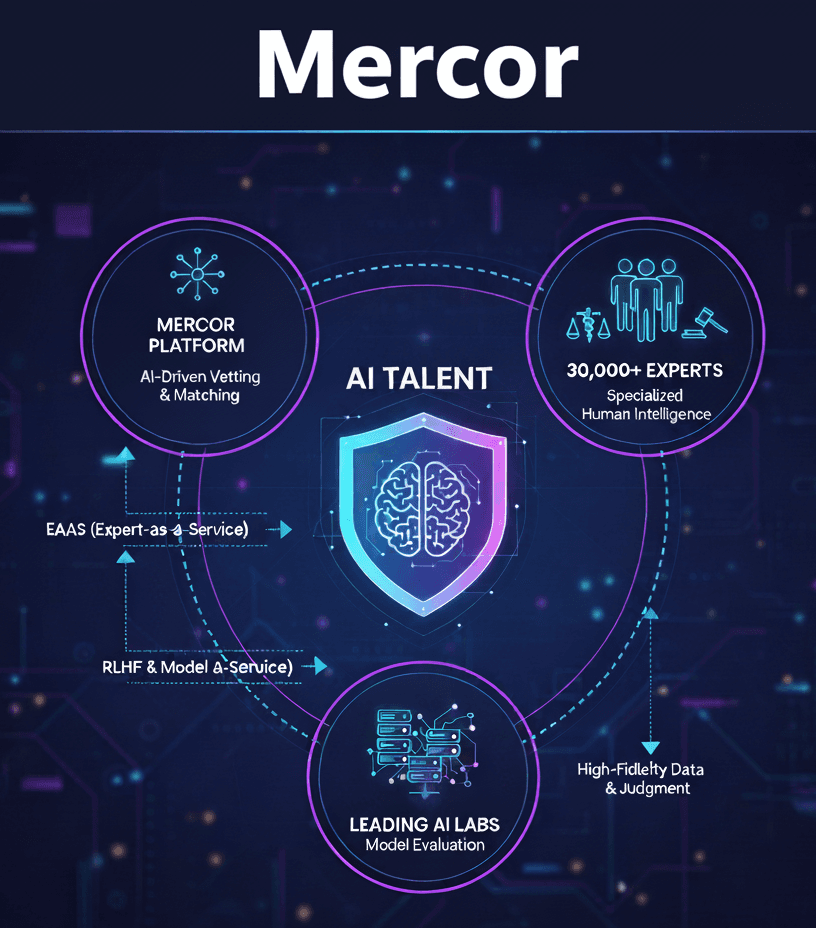
A significant security incident has reportedly compromised the data infrastructure of Mercor, a company specializing in expert-level human data collection for AI training. According to a social media post by AI researcher Harsh N. (hrkrshnn), which was amplified by tech commentator Matthew Weinbach, hackers have gained access to Mercor's systems. The core claim is that "all frontier labs" use Mercor's services to build their models, making this a potential supply-chain attack on the foundation model industry.
What Happened
The source material is a retweet of a brief statement from Harsh N. It states:
"Mercor does expert human data collection that all frontier labs use to build their models. Now hackers have access to that d…"
The tweet appears to be cut off, but the implication is clear: a breach has occurred, and malicious actors now have access to Mercor's data and potentially its internal systems.
Mercor's role, as described, is to provide "expert human data collection." In the context of frontier AI model development, this typically refers to high-quality, specialized annotation and evaluation tasks that are critical for training and aligning large language models (LLMs) and other AI systems. This can include:
- Constitutional AI Data: Human feedback used to train AI assistants to be helpful, harmless, and honest (HHH).
- Code & Reasoning Evaluations: Expert reviews of AI-generated code, mathematical proofs, or logical reasoning chains.
- Preference Ranking: Human judgments used to create datasets for reinforcement learning from human feedback (RLHF) or direct preference optimization (DPO).
- Specialized Domain Annotation: Labeling data in fields like law, medicine, or finance that requires expert knowledge.
Context: The Critical Role of Data Annotation Vendors
The development of state-of-the-art AI models has created a massive, behind-the-scenes industry for data labeling and human evaluation. While synthetic data and automated pipelines are growing, the highest-quality training signals for alignment and safety often still come from carefully curated human input. Companies like Scale AI, Surge AI, and reportedly Mercor, act as essential contractors for AI labs, handling sensitive data that directly shapes model behavior.
A breach at such a vendor is not merely a leak of static datasets. It could expose:
- Proprietary Prompt-Response Pairs: The exact instructions and ideal outputs labs are using to steer model capabilities.
- Model Weakness Analysis: Data revealing which model behaviors or failure modes labs are most focused on correcting.
- Competitive Intelligence: Which labs are using Mercor's services and potentially what capabilities they are prioritizing (e.g., advanced coding, scientific reasoning, agentic planning).
- Internal Tooling & Methodologies: The software and processes used to manage large-scale expert annotation, which itself is valuable intellectual property.
As of this writing, neither Mercor nor any major AI lab (such as OpenAI, Anthropic, Google DeepMind, or Meta) has issued a public statement confirming or detailing the breach. The report originates from social media, and its scope and severity remain unverified by official channels.
Potential Implications
If confirmed, the breach represents a serious security event for the AI ecosystem.
- Model Security: Exposed preference data could, in theory, be used to craft adversarial attacks or to attempt to replicate a lab's fine-tuning pipeline.
- Competitive Espionage: Rival entities or nation-states could gain insights into the development roadmaps of leading AI companies.
- Reputational & Trust Risk: Labs may reconsider their reliance on third-party vendors for core data tasks, potentially slowing development or increasing costs as they bring more work in-house.
- Regulatory Scrutiny: This incident would highlight the software supply-chain risks in AI development, potentially attracting attention from data protection regulators.
The truncated nature of the source tweet ("access to that d…") leaves key questions unanswered: What data was exfiltrated? Was it customer data, annotation data, or both? Have the affected AI labs been notified? Is there evidence of the data being misused or sold?
gentic.news Analysis
This reported breach touches on several critical, under-discussed vulnerabilities in the modern AI development stack. For years, the focus has been on model weights and training compute as the crown jewels. This incident underscores that the data pipelines and human feedback loops are equally sensitive assets. The knowledge that "all frontier labs" use a particular vendor, if accurate, creates a single point of failure—a high-value target for both cybercriminals and strategic competitors.
This aligns with a growing trend we've noted: the increasing value and opacity of alignment data. As covered in our analysis of Anthropic's Constitutional AI paper and OpenAI's preparedness framework, the methodologies for making models safe and steerable are becoming as proprietary as the models themselves. A breach that reveals the specific rubrics, constitutional principles, or preference rankings used by a top lab could compromise its unique approach to AI safety.
Furthermore, this incident recalls the software supply-chain attacks that have plagued traditional tech, like the SolarWinds hack. The AI industry is now mature enough to face similar threats. Its development process is distributed across cloud providers (AWS, GCP, Azure), chip manufacturers (NVIDIA), and now specialized data vendors. Securing this entire chain is a monumental task that has likely been under-prioritized in the race for capabilities.
If verified, expect a rapid, industry-wide shift. AI labs will likely mandate stricter security audits for their vendors, push for more data compartmentalization, and accelerate investments in fully synthetic or automated alignment techniques that reduce dependency on human data pipelines. The era of assuming data annotation is a "low-risk" outsourcing activity is likely over.
Frequently Asked Questions
What is Mercor?
Mercor is a company that provides expert-level human data collection and annotation services. In the AI industry, this means they employ specialists to label data, evaluate AI outputs, and generate high-quality training examples used by AI labs to improve and align their large language models and other AI systems.
What kind of data could have been exposed in the breach?
While unconfirmed, a breach at a data annotation vendor could expose several types of sensitive information: 1) Proprietary prompt-and-response pairs used to train AI models, 2) Internal evaluations and rankings of AI outputs that reveal model weaknesses, 3) The specific guidelines and instructions given to human annotators, which embody a lab's alignment strategy, and 4) Potentially, customer information related to the AI labs that use the service.
Which AI companies might be affected by this breach?
The source tweet claims "all frontier labs" use Mercor's services. While this is not verified, "frontier labs" typically refers to organizations like OpenAI, Anthropic, Google DeepMind, Meta's FAIR, and possibly others like xAI or Inflection. These companies are at the forefront of developing the most capable AI models and rely heavily on high-quality human feedback data.
What should AI labs do in response to such a breach?
If the breach is confirmed, affected AI labs would need to conduct a forensic assessment to determine exactly what data was accessed. They may need to audit their models for any potential compromise or bias introduced by the exposed data. Long-term, labs will likely enforce much stricter security requirements on their vendors, including encryption of data in transit and at rest, rigorous access controls, and potentially bringing more of the sensitive data annotation workflow in-house to reduce third-party risk.