What Happened: Meta's Infrastructure Innovation
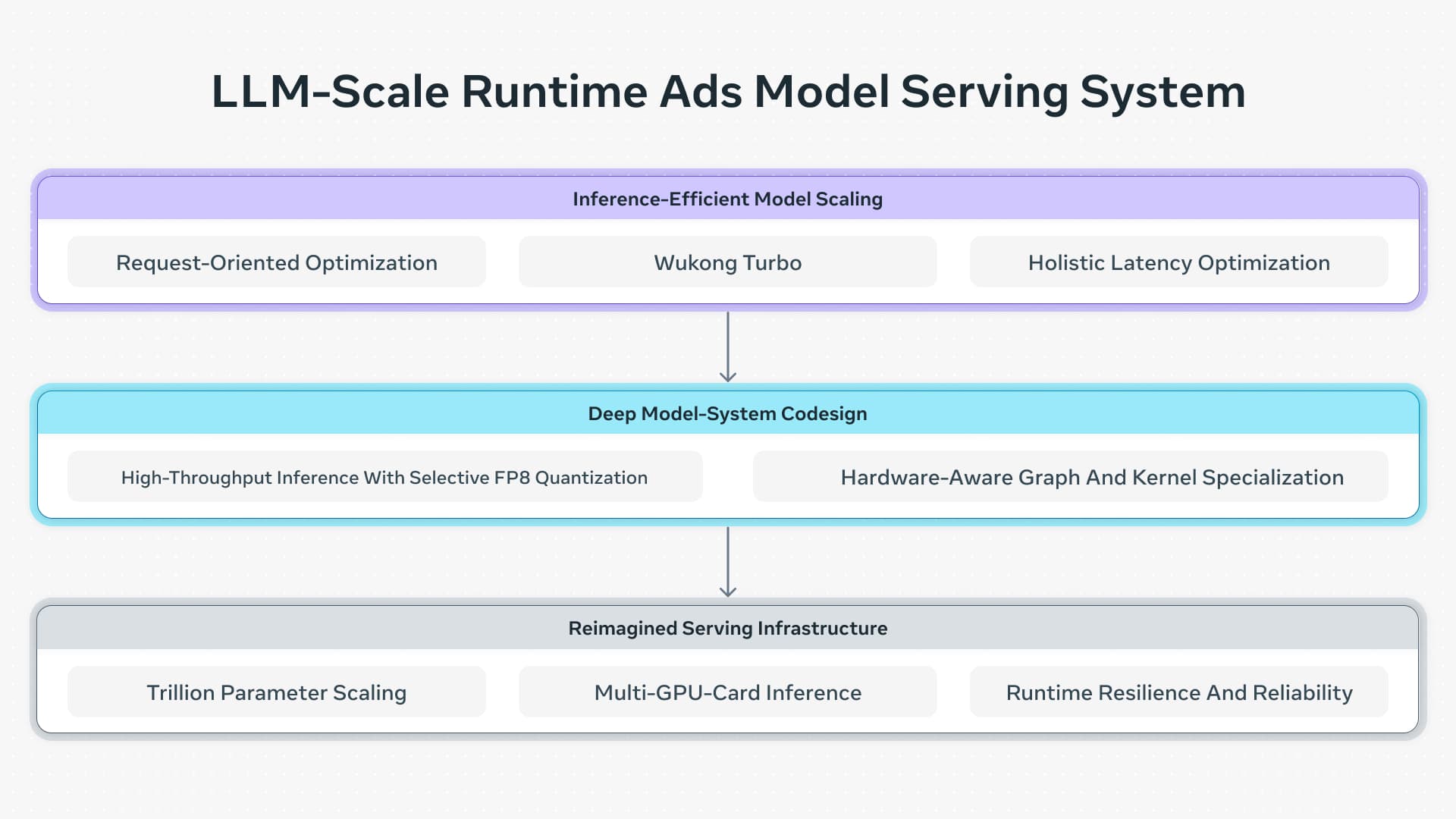
Meta has publicly detailed a significant engineering achievement from its ads infrastructure team: the development of an Adaptive Ranking Model (ARM). The core challenge they addressed is the prohibitive inference cost of deploying large language model (LLM)-scale architectures for real-time ranking tasks, such as ad selection. Traditional scaling sees inference cost rise linearly with model size, creating a major barrier to using more sophisticated, larger models in latency-sensitive production systems.
The ARM architecture "bends the inference scaling curve" by introducing a dynamic, two-stage inference process. Instead of running a single massive model on every candidate, the system uses:
- A lightweight, high-recall "router" model that quickly processes all candidates.
- A large, high-precision "expert" model that is invoked selectively, only on the most promising candidates identified by the router.
This selective activation mechanism is the key innovation. By ensuring the heavy LLM-scale model is used sparingly and judiciously, Meta achieves a dramatic reduction in aggregate computational load while maintaining—or even improving—the overall ranking accuracy critical for ad performance.
Technical Details: How ARM Bends the Curve
The engineering blog post outlines the fundamental shift from a monolithic model to an adaptive system. The router model is designed for extreme efficiency, making a fast pass to score and filter the candidate pool (e.g., thousands of potential ads). Only the top-k candidates from this stage are passed to the full-capacity expert model for final, detailed scoring and ranking.
This is more sophisticated than simple cascading models. The ARM framework likely involves co-training the router and expert models to ensure the router's selection criteria are optimally aligned with the expert's final ranking objectives, preventing the system from discarding candidates the expert would have highly rated. The result is a non-linear relationship between model capacity and inference cost, enabling the use of models that would otherwise be economically unfeasible for real-time serving.
Retail & Luxury Implications: Beyond Ads to Personalization
While Meta's immediate application is for its advertising ecosystem, the underlying technology—efficient, scalable inference for large neural ranking models—has direct parallels in luxury and retail.
1. Next-Generation Product Recommendation & Search: The most computationally expensive part of an e-commerce platform is often scoring millions of products against a user's query or profile in milliseconds. An ARM-like architecture could allow retailers to deploy a massive, multi-modal expert model (understanding imagery, text descriptions, seasonal trends, and nuanced customer taste) that is only activated for a refined shortlist from a faster model. This could power hyper-personalized discovery far beyond today's collaborative filtering.
2. Dynamic Content Curation & Clienteling: For a luxury brand's app or in-house clienteling tool, ranking content (lookbooks, articles, product highlights) for a high-value client requires deep understanding. An ARM system could enable the use of a brand-specific LLM to generate deeply personalized narratives and rankings, but only for clients where the router model predicts high engagement potential, conserving resources.
3. Inventory & Markdown Optimization: Ranking products for potential markdown or promotional focus based on a complex set of signals (sell-through rate, margin, seasonality, competitor pricing) is a classic ranking problem. A large expert model could synthesize these signals more effectively, and an ARM framework would make running such a model across entire global inventory datasets computationally tractable.
The gap between Meta's ad-tech deployment and a luxury retail application is primarily one of data domain and training objective. The architectural blueprint, however, is directly transferable. The core requirement is a ranking task where a small subset of candidates merits deep, expensive analysis.
gentic.news Analysis
This announcement is part of a clear and accelerating trend from major platforms: the industrial-scale optimization of AI inference. This follows Google's recent introduction of the TurboQuant compression method (2026-03-28), which reduces LLM memory footprint by 6x, and aligns with the industry-wide push to make larger models economically viable for high-throughput services. Meta itself has been highly active in foundational AI research, as seen in its recent publications on Query-only Test-Time Training (QTT) for long-context LLMs (2026-03-31) and the teased 'Avocado' AI project (2026-03-28).
The ARM development underscores a critical strategic reality. The competition between Meta, Google, and OpenAI is increasingly fought on two fronts: model capability and inference efficiency. For retail AI leaders, this is excellent news. The immense R&D budgets of these tech giants are solving the core infrastructure problems of cost and latency. The resulting techniques and, eventually, cloud services (imagine a "Adaptive Ranking" API on AWS or Google Cloud) will trickle down, allowing retailers to leverage state-of-the-art model architectures without needing to invent the underlying serving infrastructure.
For technical decision-makers in retail, the takeaway is to monitor these inference optimization breakthroughs closely. The ability to deploy a 100-billion-parameter model for real-time personalization may move from a fantasy to a pilot project within the next 18-24 months, fundamentally changing the quality of digital customer experiences.