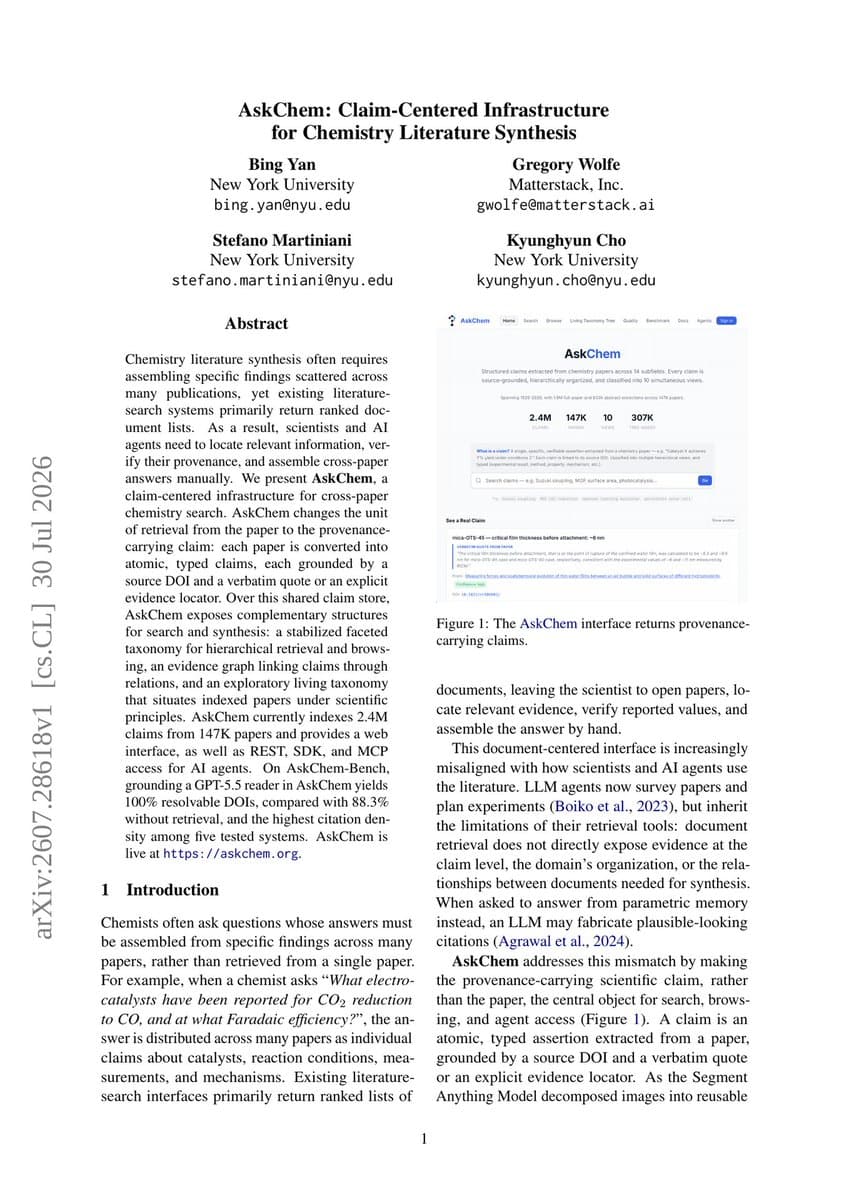
Meta released AskChem on Hugging Face, converting 147,000 chemistry papers into 2.4 million searchable claims. Each claim carries a source DOI and verbatim quote, enabling verifiable literature querying.
Key facts
- 147,000 chemistry papers processed
- 2.4 million searchable claims generated
- Each claim linked to a source DOI
- Verbatim quote included per claim
- Released on Hugging Face
Meta has released AskChem, a new AI tool hosted on Hugging Face that transforms a corpus of 147,000 chemistry papers into 2.4 million discrete, searchable claims. The announcement came via @HuggingPapers, which highlighted that every claim is grounded by a source DOI and a verbatim quote, allowing researchers to trace any assertion back to its original publication.
This is not another semantic search wrapper over PDFs. AskChem's claim-level indexing changes the unit of retrieval from the document to the atomic assertion. Instead of scanning abstracts for relevant papers, a chemist can ask a direct question—say, "what catalysts have been reported for this specific coupling reaction?"—and get back individual claims, each with provenance baked in.
Why claim-level grounding matters
The DOI-plus-quote design is the key differentiator. Most AI search tools return passages with a link; AskChem returns a claim with a verifiable citation chain. This matters because chemistry literature is dense with overlapping and sometimes contradictory results. A claim without a source is noise; with a DOI, it becomes evidence.
Meta did not disclose the underlying model architecture or the exact extraction pipeline in the public announcement. The company also did not specify whether AskChem will remain open-source or if it plans to expand the approach to other scientific domains.
The pattern: scientific literature as structured data
AskChem fits a broader push to turn unstructured scientific text into queryable structured data. The scale is notable: 147,000 papers yielding 2.4 million claims averages roughly 16 claims per paper, a density that suggests automated extraction at scale rather than manual curation.
This approach could set a precedent for scientific search across other fields—biology, materials science, even legal documents—where provenance is as important as relevance. For now, AskChem is a chemistry-specific proof point, but the underlying design is domain-agnostic.
Researchers should note that the tool's utility depends on extraction accuracy. If the claim extraction introduces errors, the DOI grounding helps catch them, but it also means users must still verify the original text. The verbatim quote mitigates this, providing the exact sentence from which the claim was derived.
What to watch
Watch for Meta to release a technical paper or model card detailing AskChem's extraction pipeline and accuracy metrics. Also monitor whether the tool expands beyond chemistry to biology or materials science, and whether Hugging Face downloads cross a meaningful threshold in the next quarter.