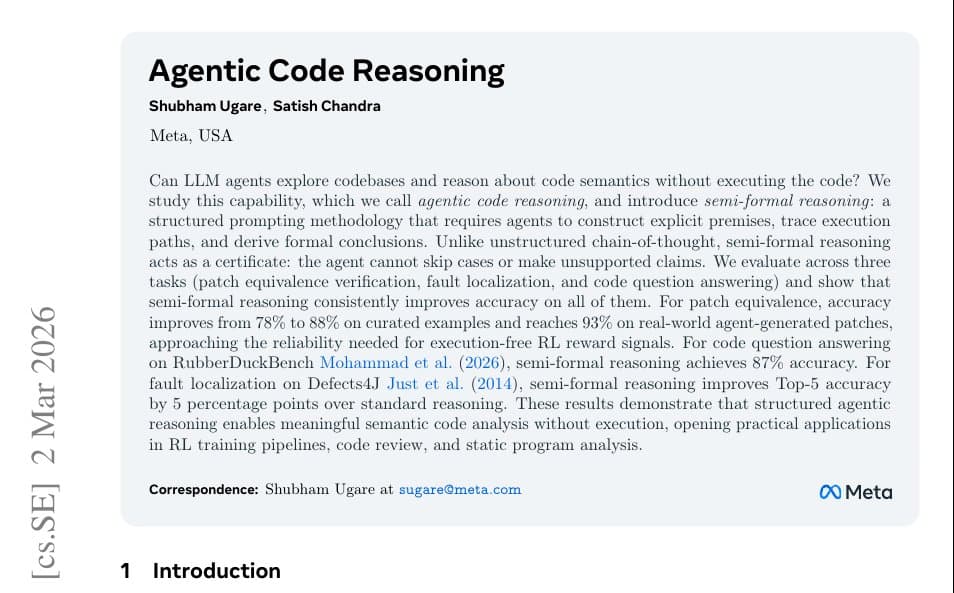
Meta AI researchers have made a significant discovery in large language model (LLM) behavior that could revolutionize how we use AI for code verification and debugging. Their findings, detailed in the paper "Agentic Code Reasoning," reveal that simply forcing LLMs to document their reasoning step-by-step with proof reduces code patch error rates by nearly 50%.
The Problem: AI's Dangerous Assumptions in Code Review
When asked to verify code patches without running them, standard LLMs typically glance at function names and make confident guesses rather than thoroughly analyzing the code. This superficial approach leads to significant errors, particularly when dealing with complex codebases with custom implementations.
The paper highlights a telling example: when comparing two different code fixes, a standard AI noticed a common word and assumed it referred to a standard system tool. Because it skipped reading the actual files, the AI completely missed that the specific project had created its own custom tool with exactly the same name. This type of error demonstrates how LLMs can rely on general knowledge assumptions rather than analyzing the specific context—a dangerous tendency in code verification where precision is critical.
The Solution: Mandatory Reasoning Templates
Meta's breakthrough came from implementing a mandatory checklist template that prevents models from skipping ahead in their reasoning process. The structured approach requires the AI to:
- Explicitly document what the code modifies
- Trace the exact execution path through the code
- Prove its conclusions with specific evidence from the actual files
This simple but powerful change forces the AI to actually read local files and follow real logic instead of relying on assumptions. The researchers found that this structured reasoning approach pushed accuracy to 93% on real code patches without requiring any expensive new training or complex systems.
How Structured Reasoning Works in Practice
The structured prompting technique essentially creates a "chain of thought" requirement for code verification tasks. Rather than allowing the model to jump to conclusions, the template demands systematic documentation at each reasoning stage. This approach addresses what researchers call the "assumption gap"—the tendency of LLMs to fill in missing information with general knowledge rather than specific context.
In practical terms, when presented with a code patch to verify, the AI must now:
- List all files and functions affected
- Document dependencies and potential side effects
- Compare the proposed changes against existing implementations
- Provide line-by-line evidence for its conclusions
This methodical approach prevents the model from making the kind of superficial judgments that previously led to high error rates.
Implications for Software Development
The implications of this discovery are substantial for software engineering and AI-assisted development:
Cost-Effective Code Verification: The most significant finding is that this approach delivers high reliability without the massive computational cost of actually running software tests. Traditional testing requires building, deploying, and executing code—a resource-intensive process. This structured reasoning approach provides preliminary verification at a fraction of the cost.
Enhanced Code Review Processes: Development teams could integrate this structured reasoning approach into their code review workflows, using AI to provide more thorough preliminary analysis before human review. This could significantly reduce the time developers spend on initial code inspection.
Foundation for More Reliable AI Coding Assistants: The principles discovered here could extend beyond code verification to AI coding assistants themselves. By forcing these assistants to document their reasoning, we might achieve more reliable code generation with fewer subtle bugs.
Scalable Quality Assurance: For large codebases where comprehensive testing is impractical, this approach offers a scalable method for preliminary quality assessment.
Broader Implications for AI Development
Beyond software engineering, this research highlights a crucial insight about LLM behavior: structured reasoning requirements can dramatically improve performance on complex tasks without model retraining. This suggests that we may be underutilizing current models by not providing sufficiently structured guidance for complex reasoning tasks.
The discovery also points toward a future where AI systems might include built-in reasoning frameworks for specific domains, ensuring they approach problems systematically rather than relying on potentially flawed assumptions.
The Future of AI-Assisted Software Engineering
Meta's research represents a significant step toward more reliable AI tools for software development. As the paper notes, this "basic structured prompt can give you highly reliable code verification without the massive computational cost of actually running the software tests."
Looking forward, we can expect to see:
- Integration of structured reasoning templates into popular development tools
- Further research into domain-specific reasoning frameworks for different types of programming tasks
- Potential combination of this approach with traditional testing methods for comprehensive quality assurance
- Applications beyond code verification to other complex reasoning tasks where LLMs currently struggle with assumptions
The research demonstrates that sometimes the most effective improvements in AI performance come not from building bigger models or more complex systems, but from better understanding how to guide existing models through structured reasoning processes.
Source: Meta AI research paper "Agentic Code Reasoning" (arXiv:2603.01896)