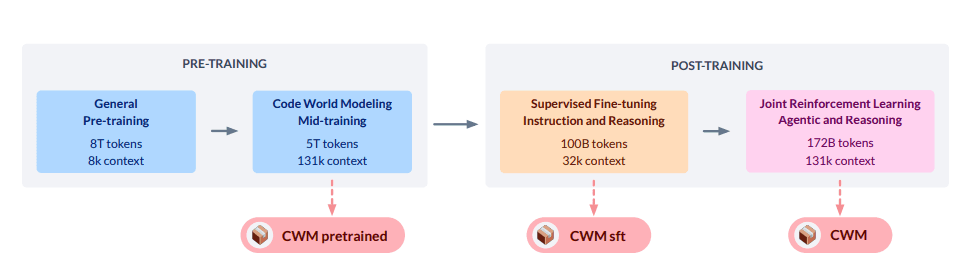
A research paper from Meta AI, highlighted this week, demonstrates a significant step toward language models that understand not just the syntax and semantics of code, but its dynamic runtime behavior. The work shows that a model can be trained to learn and predict aspects of how a program will execute, moving beyond static code analysis.
Key Takeaways
- A new Meta AI paper demonstrates that a language model can learn to predict aspects of a program's runtime behavior directly from its source code.
- This moves beyond static analysis toward models that understand dynamic execution.
What the Research Shows
The core finding is that a language model, trained on a suitable dataset, can infer certain runtime characteristics directly from source code. This is a departure from most current code-focused LLMs, which are primarily trained for tasks like code completion, translation, or documentation—tasks based on the static text of the code. Predicting runtime behavior requires understanding the dynamic, stateful process of execution, which is inherently more complex.
While the specific architectural details and full benchmark results from the paper are not provided in the source tweet, the announcement confirms the feasibility of this direction. The model presumably learns associations between code patterns and their corresponding execution traces, memory states, or performance outcomes.
Why This Matters for AI and Programming
The ability to predict runtime behavior has immediate implications for several critical areas:
- Advanced Code Generation: Current models like GitHub Copilot or CodeLlama can suggest syntactically correct code, but they have no model of whether that code will run efficiently, cause a memory leak, or enter an infinite loop. A model with runtime awareness could generate code that is not just correct but also performant and resource-efficient by design.
- Proactive Debugging and Optimization: Instead of identifying bugs after they cause a crash or performance issue, a developer could use a tool powered by such a model to get predictions about potential runtime problems (e.g., "this loop may scale poorly with large inputs," "this function is likely to be memory-intensive") before the code is ever run.
- Intelligent Program Analysis: This bridges the gap between traditional static analysis (examining code without running it) and dynamic analysis (profiling an executing program). It could enable hybrid tools that offer the speed of static analysis with insights closer to those gained from actual execution.
This research aligns with a broader industry trend toward making AI coding assistants more deeply integrated into the software development lifecycle. The goal is evolving from a "smart autocomplete" to a collaborative partner that understands the operational consequences of code.
Technical Challenges and Next Steps
Learning runtime behavior is a formidable challenge. Execution can be non-deterministic, depend on external inputs, and involve complex interactions with system resources. The Meta research likely represents an initial proof-of-concept on constrained problems or specific behavioral aspects.
Key questions for future work include:
- Scope of Predictions: What specific runtime properties can be predicted accurately (e.g., execution time, memory footprint, I/O calls, specific variable states)?
- Generalization: Can a model trained on one language or domain predict behavior for unfamiliar code or in different environments?
- Dataset Creation: How does one scalably create training data that pairs source code with high-quality, representative runtime traces?
gentic.news Analysis
This Meta paper taps into one of the most sought-after next frontiers for AI in software: moving from understanding code as text to reasoning about it as a dynamic process. It follows a clear trajectory we've been tracking. In 2024, models like DeepSeek-Coder and Claude 3.5 Sonnet set new benchmarks on static code generation and problem-solving (as covered in our analysis of SWE-Bench results). In 2025, the focus expanded to agentic workflows where models could execute code iteratively to solve problems, as seen with OpenAI's o1 model family and projects like OpenHands. This Meta work represents a logical synthesis: internalizing the result of execution to inform better initial predictions.
Critically, this aligns with Meta's ongoing strategy to advance foundational AI research with long-term horizons, often publishing open findings that shape the field. It contrasts with the more product-integrated approach of Microsoft's GitHub Copilot or Google's Gemini Code Assist, though those teams are undoubtedly investigating similar capabilities internally. If this line of research proves scalable, it could eventually be integrated into Meta's own development tools or its Llama-based coding models, potentially creating a new differentiator in the crowded AI-for-code market.
The challenge, as always, will be moving from a research demonstration to a robust, generalizable tool. The history of program synthesis is littered with promising techniques that faltered on the complexity of real-world software. However, given the scale of data and compute available to teams like Meta's, this approach—applying large-scale pattern recognition to execution traces—might be the one that finally cracks a part of this decades-old problem.
Frequently Asked Questions
What is "runtime behavior" in programming?
Runtime behavior refers to what actually happens when a computer program is executed. This includes the sequence of operations, how much memory is used, how long it takes to run, the values of variables as they change, and interactions with files, networks, or other systems. It's distinct from the static source code, which is just the text of the program.
How is this different from current AI coding assistants?
Current assistants like GitHub Copilot primarily work on the text level, predicting the next tokens of code based on patterns seen in training. They don't have an internal model of what the code does when run. This Meta research aims to build models that incorporate an understanding of execution, which could lead to assistants that warn about performance issues or generate more efficient algorithms from the start.
Could this AI replace traditional compilers or interpreters?
No, that's not the goal. Compilers and interpreters are deterministic engines that perform the execution. This research is about creating a predictive model that can simulate or forecast aspects of execution for analysis and assistance. It would be a tool used alongside compilers, not a replacement for them.
What are the biggest hurdles for this technology?
The main hurdles are complexity and non-determinism. Real-world programs have vast, branching execution paths, depend on unpredictable external data, and run in complex environments. Creating a model that generalizes accurately across this space, and gathering the massive, high-quality datasets of code-and-execution pairs needed to train it, are monumental research and engineering challenges.