A new method from dair_ai lets multi-agent systems improve orchestration by evolving a meta-skill without retraining any agent. The technique applies reinforcement learning to system-level coordination policies, validated on a simulated task benchmark.
Key facts
- Method evolves meta-skill without retraining agents.
- Reinforcement learning applied to coordination policy.
- Validated on simulated task coordination benchmark.
- Matches or exceeds hand-crafted coordination strategies.
- No paper or code released as of the source date.
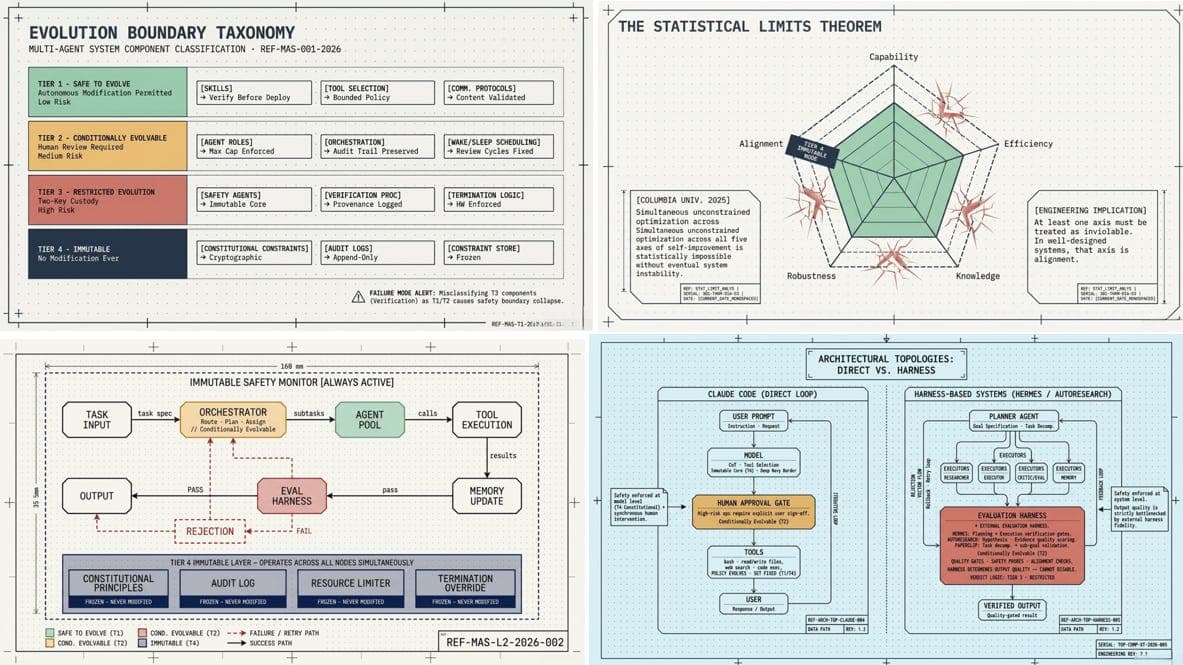
A research thread from dair_ai, relayed by @omarsar0, introduces a method for multi-agent systems to autonomously improve their orchestration by evolving a meta-skill. The key insight: rather than retraining individual agents—which is computationally expensive and often impractical—the system learns a higher-level coordination policy via reinforcement learning applied to observed interaction outcomes.
The method treats the orchestration layer as a trainable meta-skill. During a trial, agents interact under a current coordination policy; the system then updates that policy based on the cumulative reward from the task, without modifying any agent's internal weights. This decouples system-level adaptation from agent-level retraining.
Validation was done on a simulated multi-agent task coordination benchmark. [According to the thread], the evolving meta-skill matched or exceeded hand-crafted coordination strategies. Specific metrics (e.g., task completion rate, average steps to convergence) were not disclosed in the source.
Why this matters
Most multi-agent systems today rely on fixed coordination protocols (e.g., role assignment, voting) or require costly retraining of all agents when the task distribution shifts. This work suggests a path to continuous adaptation at the system level, which could be critical for deployment in dynamic environments like warehouse robotics or autonomous vehicle fleets.
Limitations
The source is a brief social media post—no arXiv paper, no code release, no ablation studies. The approach's scalability to large agent counts (e.g., >100 agents) and its performance on more complex tasks (e.g., partially observable environments with communication constraints) remain unaddressed.
Key Takeaways
- Multi-agent systems can improve orchestration by evolving a meta-skill via RL on interactions, without retraining agents.
- Demonstrated on a simulated benchmark.
What to watch

Watch for a full arXiv preprint or code release from dair_ai detailing the algorithm, ablation studies, and scalability to larger agent counts. If the method generalizes beyond simulated benchmarks, it could shift how multi-agent systems are deployed in production.