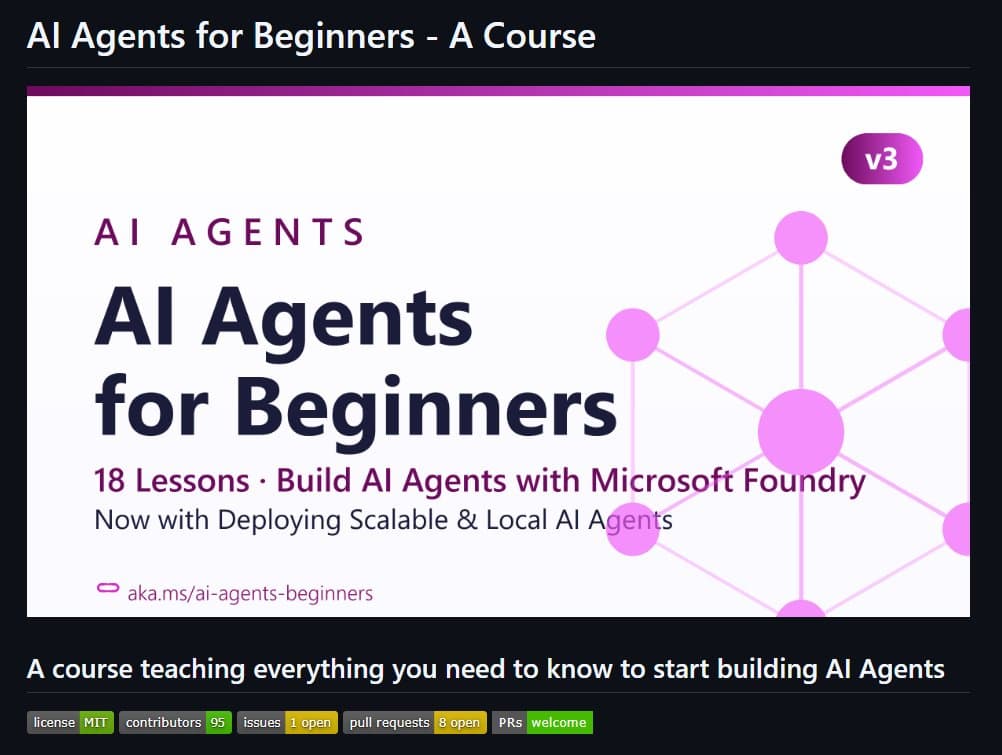
Microsoft's AI Agents for Beginners course hit 18 lessons and 73,000 GitHub stars, now built on Microsoft Agent Framework (MAF). The expansion signals Microsoft's push to move developers from prompt engineering to production-grade agent orchestration.
Key facts
- 18 lessons in Microsoft AI Agents for Beginners
- 73,000 GitHub stars on the course repo
- Built on Microsoft Agent Framework (MAF)
- Runs on Foundry Agent Service with Jupyter notebooks
- Includes MCP/A2A protocol coverage
Microsoft has quietly turned its AI Agents for Beginners course into a serious training pipeline for agentic development. The course now spans 18 lessons and has accumulated 73,000 GitHub stars, according to @_vmlops. It's no longer a simple tutorial — it's a structured curriculum built on Microsoft Agent Framework (MAF), the company's orchestration layer for building and deploying agents.
What the 18 lessons cover
The curriculum now spans the full agent lifecycle: agentic patterns, tool calling, agentic RAG, memory management, and the MCP/A2A protocols that are becoming the connective tissue of agent ecosystems. New lessons tackle context engineering, deploying scalable agents, computer-use agents, and local/on-device agents — a sign that Microsoft sees both cloud-scale and edge deployment as first-class concerns.
Each lesson ships with Python code samples that run as Jupyter notebooks against Microsoft Foundry Agent Service. The course also supports OpenAI-compatible providers like MiniMax for large-context work, which is notable given Microsoft's own heavy investment in OpenAI. That flexibility suggests the course is meant to be provider-agnostic in practice, even if it's MAF-centric in architecture.
Why the smoke tests matter
The most operationally interesting addition is the smoke tests bundled with each lesson. They let a developer verify a deployed agent actually works — not just that it runs, but that it behaves as expected. That's a small but meaningful step toward treating agents as software with testable contracts, rather than as demo-ware.
The course is positioned as a follow-up to Microsoft's generative-ai-for-beginners series, targeting developers moving from "using LLMs" to "building agents that act." It's a deliberate funnel: Microsoft wants the next generation of agent builders to reach for MAF and Foundry as their default stack — the same playbook it used to onboard developers to Azure.
The unique take here isn't the lesson count. It's the timing. Microsoft is shipping agent education in lockstep with its enterprise agent push, and the inclusion of MCP/A2A plus local/on-device agents suggests the company is betting that agents will run everywhere — not just in the cloud. The course is effectively a recruitment tool for its agent ecosystem, and the 73k stars are the proof that the strategy is landing.
What to watch
Watch for Microsoft to ship a certification or paid tier around this course, likely tied to Foundry Agent Service adoption. Also track whether the course repo adds a benchmark or eval harness — a sign Microsoft is standardizing agent evaluation the way it did with model evals.