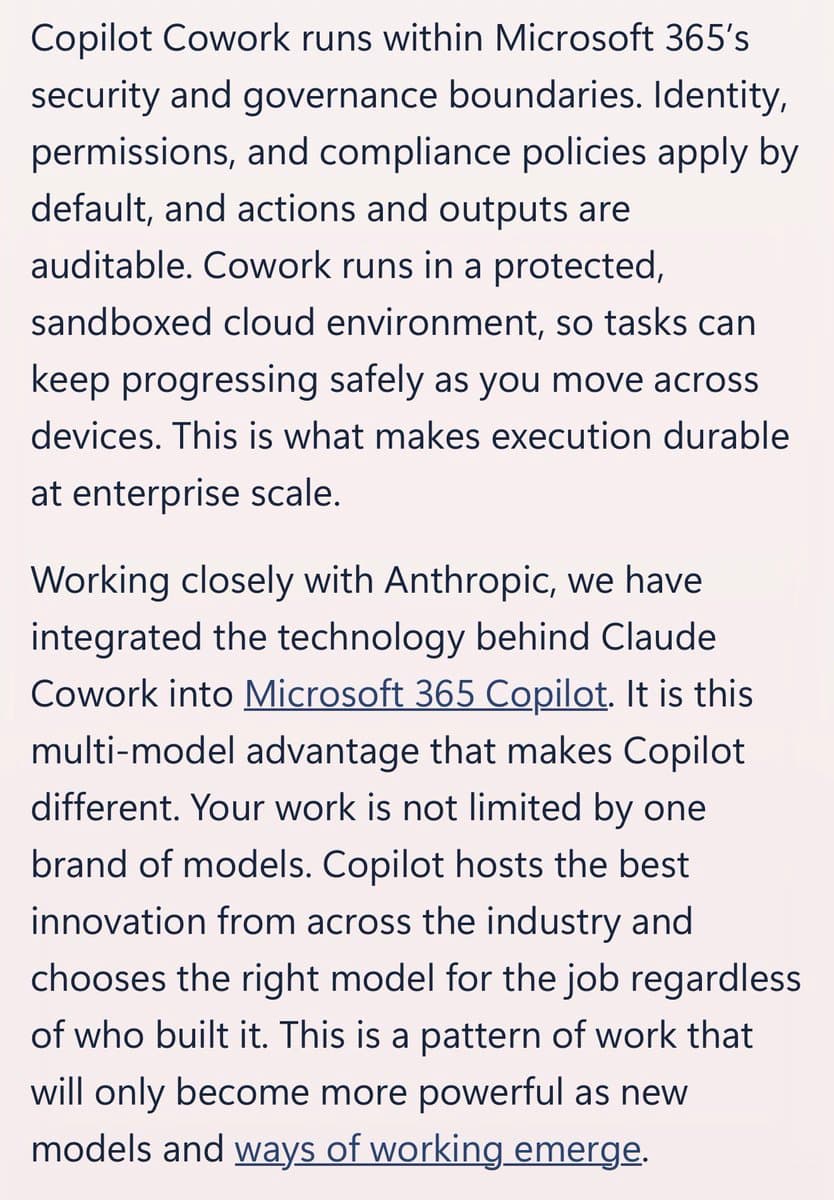
Microsoft appears to be entering the collaborative AI agent space with what industry observers are calling a potential "branded version of Cowork," according to AI researcher and Wharton professor Ethan Mollick. While details remain scarce, the development signals Microsoft's continued expansion beyond its successful Copilot branding into more specialized AI assistant territory.
The Cowork Context
For those unfamiliar, Cowork represents a category of AI platforms designed to function as collaborative partners rather than simple tools. These systems typically combine multiple AI models and specialized capabilities to handle complex, multi-step tasks that would traditionally require human intervention or coordination between different software applications.
Mollick's brief commentary on the platform raises two critical questions that could determine the success of Microsoft's potential entry into this space. First, whether Microsoft will maintain transparency about which AI models power different aspects of the system, particularly whether it might use "lower-end models without telling you." Second, whether this represents a sustained commitment to the evolving AI agent ecosystem or merely a "one-off" experiment.
Microsoft's AI Ecosystem Strategy
This development comes as Microsoft continues to aggressively expand its AI offerings across its product suite. The company has successfully established its Copilot branding across Office applications, GitHub, Windows, and various enterprise solutions. A specialized agent platform would represent both an extension of this strategy and a potential departure into more autonomous AI systems.
Microsoft's approach to AI has been characterized by both proprietary development and strategic partnerships, most notably with OpenAI. The question of which models power any new agent platform becomes particularly relevant given Microsoft's access to various tiers of AI capabilities through different partnerships and internal development efforts.
The Transparency Question
Mollick's concern about potential use of "lower-end models" touches on a growing industry debate about AI transparency. As AI systems become more complex and layered, with different components potentially powered by different models, users increasingly want to understand what capabilities they're actually accessing.
This transparency issue extends beyond mere technical curiosity. Different AI models have different strengths, weaknesses, and cost structures. Enterprise customers in particular need to understand what they're paying for and what performance they can expect. A lack of clarity about model usage could create trust issues, especially if users discover they're receiving inferior performance for certain tasks without being informed.
Sustainability in a Rapidly Evolving Space
The AI agent landscape is evolving at breakneck speed, with new capabilities, integration patterns, and use cases emerging constantly. Mollick's second question—whether Microsoft's offering will "keep up as the space evolves"—speaks to the challenge of maintaining relevance in this dynamic environment.
Microsoft has demonstrated both remarkable agility and occasional sluggishness in different technology sectors. The company's success with Copilot shows it can move quickly when aligned with core business interests. However, specialized agent platforms require continuous investment in research, development, and integration as new AI capabilities emerge.
Competitive Implications
If Microsoft does launch a Cowork-like platform, it would position the company against both startups specializing in AI agents and other tech giants exploring similar territory. Google, Amazon, and various enterprise software companies are all investing in more sophisticated AI assistant capabilities.
Microsoft's potential advantages include its massive existing enterprise customer base, deep integration with productivity software, and extensive cloud infrastructure. However, specialized AI agent startups often move faster and focus more narrowly on specific use cases or industries.
What This Means for Users
For individual users and organizations, the emergence of major players like Microsoft in the AI agent space could bring both benefits and challenges. On the positive side, Microsoft's entry could accelerate adoption, improve integration with widely-used tools, and potentially lower costs through scale. The company's enterprise support infrastructure could also make sophisticated AI agents more accessible to organizations with strict security and compliance requirements.
Potential concerns include vendor lock-in, reduced innovation if Microsoft dominates the space, and the transparency issues already mentioned. Users will need to carefully evaluate whether a Microsoft-branded solution offers the specific capabilities they need or whether specialized alternatives might better serve their requirements.
Looking Ahead
While Mollick appropriately cautions against discussing products he hasn't tried, his observations highlight important considerations for Microsoft's AI strategy. The company's approach to this potential platform will reveal much about how it views the future of AI collaboration tools.
Will Microsoft prioritize seamless integration across its ecosystem over best-in-class specialized capabilities? Will it be transparent about the AI models powering different functions? And will it commit to the continuous innovation required to stay relevant in the AI agent space? These questions will likely determine whether any Microsoft offering becomes a market leader or just another entry in a crowded field.
As with many AI developments, the proof will be in the implementation. Users and industry observers will be watching closely to see how Microsoft addresses these fundamental questions about transparency, capability, and long-term commitment.
Source: Ethan Mollick (@emollick) on X/Twitter