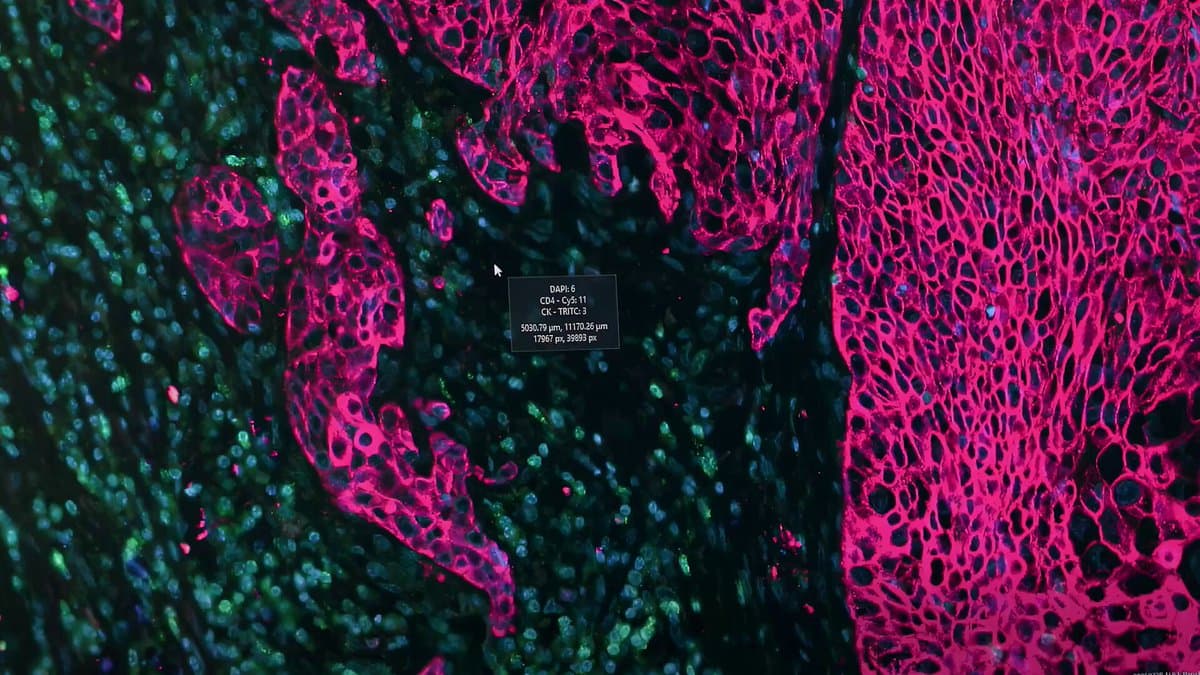
Microsoft has released GigaTIME, a new AI model designed to transform inexpensive, standard medical images into highly detailed protein maps of cancer cells. The model aims to bypass costly and difficult-to-scale physical lab equipment by using software to mathematically simulate expensive chemical tests.
What GigaTIME Does
GigaTIME analyzes basic morphological shapes in standard hematoxylin and eosin (H&E) stained tissue slides—which cost between $5 and $10—and predicts the spatial location of specific proteins that reveal how a tumor interacts with the immune system. The physical chemical test to map these proteins, such as multiplex immunofluorescence, typically costs over $2,000 per patient due to specialized reagents and imaging equipment.
The core function is virtual spatial proteomics: taking a widely available, low-resolution input and generating a high-resolution, multiplexed protein map as output.
Scale of Training and Discovery
According to the announcement, Microsoft trained GigaTIME on 40 million cells. The training dataset was built from processing tissue slides from 14,256 patients, resulting in a database of 300,000 detailed medical images.
The most significant claimed outcome is the discovery of 1,234 new connections between specific cell proteins and patient survival rates. This suggests the model is not just replicating existing tests but enabling novel biological discovery at scale by analyzing patterns across massive patient populations that were previously impractical to study with physical assays.
Technical and Practical Implications
The development represents a direct application of AI to circumvent a hardware bottleneck in biomedical research. The expensive, low-throughput nature of physical spatial proteomics has limited large-scale studies of tumor microenvironment and immune response. GigaTIME proposes a software-based, scalable alternative.
Researchers could theoretically re-analyze vast existing archives of cheap H&E slides from cancer biobanks to generate virtual protein maps and hunt for new prognostic biomarkers, all without consuming precious tissue samples for additional physical tests.
Limitations and Unknowns
The source material does not provide:
- Peer-reviewed publication or preprint details.
- Specific performance metrics (e.g., prediction accuracy vs. physical ground truth).
- The exact set of proteins predicted.
- Architectural details of the model.
- Information about validation on independent cohorts.
As with any AI-based surrogate model, its clinical and research utility will depend on the fidelity of its predictions and its generalizability across different tissue types, cancer subtypes, and imaging protocols.
Microsoft's release highlights a growing trend in computational pathology: using deep learning to extract maximal molecular information from minimal, inexpensive inputs.