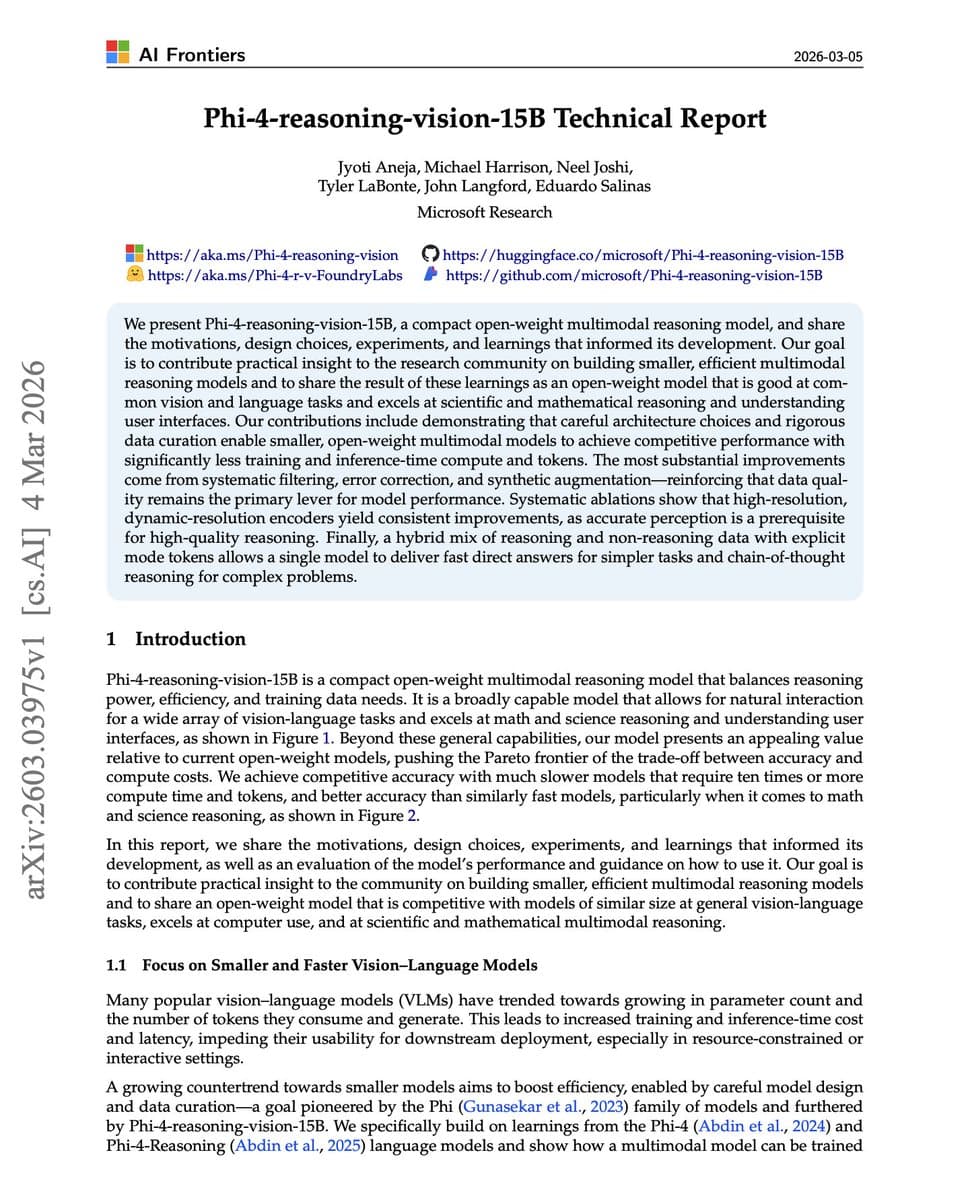
In a significant development for practical AI deployment, Microsoft Research has unveiled Phi-4-reasoning-vision-15B, a 15-billion parameter multimodal reasoning model that combines visual understanding with structured reasoning capabilities. This compact yet powerful model represents a strategic shift toward efficiency-focused AI systems that can handle complex tasks without requiring the massive computational resources of frontier models.
According to the research announcement, Phi-4-reasoning-vision demonstrates what's possible at the 15-billion parameter scale, challenging the prevailing assumption that increasingly larger models are necessary for advanced reasoning capabilities. The model specifically targets what researchers describe as "the sweet spot between capability and efficiency" for practical AI applications.
The Technical Breakthrough: Multimodal Reasoning in a Compact Package
Phi-4-reasoning-vision-15B represents a notable achievement in model efficiency. While frontier models like GPT-4 and Claude 3 operate with hundreds of billions of parameters, Microsoft's approach demonstrates that sophisticated multimodal reasoning—combining both text and visual understanding—can be achieved at a fraction of the scale.
The model's architecture enables it to process and reason across different modalities simultaneously, allowing it to understand relationships between visual elements and textual context. This capability is particularly valuable for tasks that require interpreting diagrams, charts, real-world images alongside explanatory text, or any scenario where visual and linguistic information must be integrated for proper understanding.
Microsoft's research team detailed their training methodology in the accompanying paper, emphasizing techniques that maximize reasoning capabilities while maintaining computational efficiency. The approach likely involves specialized training regimens, architectural innovations, and carefully curated datasets designed to enhance reasoning abilities without simply scaling up parameter counts.
Why Smaller Reasoning Models Matter for AI Agents
The development of Phi-4-reasoning-vision addresses a critical gap in the current AI landscape: the practical deployment of intelligent agents. As noted in the announcement, "Smaller reasoning models that handle vision are essential for practical agent deployments."
This statement highlights several important considerations:
Cost Efficiency: Running frontier models at scale is prohibitively expensive for many applications. A 15-billion parameter model requires significantly less computational power, making it feasible for widespread deployment.
Latency Reduction: Smaller models typically offer faster inference times, which is crucial for real-time applications and interactive systems.
Accessibility: More efficient models lower the barrier to entry for organizations without massive computational resources, democratizing access to advanced AI capabilities.
Specialization Potential: Compact models can be more easily fine-tuned for specific domains or tasks, potentially outperforming general-purpose frontier models in their areas of specialization.
Implications for the AI Industry
The introduction of Phi-4-reasoning-vision comes at a pivotal moment in AI development. As the industry grapples with the diminishing returns of simply scaling model size, Microsoft's approach points toward alternative pathways for advancing AI capabilities.
This development suggests several potential shifts:
Decentralization of AI Capabilities: Smaller, more efficient models could enable edge computing applications where AI reasoning needs to happen locally rather than in the cloud.
Specialized Agent Ecosystems: Different AI agents could utilize different-sized models based on their specific requirements, creating more optimized and cost-effective systems.
Sustainability Considerations: Reduced computational requirements translate to lower energy consumption, addressing growing concerns about the environmental impact of large-scale AI operations.
New Business Models: More efficient models could enable previously impractical applications, opening new markets and use cases for AI technology.
The Broader Context: Microsoft's Phi Family Evolution
Phi-4-reasoning-vision represents the latest entry in Microsoft's Phi series of language models, which has consistently focused on achieving impressive capabilities at smaller scales. Previous iterations, including Phi-2 and Phi-3, demonstrated that carefully designed smaller models could compete with much larger counterparts on certain benchmarks.
The addition of multimodal capabilities to this efficient architecture marks a significant expansion of the Phi family's potential applications. By combining visual understanding with the reasoning strengths of previous Phi models, Microsoft is creating a versatile tool that could serve as the "brain" for various AI agent applications.
Challenges and Future Directions
While Phi-4-reasoning-vision represents an important advancement, several questions remain:
- How does its performance compare to frontier models on complex multimodal reasoning tasks?
- What are the specific limitations of the 15-billion parameter scale for multimodal understanding?
- How will the model be made available to developers and researchers?
- What fine-tuning capabilities will be supported for domain-specific applications?
The research paper referenced in the announcement should provide more detailed answers to these questions, offering insights into the model's architecture, training methodology, and performance characteristics.
Conclusion: A Step Toward Practical AI Intelligence
Microsoft's Phi-4-reasoning-vision-15B represents more than just another AI model release; it signals a strategic reorientation toward practical, deployable intelligence. By demonstrating that sophisticated multimodal reasoning can be achieved at a fraction of the scale of frontier models, Microsoft is challenging the industry's scaling obsession and pointing toward a more nuanced approach to AI advancement.
As AI continues to transition from research labs to real-world applications, efficiency-focused models like Phi-4-reasoning-vision will likely play an increasingly important role. They offer a pathway to intelligent systems that are not only capable but also practical, affordable, and accessible—qualities essential for the widespread adoption of AI technology.
The development underscores an important truth in AI: bigger isn't always better, and sometimes the most significant advances come from working smarter within constraints rather than simply removing them through scale.
Source: Microsoft Research announcement via @omarsar0 on X/Twitter