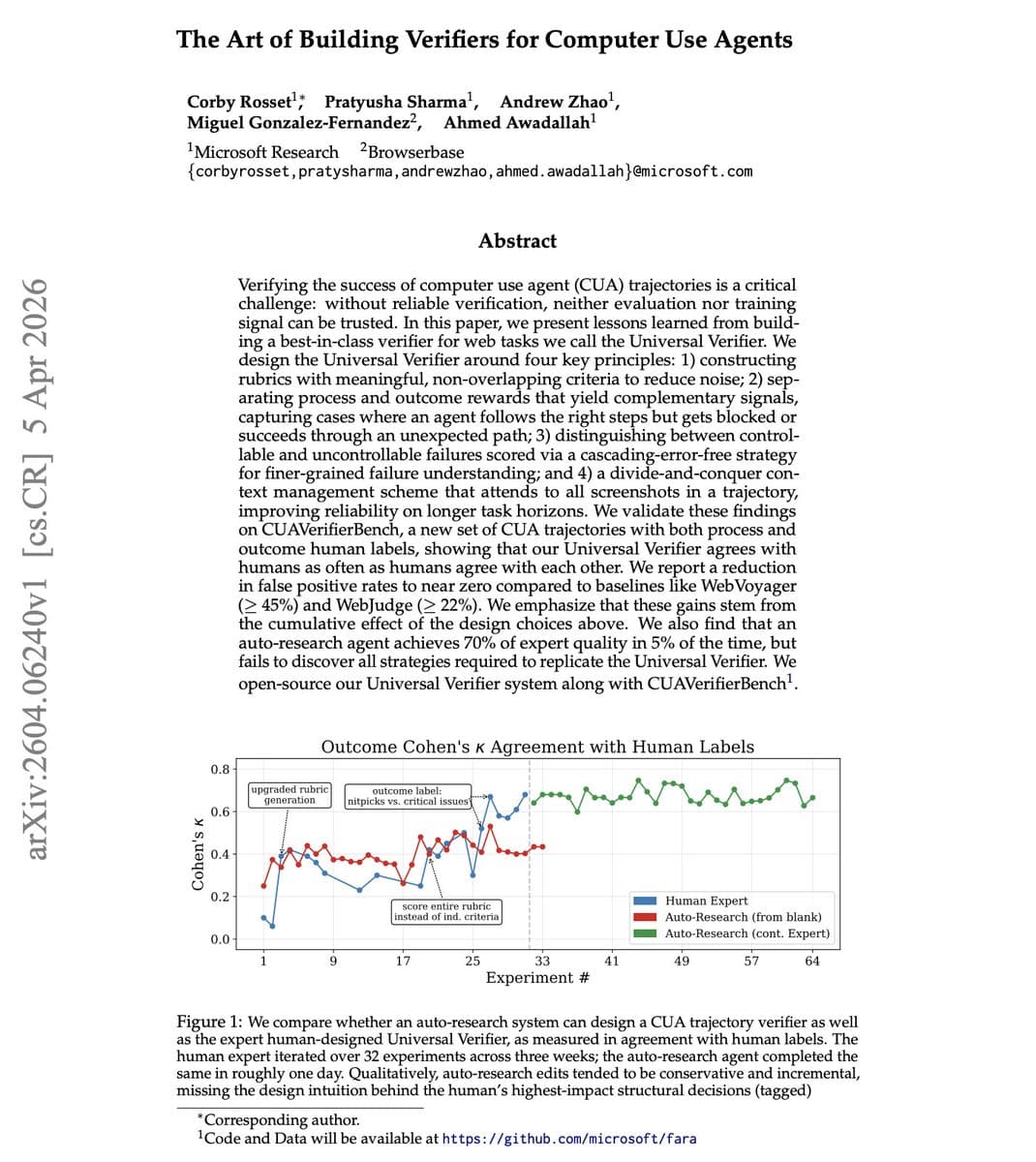
A new paper from Microsoft Research tackles a fundamental flaw plaguing the evaluation of AI agents: you often can't trust whether the agent actually succeeded. The researchers introduce the Universal Verifier, a framework built on four core design principles that reduces false positive rates in agent evaluation from over 45% to near zero. This addresses a critical bottleneck where unreliable verification corrupts both benchmarks and the training data derived from them.
The Hidden Problem: Corrupted Benchmarks
Current benchmarks for AI agents performing web-based tasks (like WebVoyager and WebJudge) rely on verifiers to judge whether an agent's actions—clicking, typing, navigating—achieved the intended goal. The paper identifies a major flaw: these verifiers have high false positive rates, meaning they often declare an agent successful when it has actually failed. The researchers measured false positive rates of over 45% on WebVoyager and over 22% on WebJudge. When benchmarks are this noisy, progress becomes illusory. Training agents on trajectories labeled as "successful" but which are actually failures further poisons the data pipeline.
What Microsoft Built: The Universal Verifier Framework
The Universal Verifier isn't a single model but a methodology and system for building reliable, best-in-class verifiers for web tasks. It's constructed on four key principles derived from lessons learned during development:
- Non-Overlapping Rubrics: Evaluation criteria must be mutually exclusive to prevent contradictory scoring and make the verification process more deterministic.
- Separate Process vs. Outcome Rewards: The system must judge the correctness of actions (process) separately from whether the final goal was achieved (outcome). This allows for diagnosing where failures occur.
- Distinguish Controllable vs. Uncontrollable Failures: It differentiates between failures caused by the agent's own actions (controllable) and those caused by external factors like website errors or latency (uncontrollable). This is crucial for fair evaluation and effective training.
- Divide-and-Conquer Context Management: Instead of feeding the entire interaction history (a long sequence of screenshots and actions) into a single model, the system breaks the verification task into smaller, manageable sub-tasks across the trajectory. This improves accuracy and scalability.
Key Results: From Noisy to Near-Perfect Verification
The impact of applying this framework is stark. The resulting verifiers achieve a false positive rate close to 0%, a dramatic reduction from the 22-45% baseline. This creates a trustworthy ground truth for evaluating agent performance. The researchers note that without such reliable verifiers, both benchmark leaderboards and the training data generated from agent rollouts become fundamentally corrupted.
How It Works: Human Expertise + Automated Scaling
An intriguing finding from the paper highlights the complementary roles of human design and automation. The researchers experimented with using an AI agent to automatically research and develop verification strategies. This auto-research agent reached about 70% of the quality of the human-expert verifier in just 5% of the time. However, it failed to discover the high-level structural design decisions (like the four core principles) that yielded the biggest gains. The conclusion is that human expertise is essential for architectural innovation and insight, while automated optimization is powerful for rapidly refining and scaling within a given design paradigm.
Why This Matters: Fixing the Foundation
Reliable evaluation is the bedrock of progress in machine learning. For AI agents—a field moving rapidly from research to deployment—flawed benchmarks create a house of cards. Microsoft's Universal Verifier provides a methodological blueprint to rebuild that foundation with rigor. By solving the verification problem, it enables:
- Accurate Benchmarking: Leaderboards that truly reflect agent capabilities.
- Clean Training Data: Generating high-quality synthetic data from successful agent trajectories without contamination from false positives.
- Diagnostic Clarity: Pinpointing exactly how and why an agent fails, speeding up iterative development.
gentic.news Analysis
This work from Microsoft Research directly confronts a growing pain point in the AI agent ecosystem. As we covered in our analysis of Cognition Labs' Devin, the push towards autonomous coding and web agents has accelerated, but evaluation has remained ad-hoc. The Universal Verifier aligns with a broader industry trend towards robust evaluation frameworks, similar to Anthropic's recent work on scalable oversight for LLM alignment. It also creates an interesting competitive dynamic: companies like Google (with its Gemini-based agents) and startups like Sierra now have a publicly documented, high-standard methodology to meet or exceed for their own agent evaluations.
The finding that auto-research agents could not replicate key human design insights is a significant, nuanced data point in the AI-for-AI-development debate. It suggests that while automation is powerful for optimization, strategic, architectural innovation still resides firmly in the human domain—for now. This research provides the tools to make the iterative loop of building better agents both faster and more trustworthy, which is essential as agents move from demos to production systems handling real user tasks.
Frequently Asked Questions
What is a false positive rate in AI agent evaluation?
A false positive occurs when an evaluation system incorrectly labels an agent's task attempt as a success when it actually failed. A 45% false positive rate means nearly half of all "successes" reported by a benchmark are wrong, severely distorting performance measurements.
How does the Universal Verifier differ from previous agent verifiers?
Previous verifiers often treated verification as a single, monolithic classification task. The Universal Verifier introduces a structured framework based on four design principles—like separating process from outcome rewards and using divide-and-conquer context management—which makes the verification process more granular, interpretable, and accurate.
Can this Universal Verifier be used for any type of AI agent?
The paper specifically focuses on agents operating in web environments, where trajectories consist of screenshots and actions. However, the core principles—non-overlapping rubrics, separating process from outcome, and classifying failure types—are likely applicable to the evaluation of agents in other domains, such as robotics or desktop software automation.
What does "near zero" false positives mean? Is it perfect?
"Near zero" indicates a drastic reduction to a very low, often single-digit percentage, as opposed to the previous 22-45% range. It is not necessarily perfect (0.00%), but it represents a level of reliability that makes the benchmark useful for measuring true progress and generating clean training data.