Microsoft has open-sourced VibeVoice, a family of voice AI models designed to overcome a fundamental limitation in current speech technology: the need to chunk long audio recordings into short segments. The models handle both automatic speech recognition (ASR) and text-to-speech (TTS) for exceptionally long contexts, processing up to an hour of audio in a single, continuous pass.
What's New: Continuous Processing for Long-Form Audio
Current speech AI models typically slice input audio into segments of a few seconds to tens of seconds due to computational and memory constraints. This chopping process destroys long-range context, corrupts speaker identity tracking (diarization), and creates artifacts at segment boundaries. VibeVoice addresses this directly with three core model variants:
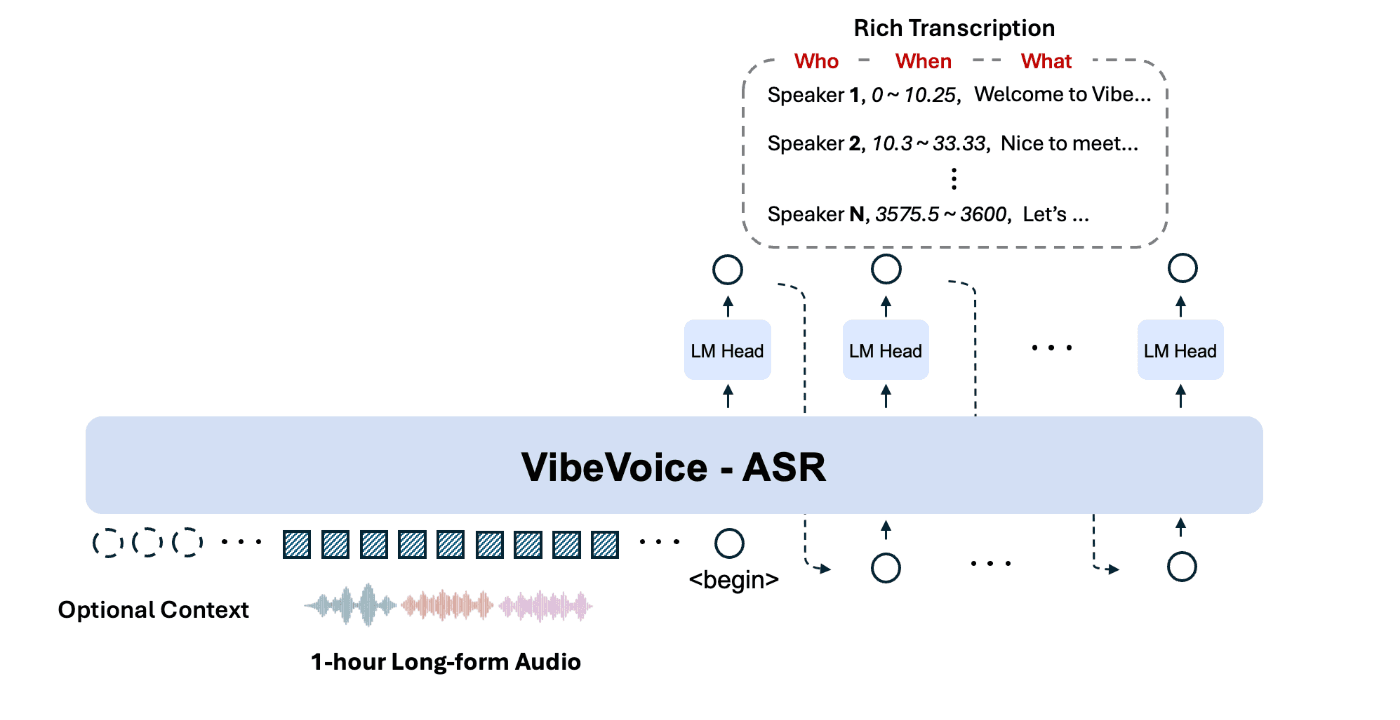
- VibeVoice-ASR: An automatic speech recognition model that can process up to 60 minutes of audio in a single forward pass. It outputs a structured transcription that includes speaker labels, timestamps, and the spoken text, maintaining context across the entire session.
- VibeVoice-TTS: A text-to-speech model that can generate up to 90 minutes of multi-speaker audio with up to four distinct voices. It models natural conversational turn-taking and emotional expression in a single, coherent generation.
- VibeVoice-Realtime: A smaller, 0.5 billion parameter streaming TTS model optimized for low latency, with a reported first-audio latency of approximately 300 milliseconds.
A key technical enabler mentioned is the use of a continuous speech tokenizer operating at an ultra-low frame rate of 7.5 Hz. This drastically reduces the sequence length of long audio clips, making the long-context modeling computationally tractable without sacrificing perceived audio quality.
Technical Details & Capabilities
The release appears to be a GitHub repository containing the model definitions, weights, and likely inference code. Based on the source, the standout features are:
For VibeVoice-ASR:
- No Chunking: The primary advertised breakthrough. The model's architecture is built to attend to the full 60-minute context.
- Structured Output: It doesn't just output raw text. It provides a transcript annotated with
(speaker, timestamp, text). - Hotword Support: Users can feed the model custom hotwords (e.g., proper names, technical terms, product names) to bias recognition and significantly improve accuracy on domain-specific vocabulary.
For VibeVoice-TTS:
- Long-Form, Multi-Speaker Generation: The ability to generate coherent, multi-voice dialogues or narrations lasting up to 90 minutes is a significant step beyond typical TTS systems that generate a few sentences at a time.
- Conversational Modeling: The model is designed to generate natural prosody for turn-taking and emotional expression across speakers within the long sequence.
For VibeVoice-Realtime:
- The 0.5B parameter size is notably small for a frontier model, suggesting it is designed for practical, cost-effective deployment at scale.
How It Compares: A Shift from Segmented to Holistic Processing
This approach represents a architectural shift from the industry-standard pipeline, which often separates diarization, transcription, and context modeling into discrete, chunked stages.
Audio Length Chunked (e.g., 10-30s segments) Single pass (up to 60 min) Speaker Tracking Separate diarization model, errors compound at chunk edges Integrated diarization & transcription Context Limited to chunk; lost across boundaries Full-session context available TTS Long-Form Concatenated short segments, potential prosody breaks Coherent generation up to 90 minBy treating a long audio session as a single sequence, VibeVoice aims to provide more accurate, coherent, and structurally rich outputs, particularly for use cases like meeting transcripts, lecture recordings, podcasts, and audiobook generation.
What to Watch: Open-Source Performance & Benchmarks
While the technical claims are substantial, key details for practitioner evaluation are pending:
- Benchmark Scores: No word error rate (WER) or speaker diarization error rate (DER) metrics were provided in the initial announcement against standard datasets like LibriSpeech or AMI.
- Compute Requirements: The computational cost of processing a 60-minute sequence in a single forward pass is not specified, though the 7.5Hz tokenizer is a critical efficiency innovation.
- Real-World Latency: For VibeVoice-ASR, the total processing time for a full hour of audio is a crucial practical metric.
The open-source release will allow the community to validate these claims on diverse datasets and assess the trade-offs between the novel long-context capability and traditional metrics like accuracy and speed.
gentic.news Analysis
Microsoft's release of VibeVoice is a direct shot across the bow of the current speech AI ecosystem, dominated by APIs from OpenAI (Whisper), Google (Speech-to-Text), and Amazon (Transcribe). While those services have improved, they largely rely on the chunked processing paradigm VibeVoice criticizes. This move follows Microsoft's established playbook of open-sourcing disruptive, infrastructure-level AI research—as seen with the ORCA reasoning models and the Phi family of small language models—to shape developer adoption and challenge the API-centric status quo.
The emphasis on integrated speaker diarization is particularly notable. This has been a persistent, thorny challenge in speech AI, often requiring a separate model pipeline. By baking it into a single model, Microsoft is addressing a major pain point for enterprise users who need accurate meeting transcripts. This aligns with a broader industry trend we highlighted in our coverage of Google's "Project Ellmann" last December, which aimed to use LLMs for lifelong memory and context across modalities. VibeVoice applies a similar "holistic context" principle but specifically to the temporal and speaker-structured domain of long-form speech.
Furthermore, the release of the small VibeVoice-Realtime (0.5B) model signals a clear dual strategy: pushing the frontier with large, capable models while also providing a deployable option. This mirrors the approach taken in the LLM space with models like Microsoft's own Phi-3-mini, offering a practical on-ramp for developers. If the performance claims hold, VibeVoice could rapidly become the backbone for next-generation transcription services, podcast production tools, and voice agent platforms, applying pressure on competitors to move beyond the chunking paradigm.
Frequently Asked Questions
What is the main problem VibeVoice solves?
VibeVoice solves the problem of audio chunking. Most speech AI systems are forced to break long recordings (like meetings or lectures) into short segments of 10-30 seconds to process them. This destroys long-range context, makes it hard to track who is speaking, and creates errors at the boundaries between chunks. VibeVoice processes up to 60 minutes of audio in one go, preserving full context and delivering coherent, speaker-aware transcripts.
Is Microsoft VibeVoice available to use now?
Yes, based on the announcement, Microsoft has open-sourced the VibeVoice family of models. The code and model weights are available in a GitHub repository, which means developers can download and run the models themselves, likely under an open-source license, rather than accessing them via a cloud API.
How does VibeVoice handle different speakers?
VibeVoice-ASR has integrated speaker diarization. This means it doesn't just transcribe text; it also identifies and labels different speakers within the audio stream (e.g., "Speaker A," "Speaker B") and timestamps when they speak. It can output a structured transcript that shows who said what and when, all from a single model without a separate diarization step.
What are the practical applications of VibeVoice?
The primary applications are in any scenario involving long-form, multi-speaker audio. This includes:
- Meeting & Lecture Transcription: Generating accurate, speaker-labeled transcripts of hour-long sessions.
- Media Production: Creating transcripts for podcasts, interviews, and documentaries.
- Audiobook & Content Generation: Using VibeVoice-TTS to generate long, multi-character narrations in a single, coherent voice session.
- Real-Time Voice Agents: Deploying the small VibeVoice-Realtime model for low-latency, conversational AI applications.