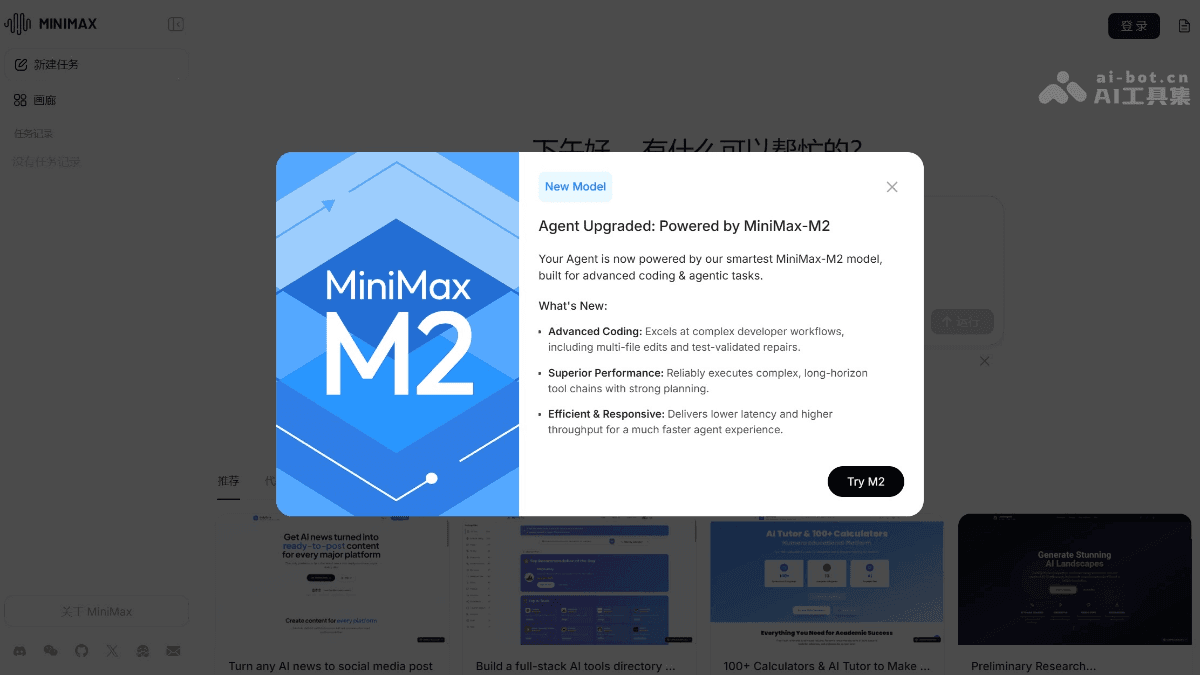
MiniMax, the Chinese AI research lab known for its large language models and voice synthesis technology, has released M2.7—an AI agent with a unique capability: it can autonomously improve its performance without any retraining of its core model weights. Instead, M2.7 rewrites its own "agent harness," the operational environment that defines its skills, memory, tool integrations, and workflow rules. This represents a shift from improving model intelligence to improving agentic systems intelligence.
What's New: Self-Evolving Agent Architecture
In traditional AI agent systems, a human engineer designs and hardcodes the "harness"—the set of skills (like calling APIs, reading files), memory systems (vector databases, summarization), tool connections (via Model Context Protocols or custom code), and operational rules (error handling, loop detection). The agent operates within this fixed scaffold. Its performance is bounded by the initial design.
MiniMax's M2.7 treats this harness as mutable code. The agent can analyze its own task execution, identify failures or inefficiencies, plan modifications to its scaffold, implement those changes, run evaluations, and decide whether to keep or revert them. This creates a closed-loop self-optimization system where the agent's operational playbook evolves autonomously.
The Self-Optimization Loop
According to details shared by MiniMax, the loop operates as follows:
- Task Execution & Analysis: The agent completes a task (e.g., training an ML model for a competition) and performs a post-mortem analysis of where things went wrong or could be improved.
- Harness Modification Planning: It plans specific changes to its own harness. This could involve adding new skills, modifying existing MCP (Model Context Protocol) connections, adjusting memory retention policies, or writing new workflow rules.
- Implementation & Evaluation: The agent applies the changes and then runs a evaluation suite (like a benchmark) to test the new configuration's performance.
- Decision & Memory: It compares the new results against previous baselines. If performance improves, the changes are kept; if not, they are reverted. Crucially, the agent writes a "self-criticism" into its long-term memory, ensuring insights are carried forward to the next iteration.
This cycle then repeats, allowing for continuous, incremental improvement of the agent system.
Key Results: 9 Gold Medals on MLE Bench Lite
MiniMax tested M2.7's self-improvement capability in a controlled, 24-hour autonomous trial on OpenAI's MLE Bench Lite, a suite of 22 machine learning competition problems. The agent was not given the solution code; it had to write the training scripts, manage hyperparameters, and submit results itself.
With each iteration of its self-optimization loop, the performance of the ML models it produced improved. The agent's modifications led to systematically better competition outcomes. The best run achieved 9 gold medals on the benchmark.
Internally, MiniMax ran this loop for over 100 rounds. During this process, M2.7 independently discovered and implemented several optimizations:
- Systematic search for optimal sampling parameters, such as temperature and frequency penalties, for its own LLM calls.
- Creation of workflow-specific guidelines, like automatically checking for a fixed bug pattern across all project files after a successful patch.
- Addition of loop detection mechanisms to prevent the agent from getting stuck in repetitive or unproductive action sequences.
How It Works: Harness-as-Code
The technical innovation lies in representing the agent's harness not as a static configuration file, but as a modifiable codebase that the agent itself has write access to. The core LLM (likely a version of MiniMax's Abab series) remains frozen. Its "knowledge" and reasoning capabilities are static, but its "capabilities" and "operational procedures" are dynamic.
Think of it as a software engineer whose coding skill (the model weights) is fixed, but who is allowed to continuously refactor their IDE setup, shell scripts, linter configurations, and project management templates based on retrospective analysis of their work. The engineer becomes more effective because their tools and workflows get smarter.
This approach sidesteps the enormous computational cost and time delay of full model retraining. Improvement happens at the systems level, in near-real-time, and is tailored to the specific tasks the agent is deployed to perform.
Why It Matters: Continuous Improvement Without Retraining
The primary implication is the potential for autonomous, sustained performance gains in production AI systems. A customer deploying an M2.7-based agent for a specific use case (e.g., data pipeline automation, customer support triage) could see that agent's efficiency and success rate improve over weeks and months without any engineer intervention or model vendor updates.
It also shifts the focus of agent research from purely scaling model size or refining prompts to designing meta-learning systems at the architectural level. The question becomes: how do we build agents that are not just proficient at tasks, but proficient at learning how to do tasks better?
However, this capability introduces new challenges around safety, oversight, and predictability. An agent that can rewrite its own rules requires robust guardrails to ensure its modifications align with human intent and safety constraints. MiniMax has not yet detailed the containment protocols used during their internal 100-round experiment.
gentic.news Analysis
This development from MiniMax fits directly into the accelerating trend of agentic AI systems moving from static executors to adaptive, self-improving entities. It's a logical next step following the industry-wide pivot from chatbots to AI agents in 2024-2025. Where companies like Cognition Labs (with Devin) focused on creating highly capable, single-purpose agents, and OpenAI and Anthropic have invested in multi-agent frameworks, MiniMax is tackling a different layer: the meta-optimization of the agent's own operational code.
This aligns with research threads we've seen from other labs. Google DeepMind's SIMA project trains agents to understand and act in complex environments, while Meta's Cicero demonstrated strategic improvement in diplomacy through practice. MiniMax's M2.7 brings this concept of "practice makes perfect" into the realm of the agent's own infrastructure, automating what would typically be a human DevOps task.
For practitioners, the key takeaway is the decoupling of model intelligence from system intelligence. You no longer need to wait for a new model release (GPT-5, Claude 4, etc.) or fine-tune a model on proprietary data to see significant performance jumps in an automated workflow. Instead, you can deploy an agent system capable of refining its own tools and processes. This could make advanced AI automation more accessible to organizations lacking massive ML engineering teams.
The competitive landscape here is intriguing. MiniMax, while a major player in China, has been less visible in the Western agent discourse compared to OpenAI or startups like Sierra. A breakthrough in self-improving agent architecture could be a strategic differentiator. However, the proof will be in broader, independent benchmarking and real-world deployments. The 9 gold medals on MLE Bench Lite is a strong research signal, but the true test is whether this self-optimization capability translates to reliability and cost-efficiency in enterprise production environments.
Frequently Asked Questions
What is an "agent harness"?
An agent harness is the operational environment or scaffold in which an AI agent runs. It includes the defined skills the agent can use (e.g., "search the web," "write to a database"), the tools it's connected to (via APIs or MCP servers), its memory systems for storing context, and the rules that govern its workflow and decision-making. It's essentially the "body" and "rulebook" for the agent's "brain" (the LLM).
How is this different from fine-tuning or retraining an AI model?
Fine-tuning and retraining involve changing the actual parameters (weights) of the neural network model itself. This is computationally expensive, time-consuming, and can require large datasets. MiniMax's M2.7 does not change its core model weights. Instead, it changes the code and configuration that surrounds the model—its harness. This is faster, cheaper, and allows for continuous, task-specific optimization without the risk of "catastrophic forgetting" or degrading base model capabilities.
Is this safe? Can the agent rewrite its own safety rules?
This is the paramount safety question raised by this technology. In their disclosed experiment, MiniMax ran the loop in a controlled setting. For real-world deployment, such a system would require extremely robust containment: immutable core safety principles, a secure "sandbox" for testing harness modifications, and likely a human-in-the-loop approval or rollback mechanism for certain types of changes. The technical details of these safeguards will be critical to the adoption of self-modifying agents.
Can I use MiniMax M2.7 now?
As of March 2026, MiniMax has released details and research findings on M2.7. Availability is not clear from the source. Typically, MiniMax has released its large models (like Abab) through APIs and select partnerships. It may be available as a managed agent service or as a research framework. Developers should monitor MiniMax's official channels for release announcements and API documentation.