MiniMax, the Chinese AI company, announced via a social media post that its latest model, MiniMax M2.7, has claimed the number one position on the Hugging Face Open LLM Leaderboard. The key technical detail is its architecture: the model contains 230 billion total parameters but uses a sparse activation mechanism to engage only about 10 billion parameters per token, a design known as a Mixture of Experts (MoE).
Key Takeaways
- MiniMax announced its M2.7 model has taken the top spot on the Hugging Face Open LLM Leaderboard.
- The model uses a sparse mixture-of-experts architecture with 230B total parameters but only activates 10B per token.
What Happened
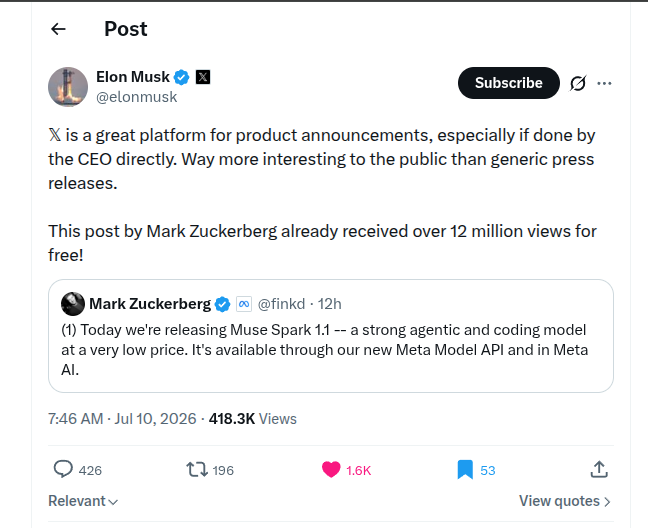
On April 17, 2026, MiniMax CTO Ryan Lee posted that the company's M2.7 model was "No.1. Again!" on the Hugging Face Open LLM Leaderboard. The post thanked open-source developers and highlighted the model's efficiency, stating it "has only 230B parameters with 10B activated, yet deliver[s]..." The tweet was retweeted by the official MiniMax account, confirming the achievement.
The Hugging Face Open LLM Leaderboard is a widely recognized benchmark that ranks large language models on a suite of evaluations including ARC (AI2 Reasoning Challenge), HellaSwag, MMLU (Massive Multitask Language Understanding), and TruthfulQA. Taking the top spot indicates that M2.7 has achieved a new state-of-the-art aggregate score among openly benchmarked models.
Context & Technical Implications
The announcement points to a significant trend in efficient large-scale model design: Sparse Mixture-of-Experts (MoE). Instead of a dense model where every parameter is used for every computation, an MoE model has many specialized sub-networks ("experts"). A routing network selects a small subset of these experts—in this case, activating only 10B out of 230B total parameters—for each token processed. This drastically reduces computational cost during inference while maintaining a massive parameter count for knowledge storage.
For practitioners, this means a model with the potential knowledge capacity of a 230B-parameter model can run at a latency and cost closer to that of a 10B-parameter dense model. This architecture has been pioneered by models like Google's Switch Transformers and, more recently, Mistral AI's Mixtral models. MiniMax's M2.7 achieving a top benchmark score validates the performance potential of this approach when scaled effectively.
What We Don't Know (Yet)
The social media announcement is light on specifics. Key details absent include:
- The exact aggregate score or per-task benchmark numbers.
- The composition of the training data.
- The specific MoE configuration (e.g., number of experts, top-k routing).
- Availability details: Is the model being released open-source, via API, or kept internal?
Typically, a full leaderboard-topping result would be accompanied by a technical report or paper. The absence of such a document suggests this may be an initial announcement, with more details to follow.
gentic.news Analysis
This move by MiniMax is a direct shot across the bow of Western AI leaders like Meta (Llama), Mistral AI, and xAI (Grok), who have been vying for the top of the open-weight model rankings. As we covered in our analysis of the "China's MoE Wave" last quarter, Chinese AI labs have been aggressively adopting and scaling sparse architectures to bypass compute and energy constraints. MiniMax's previous model, M1.5, was a capable dense model, but this pivot to a large-scale MoE for M2.7 shows a clear strategic shift towards efficiency-at-scale.
The timing is also notable. This announcement comes just weeks after DeepSeek's release of its massive MoE model, highlighting a fiercely competitive domestic landscape in China. MiniMax isn't just competing globally; it's fighting for leadership within a crowded and well-funded local field that includes Alibaba's Qwen, 01.AI, and Baidu. Taking the #1 spot on a globally recognized leaderboard is a powerful marketing and recruitment tool in this environment.
For the broader open-source community, the critical question is openness. The Hugging Face Leaderboard requires some level of openness for evaluation, but the degree of MiniMax's intended release—full weights, partial release, or API-only—will determine its real impact. If fully open-sourced, M2.7 could become a new base model for fine-tuning across the industry. If kept behind an API, it positions MiniMax as a cloud provider competing directly with offerings from OpenAI and Anthropic, but with a potentially more cost-efficient underlying model.
Frequently Asked Questions
What is the Hugging Face Open LLM Leaderboard?
The Hugging Face Open LLM Leaderboard is a public benchmark that evaluates large language models on a standardized set of tasks designed to measure reasoning, knowledge, and truthfulness. It includes benchmarks like ARC, HellaSwag, MMLU, and TruthfulQA. Models are ranked by their aggregate score, providing a common ground for comparing performance.
What is a Mixture of Experts (MoE) model?
A Mixture of Experts is a neural network architecture where the model is composed of many smaller sub-networks (the "experts"). For each input token, a routing network selects only a few relevant experts to activate. This allows the total model size (total parameters) to be very large—holding vast knowledge—while the computational cost per token (active parameters) remains much lower, leading to faster and cheaper inference.
Is the MiniMax M2.7 model available to use?
As of this announcement via social media, no details on availability have been provided. The model has been evaluated on the leaderboard, but it is unclear if the weights will be open-sourced, released under a research license, or made available only through a commercial API. Typically, such details follow in a technical report or official blog post.
How does MiniMax compare to other Chinese AI companies?
MiniMax is a major player in China's AI scene, known initially for its text-to-audio and conversational AI. It has since expanded into foundational LLMs. It competes with other well-funded Chinese AI labs like 01.AI (Yi models), DeepSeek, Alibaba's Qwen team, and Baidu. This leaderboard result, if sustained, would position MiniMax's research team among the very top tier in terms of publicly demonstrated model capability.