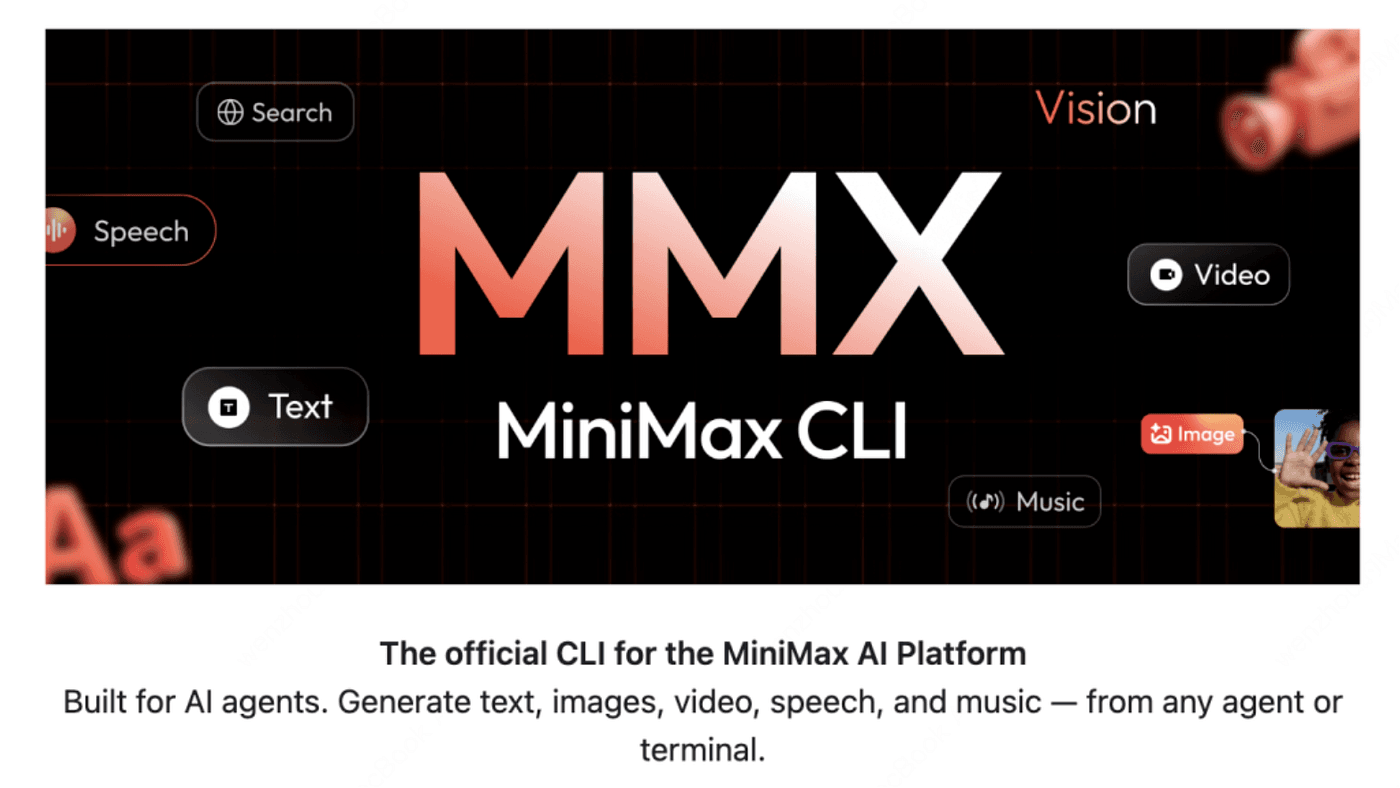
Chinese AI company MiniMax has open-sourced three new "Music Skills" designed to be used by AI agents running on its MMX-CLI (Command Line Interface) platform. The skills enable agents to perform a range of audio tasks, from generating original music to singing in a specific persona and curating personalized playlists.
Key Takeaways
- MiniMax has open-sourced three 'Music Skills' for its MMX-CLI agent platform.
- The skills allow AI agents to generate music, sing in a persona, and curate playlists from a user's local library.
What's New: Three Native Music Skills
The three open-source skills are designed to integrate natively with the MMX-CLI environment and work alongside MiniMax's multimodal models, including its recently released Music 2.6 model.
- minimax-music-gen: This skill allows an agent to generate a full music track from a one-line text prompt. According to the announcement, the agent can automatically decide whether to create an original composition, an instrumental piece, or a cover version based on the prompt.
- buddy-sings: This skill enables an agent—specifically one with a defined character persona, like a "Claude Code" character—to generate and perform a song in the first person, reflecting its programmed personality.
- minimax-music-playlist: This skill gives an agent the ability to scan a user's local music library, learn their taste, and autonomously build a curated playlist.
Technical Details: Integration and Access
The skills are "tuned to run natively in MMX-CLI." For developers or users to implement them, they need to connect a MiniMax Token Plan (the company's API credit system) and add the MMX-CLI tool. Once set up, an agent running in that environment can autonomously "pick up the Skills on its own."
The release points to a continued focus by MiniMax on its agent development platform. By open-sourcing these specific audio capabilities, the company is likely aiming to spur developer experimentation and build more complex, multi-skill agents within its ecosystem. The skills leverage the company's existing multimodal and audio generation stack, positioning them as practical applications of its core AI models.
How It Compares: Agent Skills as a Frontier
While several companies offer text-to-music generation (like Suno, Udio, and Meta's AudioCraft) and playlist curation is a standard feature of streaming services, MiniMax's approach is distinct in framing these as modular "Skills" for an autonomous agent framework.
This aligns with a broader industry trend of moving beyond single-task AI models towards multi-functional agent systems. Unlike a standalone music generator, these skills are designed to be tools an agent can choose to use as part of a larger interaction or task chain. The buddy-sings skill, in particular, highlights a focus on character-driven AI and embodied interaction, a growing niche within agent research.
What to Watch: The Push for Practical Agent Ecosystems
The release is a tactical move to add utility to the MMX-CLI platform. The success of such agent frameworks depends heavily on the breadth and quality of available skills. By providing ready-made, high-quality music skills, MiniMax is lowering the barrier for developers to create more engaging and versatile agents.
Key questions remain about the performance and limitations of these skills, as the announcement does not include audio samples or technical benchmarks. Their effectiveness will depend on the underlying capabilities of MiniMax's Music 2.6 model and the agent's ability to correctly invoke the skills based on user intent.
gentic.news Analysis
This open-source release is a strategic play by MiniMax to populate its developer-focused agent platform, MMX-CLI, with compelling, ready-to-use capabilities. It follows the company's established pattern of releasing strong, open-source multimodal components—like its ViT-22B vision transformer in late 2024—to attract developer mindshare and build an ecosystem around its core models and APIs.
The move aligns with a clear competitive trend we've been tracking: the race to define the dominant agent skill protocol. While companies like OpenAI push function-calling within their models and startups like Cognition Labs focus on coding agents, MiniMax is betting on a curated, model-native skill library for its CLI environment. The inclusion of a character-based singing skill (buddy-sings) directly connects to another major trend we've covered: the rise of persona-driven AI companions. This skill essentially provides a vocal performance layer for the character agents developers are already building, a feature previously requiring complex, custom integration.
By open-sourcing these skills, MiniMax is not just giving away code; it's attempting to standardize how music generation and audio interaction are handled within its agent ecosystem before a de facto standard emerges elsewhere. The requirement for a MiniMax Token Plan ensures that while the skills are free to use, they drive usage and lock-in for the company's proprietary inference platform and latest models like Music 2.6.
Frequently Asked Questions
What is MMX-CLI?
MMX-CLI is a command-line interface tool developed by MiniMax for building, testing, and running AI agents. It provides an environment where agents can access various "Skills"—pre-built capabilities like these music functions—and utilize MiniMax's suite of multimodal models.
Do I need to pay to use these open-source Music Skills?
While the skill code itself is open-source, you need a MiniMax Token Plan (the company's API credit system) to actually run them. The skills require calls to MiniMax's underlying AI models (like Music 2.6) to generate audio, which incurs costs through the token plan.
How is this different from using Suno or Udio?
Suno and Udio are primarily standalone web applications or APIs for generating music from text. MiniMax's skills are designed to be tools within an AI agent. The agent decides when and how to use the skill as part of a broader conversation or task, such as a character agent choosing to sing a song in response to a user's mood.
Can I use these skills outside of the MMX-CLI environment?
The skills are specifically "tuned to run natively in MMX-CLI." While the source code is available, they are designed to integrate with MiniMax's agent framework and models. Porting them to another system would likely require significant modification.