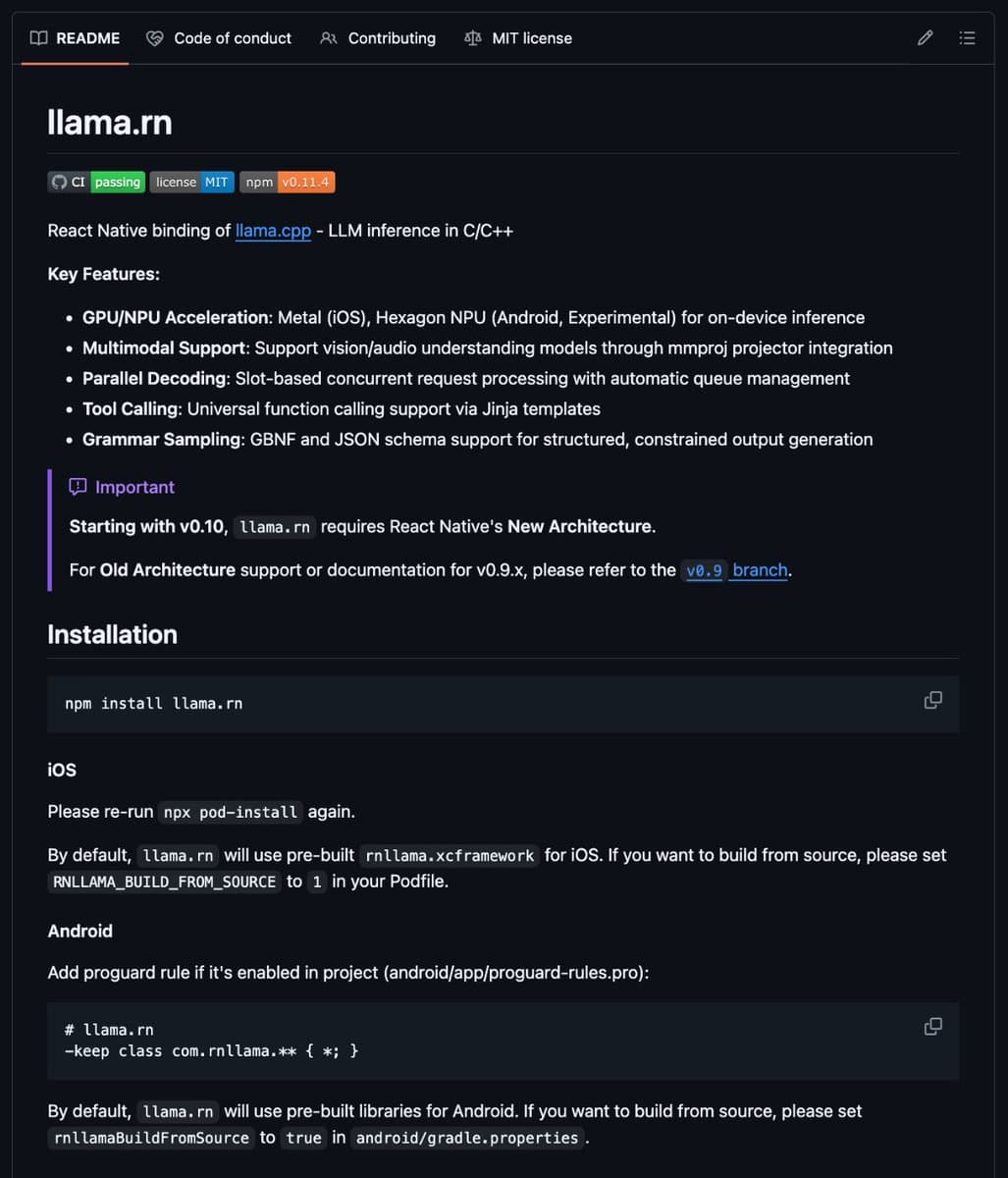
A significant advancement in mobile artificial intelligence has emerged with the release of llama rn, a React Native binding of llama.cpp that enables developers to run full large language models directly on smartphones with as little as 4GB of RAM. This development represents a major shift toward truly local AI processing, eliminating dependency on cloud services while maintaining impressive performance.
What Makes llama rn Different?
Unlike previous mobile AI implementations that relied on simplified models or cloud processing, llama rn brings full-featured LLMs to native mobile applications. The framework supports popular open-source models including Llama, Qwen, and Mistral, running them entirely on-device without requiring internet connectivity.
The technical implementation is particularly noteworthy. llama rn leverages platform-specific hardware acceleration:
- iOS devices utilize Metal acceleration for GPU processing
- Android devices tap into Hexagon NPU (Neural Processing Unit) capabilities
- CPU-only operation remains viable for devices without specialized hardware
Remarkably, the developers claim the on-device processing is "faster than most cloud APIs even on CPU," suggesting significant optimization in the underlying llama.cpp implementation.
Technical Capabilities and Features
Beyond basic text generation, llama rn incorporates several advanced AI capabilities:
Multimodal Understanding: The framework includes built-in support for vision and audio processing, enabling applications that can interpret images, videos, and sound alongside text.
Structured Output: Developers can leverage tool calling and structured JSON output capabilities, making it easier to integrate LLM responses into application logic.
Performance Optimization: Parallel decoding techniques help maximize throughput on mobile hardware, while the 4GB RAM requirement makes the technology accessible to most modern smartphones.
Offline Operation: Perhaps most significantly, all processing occurs locally, ensuring user privacy, reducing latency, and eliminating cloud service costs.
Implications for Mobile Development
This breakthrough has profound implications for the mobile application ecosystem:
Privacy-First Applications: Developers can now create AI-powered apps that never send user data to external servers, addressing growing privacy concerns.
Reduced Operational Costs: Eliminating cloud API calls removes ongoing inference costs, making AI features economically viable for free applications.
Global Accessibility: Offline functionality enables AI features in regions with limited or expensive internet connectivity.
New Application Categories: The combination of local processing with vision/audio capabilities opens possibilities for real-time translation, document analysis, accessibility tools, and educational applications that work anywhere.
The Open Source Advantage
As a 100% free and open-source project, llama rn lowers barriers to entry for developers and organizations of all sizes. The React Native framework integration means existing mobile developers can incorporate AI capabilities without learning entirely new toolchains.
The project builds upon the established llama.cpp ecosystem, benefiting from ongoing optimizations and model support from that community while adding mobile-specific enhancements.
Challenges and Considerations
While promising, developers should consider several factors:
Model Size Constraints: Although optimized, full LLMs still require significant storage space, potentially limiting which models can be included in application bundles.
Battery Impact: Continuous AI processing may affect device battery life, requiring careful power management in application design.
Hardware Fragmentation: Performance will vary across devices depending on NPU availability and specifications.
Future Directions
The release of llama rn represents a milestone in the democratization of AI technology. As hardware continues to improve and optimization techniques advance, we can expect:
- Support for larger, more capable models on mobile devices
- Further performance improvements through hardware/software co-design
- Increased adoption in enterprise applications requiring data sovereignty
- New hybrid approaches combining local and cloud processing
Conclusion
llama rn marks a turning point in mobile AI development, bringing sophisticated language models directly to smartphones without compromising performance or privacy. By leveraging existing React Native infrastructure and open-source AI ecosystems, this technology has the potential to transform how we interact with AI in our daily lives.
As developers begin experimenting with these capabilities, we can anticipate a wave of innovative applications that make artificial intelligence more personal, private, and pervasive than ever before.
Source: @hasantoxr on X/Twitter