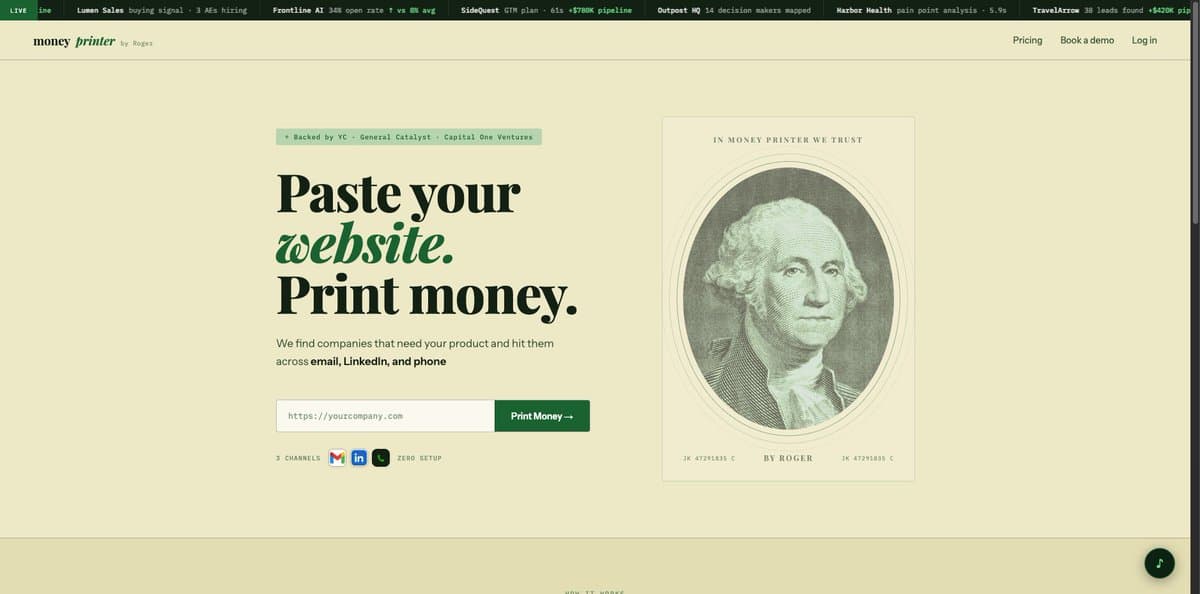
A new AI-powered tool called "Money Printer" is making a bold claim: it can automate the entire outbound sales process, turning a company's website into a source of qualified leads and customer outreach without manual setup.
According to a public test by a user, the system operates by taking a single website URL as input. It then autonomously performs a series of tasks traditionally handled by sales development representatives (SDRs) and marketing teams.
Key Takeaways
- A new AI tool called Money Printer claims to automate B2B outbound sales.
- Users paste a website URL, and the system finds target companies, identifies decision-makers, writes personalized outreach, and initiates contact via email and phone calls.
What the Tool Claims to Do
The process, as described, follows a specific pipeline:
- Account Discovery: The AI scrapes the provided website to understand the company's offerings. It then uses this data to find other companies that are "already looking for what you sell," implying intent-based targeting.
- Lead Identification: For each target company, the system finds "the exact decision makers," moving beyond generic contact forms to identify specific individuals.
- Content Generation: It writes personalized outreach messages for each identified account and decision-maker.
- Multi-Channel Execution: The system begins sending emails immediately. Its most notable claim is that it can "pick up the phone and calls them," suggesting a voice AI component for outbound calls.
The core promise is the elimination of manual steps: no building contact lists, writing campaign copy, or managing send schedules. The user simply provides a starting point (their website), and the AI handles the rest, theoretically generating customer interest autonomously.
The Claim: "Outbound as We Knew It is Dead"
The announcement positions Money Printer as a paradigm shift, arguing that traditional outbound sales—reliant on manual list-building, campaign creation, and human follow-up—is obsolete. The tool's promoter states it was tested on a random company and "pulled accounts I wouldn't have found myself," suggesting its discovery capabilities may surface opportunities beyond conventional sales intelligence platforms.
Key Unanswered Questions
The source material is an anecdotal social media post, not a product launch with detailed specifications. Critical technical and operational details are absent:
- AI Models & Data Sources: What AI models power the search, personalization, and calling features? What data sources does it use for company intent and contact information?
- Compliance & Ethics: How does the tool handle global data privacy regulations (GDPR, CCPA) regarding scraping and outreach? What is its policy on phone call regulations (e.g., TCPA in the US)?
- Performance Metrics: There are no published metrics on email open/reply rates, call connection/success rates, or overall lead qualification accuracy.
- Pricing & Availability: The tool's commercial status, pricing model, and availability are not mentioned.
gentic.news Analysis
This announcement fits directly into the aggressive trend of AI agents attempting to automate complex, multi-step business processes. It's not merely a copilot for sales reps; it's positioned as a full replacement for the initial outbound sequence. The claim of automated calling is particularly significant, placing it in competition with companies like Gong (which analyzes calls) and Chorus.ai (a ZoomInfo company), but from a proactive, AI-driven outbound angle.
Historically, sales automation has focused on CRM integration (Salesforce), email sequencing (Outreach, Salesloft), and contact data (ZoomInfo, Apollo.io). Money Printer's premise of a single-URL start point suggests a deeper integration of web scraping, LLM-based company profiling, and perhaps real-time intent data—technologies that have matured separately but are now being bundled into an autonomous agent.
The major hurdles are not technical but practical: deliverability (avoiding spam filters), compliance (navigating communication laws), and quality control (preventing brand damage from poorly executed AI calls). If even partially effective, tools like this would pressure the sales tech stack, forcing incumbents to accelerate their own AI agent development. However, if deployed carelessly, they risk triggering a regulatory and consumer backlash against AI-driven sales outreach, similar to the robocall epidemic.
Frequently Asked Questions
How does Money Printer AI find companies "looking for what you sell"?
Based on the description, the AI likely analyzes the product/service descriptions on your website. It then uses this information to search through various business databases, news sources, job postings, or public procurement sites to identify companies expressing related needs, challenges, or expansion plans that align with your offering. This is a form of intent-based targeting, though the specific data sources are not disclosed.
Is an AI tool like this legal for cold calling and emailing?
The legality is complex and varies by jurisdiction. For email, compliance with laws like the CAN-SPAM Act (US) or GDPR (EU) is required, which typically mandate clear opt-out mechanisms and accurate sender information. For automated phone calls, regulations like the Telephone Consumer Protection Act (TCPA) in the US are extremely strict, generally requiring prior express written consent for automated dialing systems or artificial/prerecorded voices. A tool operating at this scale would need robust compliance frameworks to avoid significant legal risk.
What are the main risks of using an autonomous outbound sales AI?
The primary risks include:
- Brand Damage: Poorly personalized or contextually inappropriate AI-generated messages and calls can annoy potential customers and harm your company's reputation.
- Compliance Violations: As above, automated outreach can easily violate anti-spam and telemarketing laws, leading to hefty fines.
- Low Quality Leads: Fully automated discovery and outreach may generate a high volume of low-intent or irrelevant leads, wasting sales team time on poor follow-ups.
- Technical Issues: Over-reliance on a single tool creates operational risk if the service fails or changes its pricing/terms.
How does this compare to existing sales automation platforms?
Traditional sales automation platforms (e.g., Outreach, Salesloft) are tools for humans. They help reps manage sequences, templates, and cadences, but the rep builds the list, writes the core message, and decides when to send. Money Printer, as described, is an autonomous agent. It makes the decisions about who to target, what to say, and when to contact them. The human input is reduced to providing a starting URL. This represents a shift from augmentation to full automation of the outbound process.