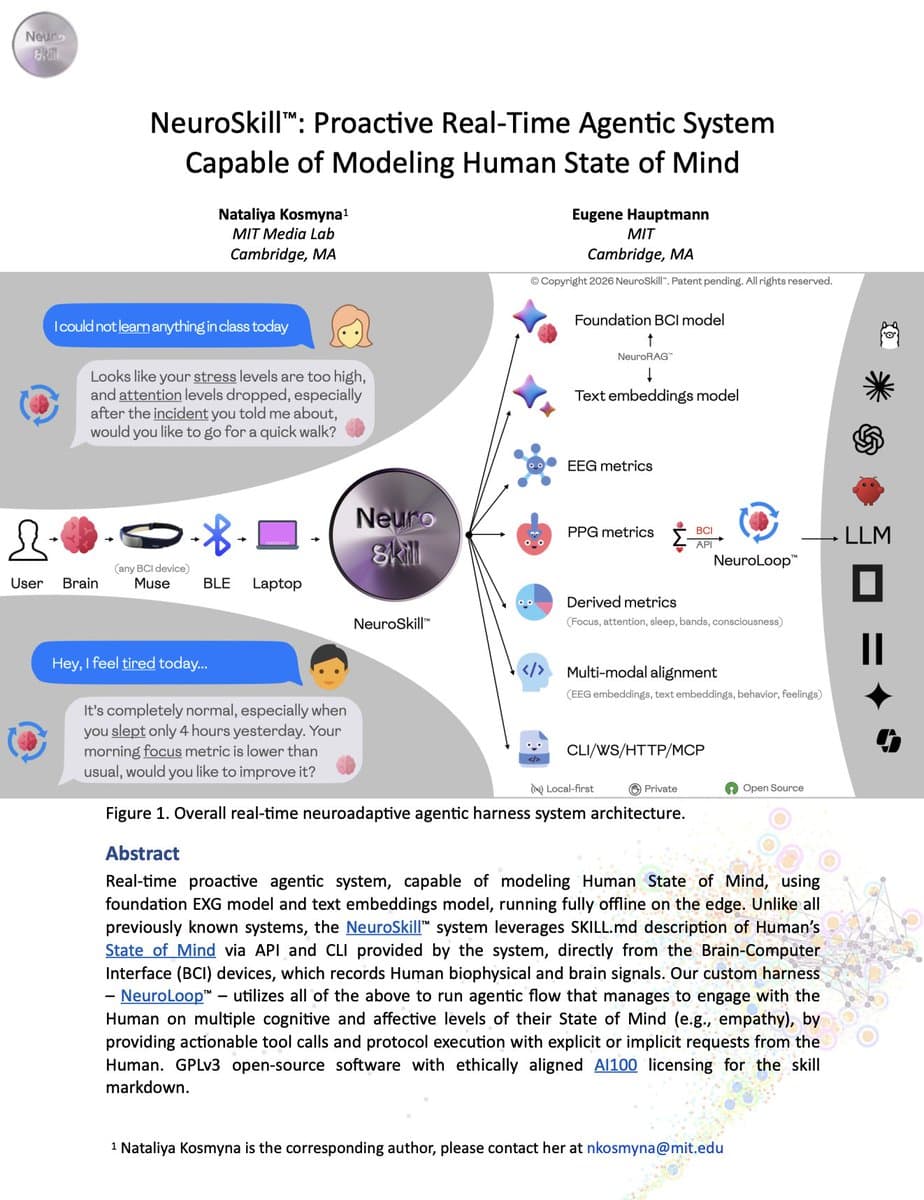
In a development that sounds like science fiction becoming reality, MIT researchers have unveiled NeuroSkill—a real-time agentic system that represents a quantum leap in human-AI interaction. Unlike conventional AI assistants that wait for explicit commands, NeuroSkill proactively models human cognitive and emotional states by integrating Brain-Computer Interface (BCI) signals with foundation models, creating what researchers describe as "one of the wildest applications of agent harnesses" seen to date.
The NeuroSkill Architecture: Merging Mind and Machine
At its core, NeuroSkill operates through a sophisticated architecture that bridges the gap between human neurology and artificial intelligence. The system captures brain signals through non-invasive BCI technology, processes these signals in real-time, and interprets them using foundation models to understand the user's cognitive and emotional state. This "Human State of Mind" is then provided to the AI agent through what researchers call a "SKILL dot md" interface—essentially a structured representation of the user's mental state.
What makes NeuroSkill particularly remarkable is its edge computing capability. The entire system runs fully offline on edge devices, eliminating privacy concerns associated with cloud-based processing while ensuring instantaneous response times. This local processing approach represents a significant advancement in making sophisticated AI systems both private and practical for everyday use.
The NeuroLoop Harness: Enabling Proactive Interaction
The system's NeuroLoop harness represents the engine that drives its agentic workflows. This component enables the AI to engage users across multiple dimensions—cognitive, emotional, and behavioral—responding not just to explicit requests but to implicit human states that users themselves might not consciously recognize or articulate.
Through actionable tool calls, NeuroSkill can initiate interactions based on detected cognitive patterns. For instance, if the system detects signs of mental fatigue through brainwave patterns, it might suggest a break or switch to less demanding tasks. If it recognizes frustration patterns, it could offer assistance or alternative approaches before the user even asks for help.
Why This Matters: The Paradigm Shift in Human-AI Interaction
Most current AI agents operate on a reactive model—they respond only when explicitly prompted. NeuroSkill fundamentally challenges this paradigm by exploring what researchers call "the frontier of proactive agents." These systems sense and respond to implicit human states, opening entirely new possibilities for adaptive human-AI collaboration.
This shift from reactive to proactive AI has profound implications across multiple domains. In education, such systems could detect when a student is struggling with a concept before they become frustrated. In healthcare, they could monitor cognitive states of patients with neurological conditions. In workplace settings, they could optimize workflows based on detected focus levels and cognitive load.
Technical Innovations and Implementation Challenges
The NeuroSkill paper details several technical innovations that make this system possible. The integration of BCI signals with foundation models requires sophisticated signal processing algorithms capable of filtering noise and extracting meaningful cognitive and emotional indicators from complex brain data. The researchers have developed novel approaches to translate these signals into structured representations that foundation models can understand and act upon.
However, significant challenges remain. BCI technology, while advancing rapidly, still faces limitations in signal clarity and interpretation accuracy. The ethical implications of AI systems that can "read" human cognitive states raise important questions about privacy, consent, and potential misuse. The researchers acknowledge these concerns and emphasize the importance of developing robust ethical frameworks alongside the technology itself.
Real-World Applications and Future Directions
The potential applications of NeuroSkill-style systems are vast and transformative. Consider mental health support systems that can detect early signs of anxiety or depression through cognitive patterns. Imagine learning platforms that adapt in real-time to a student's comprehension level and engagement state. Envision creative tools that respond to an artist's flow state or a writer's cognitive patterns.
As the technology matures, we can anticipate several development trajectories. First, refinement of BCI interfaces to become less intrusive and more accurate. Second, development of more sophisticated foundation models specifically trained to interpret cognitive and emotional states. Third, creation of ethical guidelines and regulatory frameworks to ensure these powerful systems are deployed responsibly.
The Broader Context: Proactive AI in the Agent Ecosystem
NeuroSkill arrives at a pivotal moment in AI development, as researchers and developers increasingly focus on creating more autonomous, proactive agent systems. This work connects to broader trends in agentic AI, where systems are designed to take initiative rather than simply respond to commands. The offline capability of NeuroSkill addresses growing concerns about data privacy and latency in cloud-dependent systems, potentially setting a new standard for sensitive applications.
The researchers behind NeuroSkill have made their paper publicly available, encouraging further development in this emerging field. As they note in their documentation, this represents just the beginning of exploring "the frontier of proactive agents that sense and respond to implicit human states."
Conclusion: Toward More Natural Human-AI Partnerships
NeuroSkill represents more than just another AI advancement—it points toward a future where human-AI interaction becomes more natural, intuitive, and responsive. By bridging the gap between explicit commands and implicit human states, this technology could fundamentally change how we work with intelligent systems.
As with all transformative technologies, careful consideration must be given to ethical implications and potential risks. But the promise of AI systems that can truly understand and respond to human cognitive and emotional states—running privately on our own devices—offers a compelling vision of more harmonious human-machine collaboration.
Source: MIT NeuroSkill research paper and analysis by Omar Sar (@omarsar0)