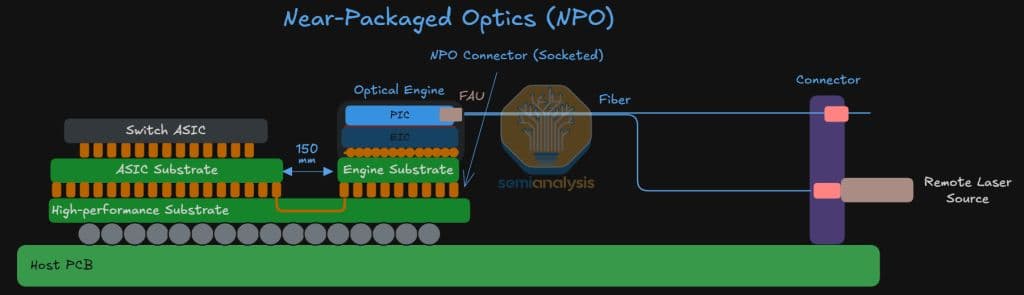
SemiAnalysis' latest thread outlines Near-Packaged Optics (NPO) as an interim step between pluggable optics and true co-packaged optics (CPO). NPO promises field-replaceable modules, reduced blast radius, and easier assembly by decoupling optical engines from the switch ASIC.
Key facts
- NPO is an interim step between pluggable optics and true CPO.
- Field-replaceable modules improve serviceability.
- Blast radius limited to individual NPO module.
- Optical engines packaged separately from switch ASIC/XPU.
- NPO bypasses CPO production and reliability challenges.
SemiAnalysis, the semiconductor research firm, has detailed Near-Packaged Optics (NPO) as an intermediate architecture in the industry's transition from pluggable optics to true co-packaged optics (CPO). According to @SemiAnalysis_, NPO addresses current production and reliability challenges that have slowed CPO adoption while preserving most of its benefits.
How NPO differs architecturally
The core architectural difference lies in packaging. In true CPO, the optical engines are co-packaged with the switch ASIC or XPU on the same substrate, which creates integration complexity and reliability risks. NPO instead packages the optical engines separately from the switch ASIC/XPU, allowing for field replacement and limiting blast radius to the individual NPO module.
This separation yields three concrete advantages, per SemiAnalysis:
- Better serviceability: Modules can be replaced in the field, avoiding the need to scrap an entire switch board when an optical component fails.
- Lower blast radius: A failure is contained to the NPO module, not the whole package.
- Easier assembly: Optical engines are packaged separately, simplifying manufacturing and reducing yield loss.
The trade-off is that NPO does not achieve the full integration density or latency reduction of true CPO, but it offers a pragmatic path for hyperscalers and switch vendors to adopt optical co-packaging sooner.
Why NPO matters now
The push toward CPO has been driven by the need to reduce power consumption and cost in AI data centers, where optical transceivers dominate interconnect power budgets. True CPO promises to eliminate pluggable transceivers, but production yields and reliability have lagged. NPO bridges this gap, allowing manufacturers to ship products today while CPO matures.
SemiAnalysis notes that NPO maintains most of CPO's benefits, including reduced power and improved signal integrity, without the production pain. This positions NPO as a viable interim solution for next-generation switch platforms, particularly in large-scale AI clusters where serviceability and blast radius are critical operational concerns.
The company did not disclose specific performance metrics or product roadmaps in the thread, but the architectural rationale suggests NPO could appear in switch designs within the next 12-18 months.
Key Takeaways
- SemiAnalysis outlines NPO as an interim packaging between pluggable and true CPO, offering serviceability and lower blast radius.
- NPO bypasses CPO production challenges while retaining most benefits.
What to watch
Watch for SemiAnalysis' follow-up posts detailing NPO performance trade-offs, and for switch vendors (e.g., Broadcom, Cisco) to announce NPO-based products in upcoming OEM roadmaps. Also monitor CPO yield improvements—if true CPO matures faster than expected, NPO's window could narrow.