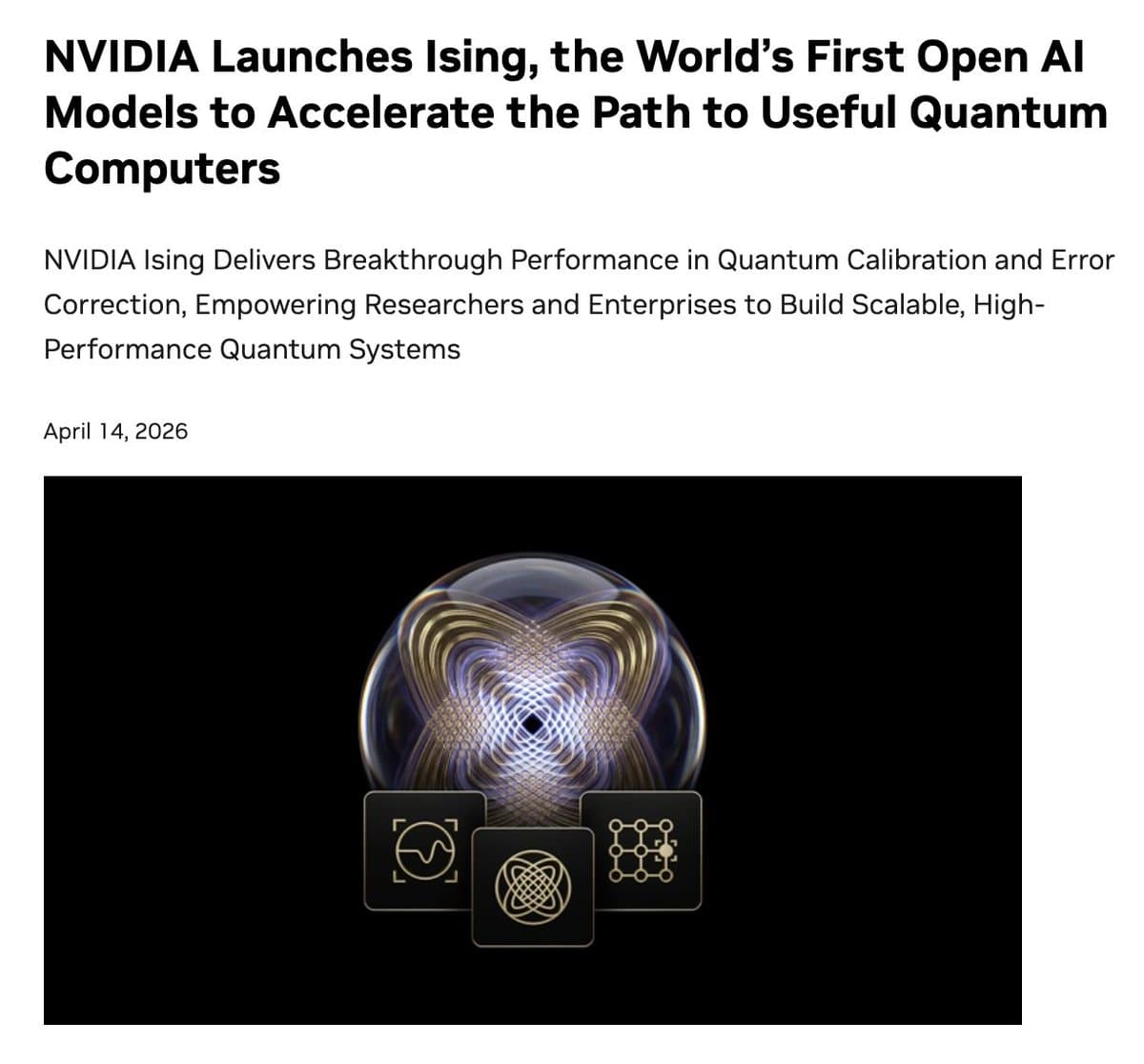
NVIDIA has released an open-source artificial intelligence model family designed to operate quantum computers, tackling the field's most persistent bottleneck: system calibration and stability. The platform, named NVIDIA Ising, uses AI to automate the manual, days-long process of tuning quantum processors and introduces a neural network for real-time error correction.
Key Takeaways
- NVIDIA launched Ising, an open-source AI model family that acts as an OS for quantum computers.
- It uses a vision language model to automate calibration and a 3D neural network for error correction, reducing calibration from days to hours.
What NVIDIA Built: An AI Control Plane for Quantum Machines
Quantum bits (qubits) are notoriously fragile. Minute temperature fluctuations or microscopic vibrations can cause a quantum processor's state to collapse, invalidating calculations. Currently, engineers manually calibrate these systems—a process that can take days—and rely on software too slow for real-time error correction during computation.
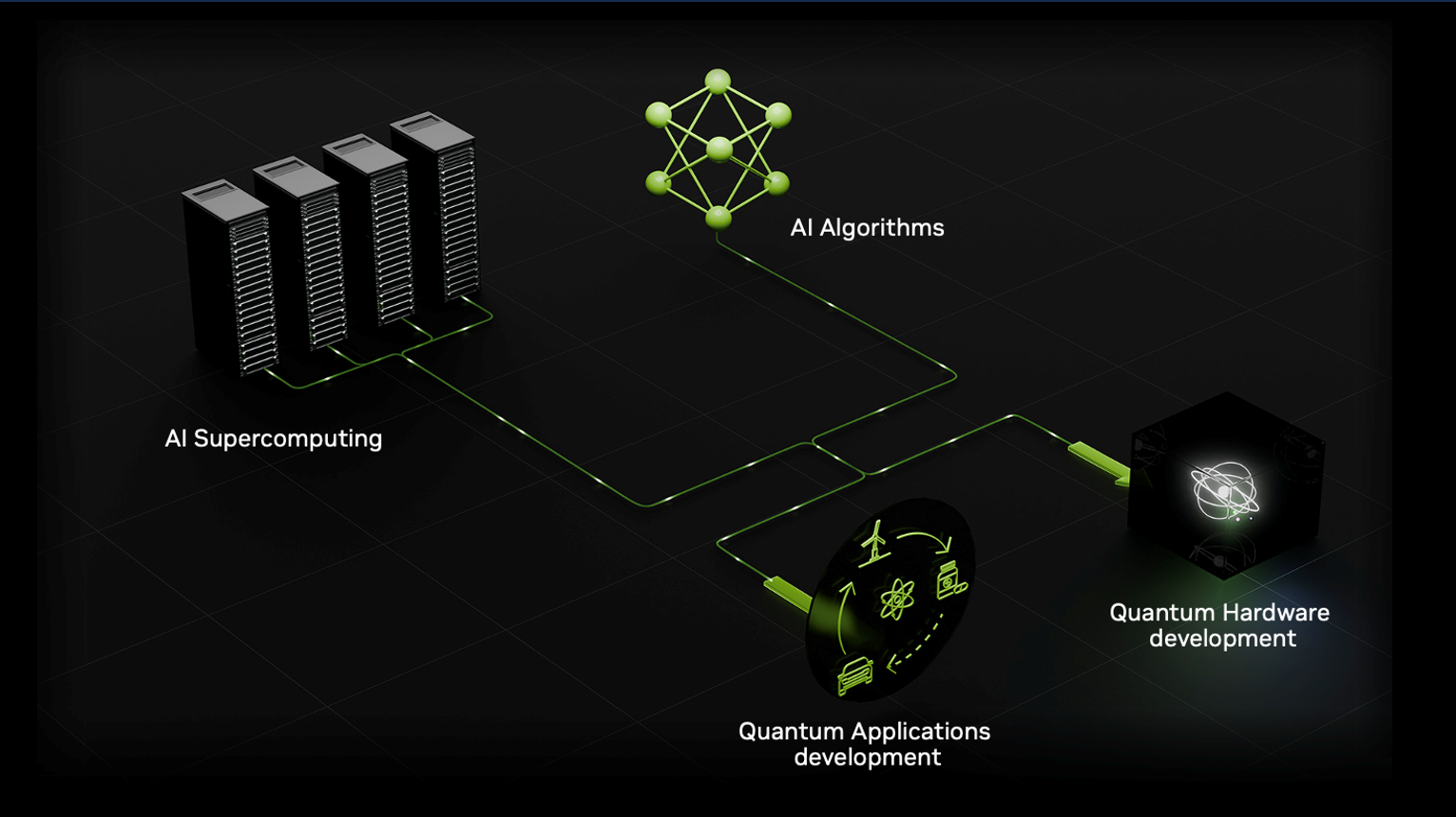
NVIDIA Ising is positioned as an AI-driven "control plane" or operating system for quantum machines. It consists of two core AI components aimed at solving these twin problems of calibration and correction.
Technical Breakdown: Vision Models and 3D Neural Networks
The system addresses the two primary operational hurdles:
Automated Calibration: Ising employs a vision language model (VLM) to monitor the quantum processor. Instead of manual tuning, the AI "watches" the system and adjusts parameters in real-time to maintain stability. NVIDIA claims this reduces calibration time from days down to hours.
Real-Time Error Correction: For errors that occur during computation, NVIDIA built a specialized 3D neural network to decode quantum errors on the fly. The company states this decoder is 2.5x faster and 3x more accurate than the current open-source industry standard. The AI predicts and attempts to fix the quantum state before a full collapse occurs.
By open-sourcing the model family, NVIDIA is aiming for broad adoption as a foundational software layer. Early adopters include Harvard, Berkeley Lab, and the Fermi National Accelerator Laboratory, who are integrating Ising into their quantum research infrastructure.
The Competitive and Strategic Landscape
NVIDIA's move places it at the intersection of two of its core strengths: AI acceleration and systems software. While other companies like IBM, Google, and Quantinuum are focused on building quantum hardware and algorithmic libraries, NVIDIA is targeting the essential, low-level control software required to make any hardware usable.
This follows NVIDIA's established strategy of providing the essential platform tools—akin to its CUDA platform for GPU computing—upon which entire industries are built. If successful, Ising could become a standard software interface, making NVIDIA's technology integral to quantum computing regardless of which hardware platform ultimately leads.
gentic.news Analysis
This announcement is a logical and aggressive expansion of NVIDIA's systems software strategy into the quantum frontier. For years, the quantum computing stack has been fragmented, with hardware developers also building their own bespoke control software. NVIDIA is leveraging its immense AI and software expertise to potentially standardize a critical layer, much as CUDA standardized GPU programming. If Ising gains traction as a robust, hardware-agnostic control plane, it could accelerate practical quantum computing by solving the "last mile" problem of system stability, allowing researchers to focus on algorithms rather than calibration.
The claim of reducing calibration from days to hours is significant, as calibration overhead is a major drain on valuable quantum processor time. However, the real test will be independent benchmarking of the 2.5x speed and 3x accuracy gains for error correction across different qubit architectures (superconducting, trapped ion, etc.). NVIDIA's success here depends on the AI models' ability to generalize across diverse quantum hardware, which is far less standardized than classical GPUs.
This development also highlights a broader trend of using advanced AI to manage complex physical systems. It mirrors efforts in fusion reactor control and advanced material discovery. NVIDIA is effectively arguing that the control problem for noisy, intermediate-scale quantum (NISQ) devices is too complex for traditional software and requires AI. The open-source approach is savvy, encouraging adoption and integration feedback from major research labs early in the technology's lifecycle.
Frequently Asked Questions
What is NVIDIA Ising?
NVIDIA Ising is an open-source family of AI models designed to act as an operating system or control plane for quantum computers. It uses a vision language model to automate processor calibration and a 3D neural network for real-time error correction.
How does NVIDIA Ising speed up quantum computing?
It tackles the major operational bottleneck: setup time. By using AI to automatically monitor and tune the quantum processor (a process called calibration), it reduces the time required from several days to a matter of hours, freeing up the machine for actual computation.
What are the performance claims for Ising's error correction?
NVIDIA states that the AI-powered error decoder in Ising is 2.5 times faster and 3 times more accurate than the current open-source industry standard for quantum error correction.
Which institutions are using NVIDIA Ising?
According to the announcement, major research institutions including Harvard, Berkeley Lab, and the Fermi National Accelerator Laboratory are early adopters and are integrating Ising into their quantum computing research systems.