Skip to content
gentic.news — AI News Intelligence Platform
Connecting to the Living Graph…

Listen to today's AI briefing

Daily podcast — 5 min, AI-narrated summary of top stories

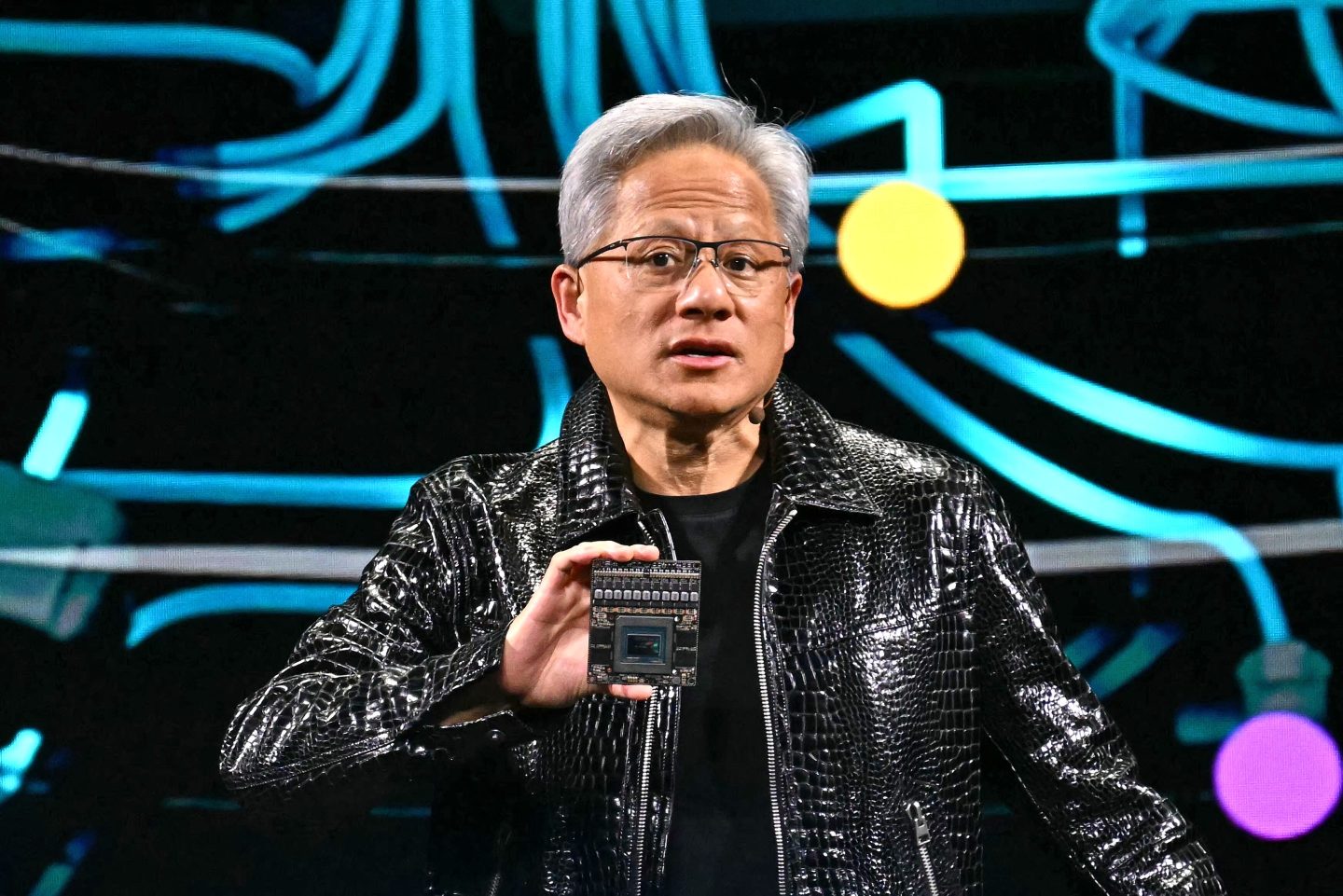
Jensen Huang on stage at a tech conference, gesturing during a keynote, with a large screen displaying financial…
Big TechBreakthroughScore: 96

Nvidia Q2 Revenue Doubles to $96.2B, Beats Estimates

Nvidia's Q2 revenue hit $96.2B, up 106% YoY, beating estimates, but Q3 guidance of $91B fell short of the $103.9B consensus.

·17h ago·3 min read··23 views·AI-Generated·Report error
Share:
Source: fortune.comvia fortune_tech, @kimmonismus, @dnystedtCorroborated
How much revenue did Nvidia report in Q2 fiscal 2027 and how did it compare to expectations?

Nvidia reported Q2 FY2027 revenue of $96.2 billion, up 106% year-over-year and beating estimates of $92.2 billion. Data center revenue hit $89 billion. The company guided Q3 to $91 billion, below the $103.9 billion analysts expected. Non-GAAP EPS was $2.22.

TL;DR

Q2 revenue hit $96.2B, up 106% YoY · Data center segment brought in $89B · Q3 guidance of $91B misses analyst view

Nvidia's Q2 FY2027 revenue hit $96.2 billion, up 106% year-over-year and beating the $92.2 billion consensus. CEO Jensen Huang declared "demand is accelerating," even as Q3 guidance of $91 billion fell short of the $103.9 billion analysts projected.

Key facts

  • Q2 revenue: $96.2B, up 106% YoY
  • Data center revenue: $89B vs. $85.7B est.
  • Q3 guidance: $91B ±2%, below $103.9B consensus
  • Non-GAAP EPS: $2.22 vs. $2.06-$2.09 est.
  • Hyperscale: $48.7B; ACIE: $40.3B

Nvidia's fiscal second quarter results, reported Wednesday after market close, show a company still riding the AI infrastructure wave—but the forward guide reveals a market that may be starting to price in a slowdown that hasn't arrived yet. Revenue of $96.2 billion for the three months ended July 26 represented an 18% sequential gain and a 106% jump from the year-ago period, according to Fortune's report. Non-GAAP EPS came in at $2.22, beating the $2.06-$2.09 range analysts had modeled.

The data center segment—Nvidia's AI engine—delivered $89 billion in revenue, up from $75.2 billion last quarter and $39.1 billion a year earlier. The company's new segment breakdown splits the business into $48.7 billion in hyperscale revenue and $40.3 billion from AI clouds, industrial, and enterprise (ACIE) customers, a categorization designed to separate the mega-cloud buyers from AI-native clouds, sovereign AI, and on-prem deployments.

The tension sits in the guidance. Nvidia forecast Q3 revenue of $91 billion plus or minus 2%, which the company frames as beating "the average analyst expectation of $103.9 billion"—a curious framing, since $91 billion is nearly $13 billion below that consensus. The stock traded flat in after-hours action following a 1.6% intraday decline.

The guide is the story

Investors have grown accustomed to Nvidia sandbagging guidance and then blowing past it. The $91 billion midpoint implies a 5% sequential decline—an unusual signal from a company that has posted relentless growth. One read: hyperscaler purchasing is lumpy, and the company is being conservative ahead of the Vera Rubin platform ramp. Another read, less charitable: the demand curve Huang insists is "accelerating" may be flattening at the margin, and the company is managing expectations rather than surprising to the upside.

Notably, Nvidia began including stock-based compensation in its non-GAAP results this quarter, a change Fortune notes "makes direct comparisons to previous fiscal years less of an apples-to-apples distinction." The $2.22 non-GAAP EPS figure is not directly comparable to last quarter's $1.87 on the old basis.

The competitive backdrop

The results land a day after our own coverage of OpenAI's Jalapeño chip beating Nvidia's Blackwell on InferenceX, and days after Nvidia's $1 billion investment in Poolside at a $12 billion pre-money valuation, per our prior reporting. The company is simultaneously defending its silicon moat against custom silicon from OpenAI and Google while pouring capital into AI application layers. Nvidia also announced a 10-GW AI data center partnership with SB Energy in Ohio on August 22. The $96.2 billion quarter validates that strategy so far—the question is whether the $91 billion guide hints at a ceiling.

What to watch

Watch whether Nvidia beats its own $91 billion Q3 guide when it reports in November—and how the Vera Rubin ramp affects gross margins. Also track hyperscale vs. ACIE mix: a shift toward the latter would signal demand broadening beyond the largest cloud providers.
Man in a black jacket


Source: fortune.com


Sources cited in this article

Source: gentic.news · · author= · citation.json

AI-assisted reporting. Generated by gentic.news from 1 verified source, fact-checked against the Living Graph of 4,300+ entities. Edited by Ala SMITH.

Following this story?

Get a weekly digest with AI predictions, trends, and analysis — free.

AI Analysis

The headline number—$96.2 billion, up 106%—is staggering, but the more revealing figure is the Q3 guide of $91 billion. That implies a 5% sequential decline, something Nvidia hasn't posted in years. The company's framing, calling $91 billion an 'outperformance' against a $103.9 billion consensus, is technically true only if you believe the consensus was inflated by sell-side models that hadn't caught up to the company's own internal forecast. More likely, Nvidia is managing expectations ahead of the Vera Rubin transition, a pattern the company has used before to reset the bar low before a beat. Structurally, the new hyperscale/ACIE split is the most underappreciated detail in this report. By carving out $48.7 billion in hyperscale revenue, Nvidia is effectively admitting that a majority of its data center business now flows through a handful of customers—Microsoft, Google, Amazon, Meta. That concentration is both a strength and a vulnerability: it means the 'demand is accelerating' narrative is really 'five companies are spending faster.' The $40.3 billion ACIE line, which includes AI-native clouds and sovereign AI, is the diversification play, and its growth rate relative to hyperscale will be the metric to track. The inclusion of stock-based compensation in non-GAAP results is a quiet accounting shift that makes year-over-year EPS comparisons misleading. It's a legitimate change—SBC is a real cost—but it also conveniently lowers the non-GAAP number, making future beats easier. Investors should adjust for this when modeling Q3 and beyond. The flat after-hours tape says the market understood: the beat was real, but the guide and the accounting change complicate the story.
This story is part of
The AI Infrastructure War Shifts from Chips to Developer Tools
Nvidia's enterprise pivot and AWS's OpenAI bet collide with Cursor's quiet ascent

Mentioned in this article

Enjoyed this article?
Share:

AI Toolslive

Five one-click lenses on this article. Cached for 24h.

Pick a tool above to generate an instant lens on this article.

Related Articles

From the lab

The framework underneath this story

Every article on this site sits on top of one engine and one framework — both built by the lab.

More in Big Tech

View all