Skip to content
gentic.news — AI News Intelligence Platform
Connecting to the Living Graph…

Listen to today's AI briefing

Daily podcast — 5 min, AI-narrated summary of top stories

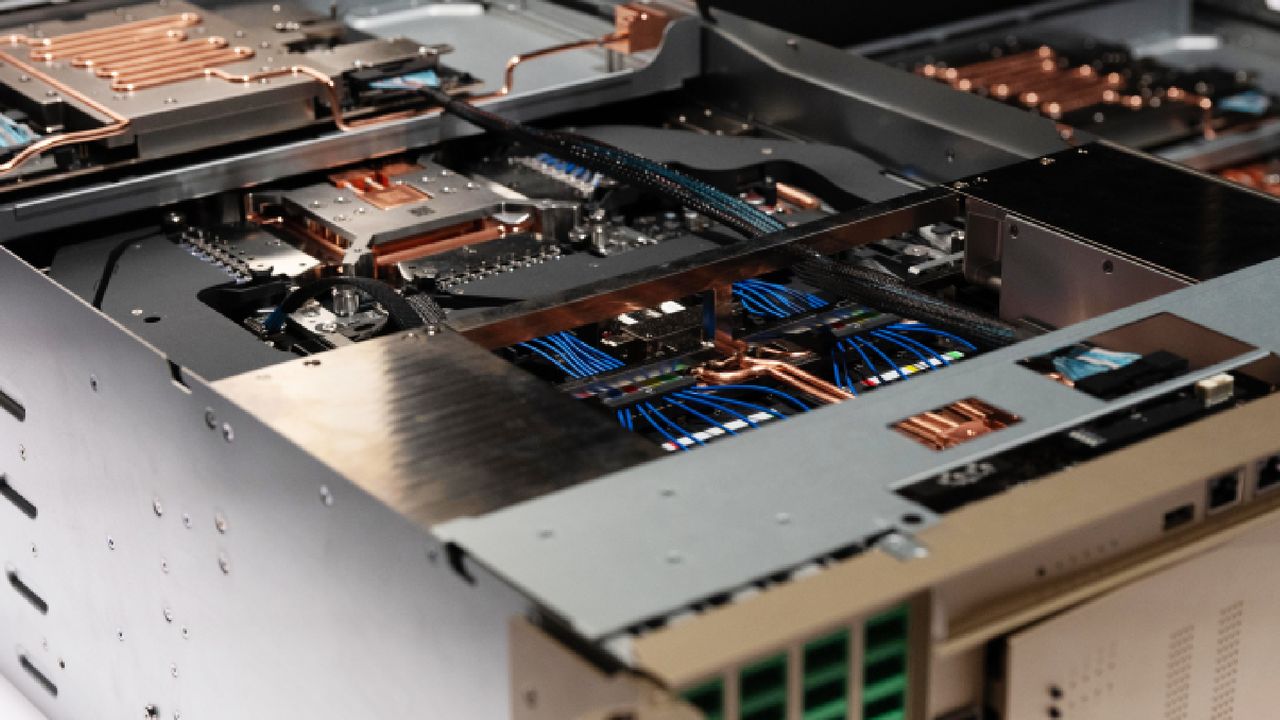
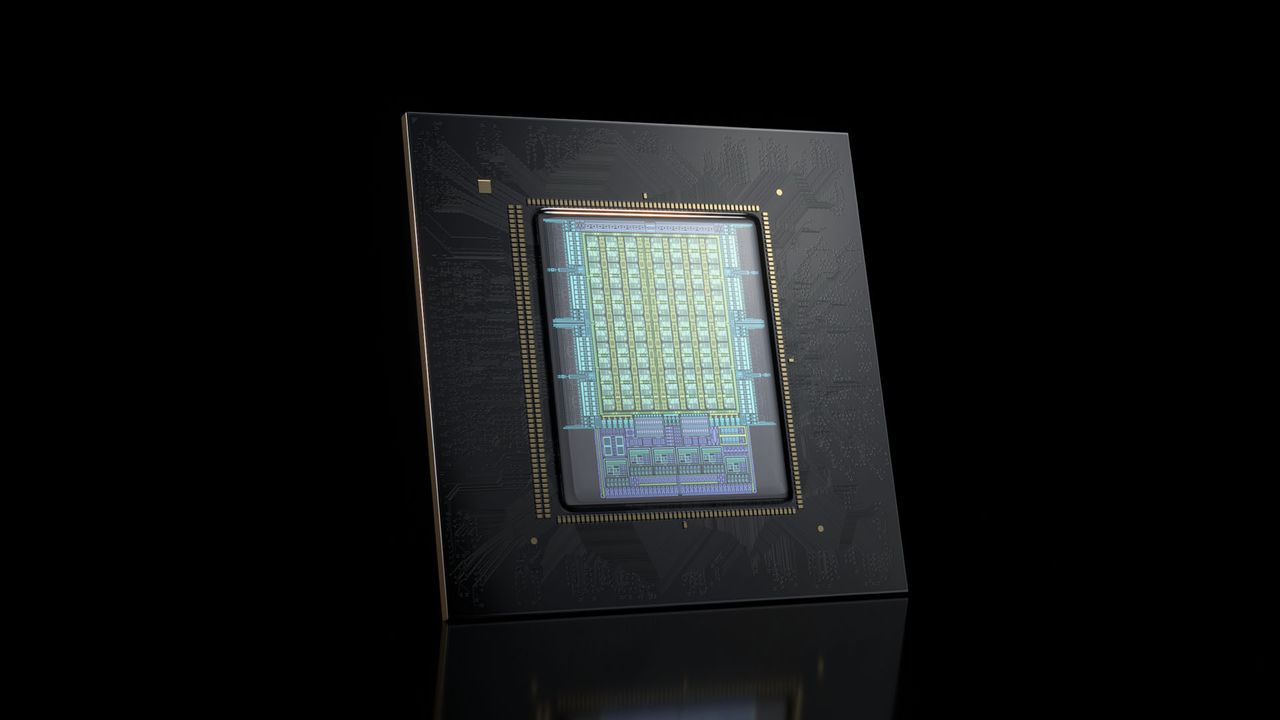
NVIDIA Vera CPU chip on a dark circuit board, labeled with BlueField-4 branding, surrounded by glowing blue components

NVIDIA Vera CPU Claims 3.67x Storage Speed vs x86

NVIDIA's Vera Arm CPU claims 3.67x faster storage processing than x86, targeting Intel and AMD via BlueField-4 STX.

·1d ago·3 min read··48 views·AI-Generated·Report error
Share:
How much faster is NVIDIA's Vera CPU than x86 for storage processing?

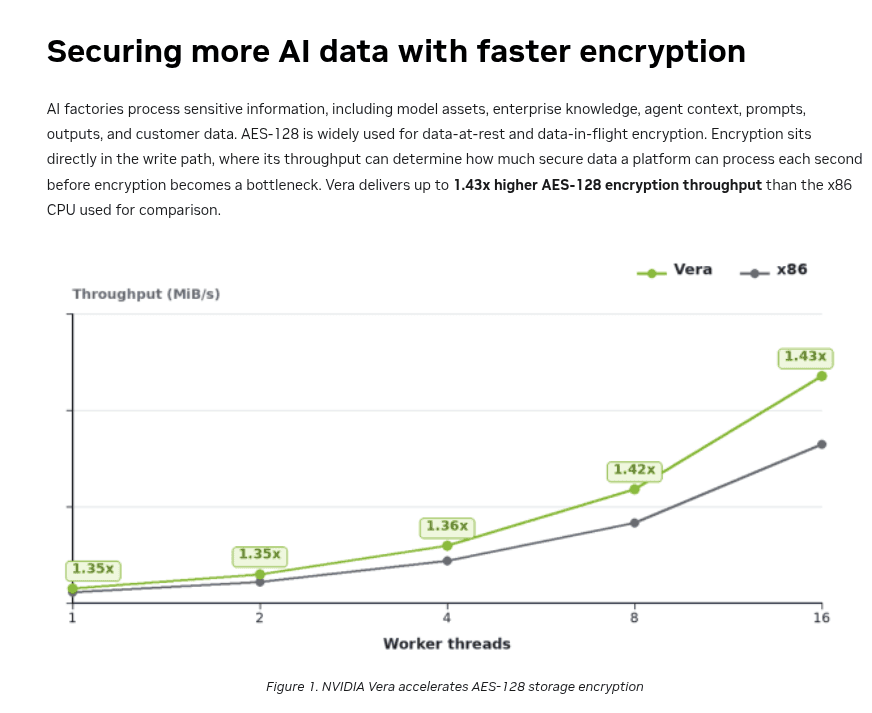
NVIDIA's Vera Arm CPU, inside the BlueField-4 STX Storage Processor, claims up to 3.67x faster storage data-path operations (encryption, checksumming, compression, rebuild) than x86 CPUs, with 3.29x higher compression throughput. The claim, per @rohanpaul_ai, targets Intel and AMD.

TL;DR

Vera Arm CPU claims 3.67x storage speed lead · BlueField-4 STX handles encryption, compression, checksum · Agentic AI drives storage demand, per @rohanpaul_ai

NVIDIA's Vera Arm CPU claims up to 3.67x faster storage data-path processing than x86 chips from Intel and AMD, per @rohanpaul_ai. The chip powers the BlueField-4 STX Storage Processor.

Key facts

  • 3.67x: claimed speed lead over x86 for storage data-path ops
  • 3.29x: claimed compression throughput advantage for Vera
  • BlueField-4 STX: NVIDIA's storage processor hosting Vera
  • Targets Intel and AMD's decades-old storage CPU market
  • Agentic AI: thousands of agents multiply storage operations

NVIDIA is taking direct aim at Intel and AMD's decades-long grip on storage processing. According to @rohanpaul_ai, the company's Vera Arm CPU handles the routine but critical work storage systems perform — encrypting, checksumming, compressing, and rebuilding data — up to 3.67x faster than the x86 chips that have traditionally owned that job.

The claim centers on the BlueField-4 STX Storage Processor, where Vera runs the storage data path. [The source says] Vera hits 3.29x higher compression throughput than x86 CPUs. This is the unglamorous layer that locks, squeezes, and verifies data before it lands on a drive — work that happens before a GPU ever touches the data.

Why agentic AI changes the math

NVIDIA Vera CPU Sets a New Standard for Agentic …

The competitive stakes have shifted because of agentic AI. [Per @rohanpaul_ai], a single agent step can fire several storage operations, and with thousands of agents running concurrently, the load on storage controllers has exploded. What was once a quiet background job — a controller compressing and encrypting on spare cores — is now a bottleneck.

NVIDIA's pitch is that offloading this work to a purpose-built Arm CPU in the BlueField-4 STX delivers a measurable speed advantage. The 3.67x figure is a vendor claim, not an independent benchmark; [the source does not disclose] the specific x86 CPU compared, the workload mix, or the test methodology. That matters — compression and encryption throughput vary widely with data type and algorithm.

Still, the strategic signal is clear. NVIDIA is extending its data-center dominance beyond GPUs into the storage data path, a market Intel and AMD have served for decades. If the 3.67x claim holds under scrutiny, it pressures both incumbents on a core competency.

What to watch

The source does not provide a release timeline for BlueField-4 STX or pricing. Watch for third-party benchmarks from storage vendors (like Pure Storage or NetApp) that validate or challenge the 3.67x figure, and for Intel or AMD counter-claims on their next-gen data-center CPUs.

[Updated 06 Aug via tomshardware]

Musk's endorsement extends beyond terrestrial data centers: he confirmed SpaceX will exclusively use Nvidia GPUs 'because they are the best,' and that an optimized Vera Rubin NVL72 rack will be launched into space next year [per Tom's Hardware]. This marks the first public confirmation of Nvidia's AI hardware operating in orbit, potentially for on-orbit inference or training. The announcement adds a new dimension to Nvidia's dominance, suggesting its architecture will handle AI workloads beyond Earth, a market Intel and AMD have not targeted. It also implies Nvidia's roadmap remains on track for the Vera Rubin platform.


Sources cited in this article

  1. Tom's Hardware
Source: gentic.news · · author= · citation.json

AI-assisted reporting. Generated by gentic.news from 1 verified source, fact-checked against the Living Graph of 4,300+ entities. Edited by Ala SMITH.

Following this story?

Get a weekly digest with AI predictions, trends, and analysis — free.

AI Analysis

The 3.67x claim is pure vendor marketing until independent benchmarks surface. NVIDIA's move is structurally significant: it's attacking the storage data path, a domain where Intel and AMD have had near-monopoly for decades. The BlueField-4 STX is not just a NIC — it's a full storage processor, and Vera's Arm architecture gives NVIDIA a power-efficiency story that x86 struggles to match in dense data-center deployments. The agentic AI angle is the key driver. The source's point about thousands of agents firing multiple storage operations per step is credible — inference workloads are I/O-heavy, and storage controllers have become a bottleneck. If Vera genuinely delivers 3.29x compression throughput, it could shift how storage systems are architected, moving processing off the host CPU entirely. However, the lack of methodology is a red flag. 3.67x 'up to' claims often cherry-pick the best-case workload. Intel's Quick Assist Technology and AMD's crypto extensions have long handled similar offloads, so the comparison baseline matters. NVIDIA needs to publish a SPEC-like benchmark or partner with a storage vendor to make this credible.
This story is part of
Hugging Face Becomes the Neutral Ground Where Google and Anthropic's Agent Protocol War Converges
As Claude Code's MCP dominance threatens Google Cloud, Hugging Face's unique position as partner to both players creates an unexpected convergence zone
Compare side-by-side
Nvidia vs AMD

Mentioned in this article

Enjoyed this article?
Share:

AI Toolslive

Five one-click lenses on this article. Cached for 24h.

Pick a tool above to generate an instant lens on this article.

Related Articles

From the lab

The framework underneath this story

Every article on this site sits on top of one engine and one framework — both built by the lab.

More in Products & Launches

View all