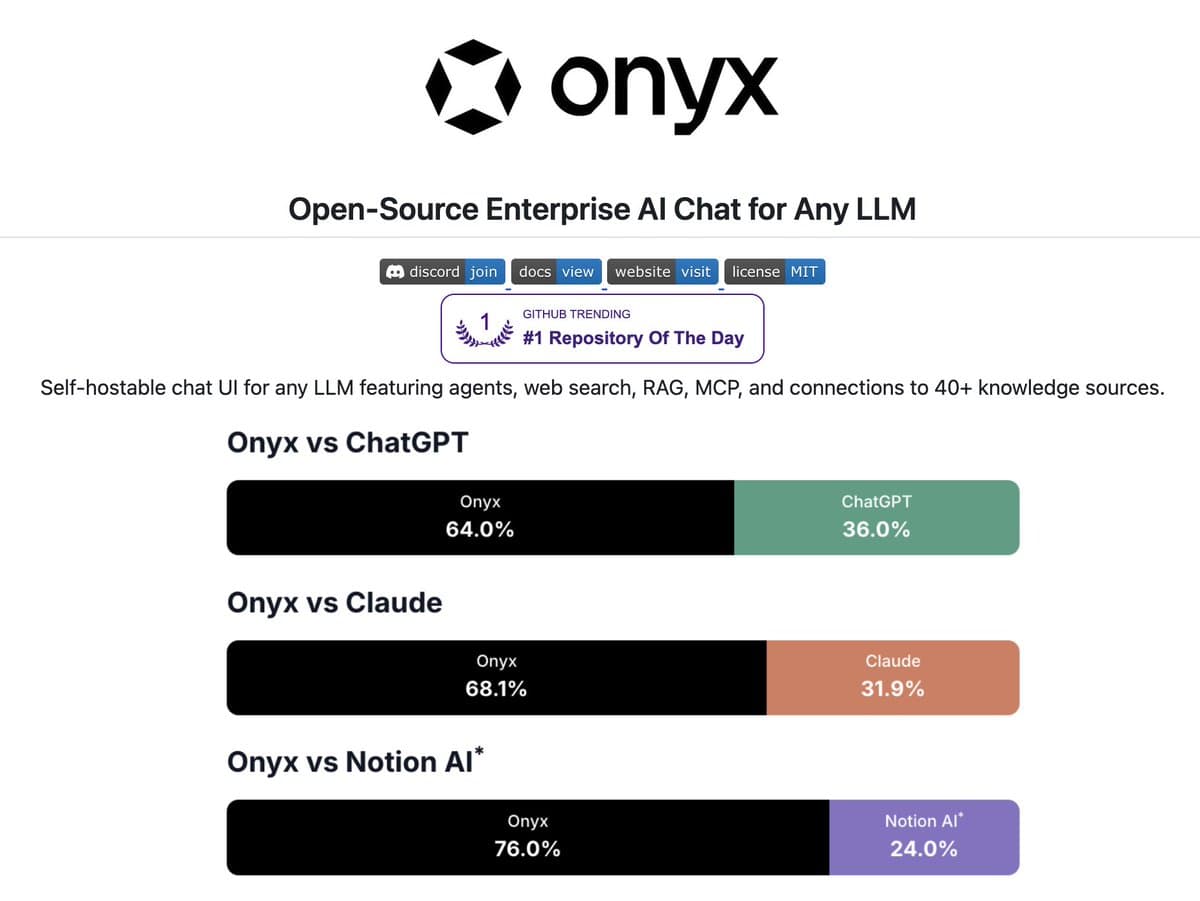
A new open-source project called Onyx is gaining rapid traction among developers looking for a self-hosted alternative to proprietary AI chat interfaces like Anthropic's Claude. The project, highlighted in a recent social media post, has amassed over 18,000 stars on GitHub and claims the top position on the DeepResearch Bench, a benchmark for AI research assistants.
What Is Onyx?
Onyx is a self-hostable chat application designed to work with virtually any large language model (LLM). Unlike closed platforms tied to a specific provider's API, Onyx gives developers and organizations full control by running on their own infrastructure. The core value proposition is providing a feature-rich, Claude-like user experience that is decoupled from any single model vendor.
Key Features and Capabilities
According to the announcement, Onyx ships with a suite of advanced capabilities typically found in premium, proprietary assistants:
- Multi-Agent Workflows: Supports the creation and orchestration of specialized AI agents.
- Retrieval-Augmented Generation (RAG): Enables the AI to pull information from private document stores and databases.
- Deep Research Mode: Facilitates complex, multi-step research tasks, likely involving web search and synthesis.
- Model Context Protocol (MCP) Support: Integrates with the emerging Model Context Protocol, a standard for connecting LLMs to tools and data sources.
- Extensive Connectivity: Connects to over 40 different data sources for RAG and research functionalities.
- Docker Deployment: Can be self-hosted via a Docker container, simplifying deployment and scaling.
The Benchmark Claim: #1 on DeepResearch Bench
The most notable claim is that Onyx is "Ranked No. 1 on DeepResearch Bench, above every proprietary alternative." The DeepResearch Bench appears to be a benchmark for evaluating AI systems on deep research tasks. If validated, this suggests that an open-source, self-hostable interface stack—when combined with a capable underlying LLM—can match or exceed the performance of integrated commercial products like Claude, ChatGPT, or Gemini in specific research-oriented workflows. The announcement does not specify which underlying LLM was used to achieve this score.
Getting Started
For developers interested in trying Onyx, the project is available on GitHub. The recommended deployment method is via Docker, which packages the application and its dependencies into a container for easy installation. The source tweet links to the project's repository for further details and setup instructions.
gentic.news Analysis
The rapid rise of Onyx (18k+ stars) is a clear signal of strong developer demand for decentralized, model-agnostic AI interfaces. This trend directly challenges the "walled garden" approach of major AI labs. Developers and enterprises are increasingly seeking to separate the user interface and agentic workflow layer from the underlying LLM, avoiding vendor lock-in and enabling them to swap models as the field evolves.
This development is part of a broader movement we've been tracking. It follows the significant momentum behind projects like OpenWebUI (formerly Ollama WebUI) and the Continue.dev VS Code extension, which also offer open-source, locally-hosted interfaces for various LLMs. The claim of topping the DeepResearch Bench is particularly intriguing. It implies that the quality of the orchestration layer—the tools, RAG pipeline, and agent logic—can be a decisive factor in performance, sometimes rivaling or surpassing the advantages of a tightly integrated, proprietary model. This aligns with our previous coverage on the growing importance of evaluation frameworks for compound AI systems, where the benchmark isn't just the raw model, but the entire applied stack.
For practitioners, Onyx represents a compelling option for building internal AI copilots or research tools. Its modularity means teams can start with a powerful open-source model like Llama 3 or Command R+ and later integrate a commercial API for specific tasks without changing the front-end. The key question for adoption will be the maturity of its deployment, security, and user management features for enterprise settings, areas where proprietary platforms currently invest heavily.
Frequently Asked Questions
What is the DeepResearch Bench?
The DeepResearch Bench is a benchmark designed to evaluate AI systems on their ability to perform deep, multi-step research tasks. It likely tests capabilities like information gathering from multiple sources, synthesis, reasoning, and citation. Onyx's claim of being ranked #1 suggests its combination of interface, agent logic, and RAG capabilities performs well on this specific metric when paired with a capable LLM.
How does Onyx compare to OpenWebUI (Ollama WebUI)?
Both Onyx and OpenWebUI are popular open-source, self-hostable chat interfaces for LLMs. The key differentiator appears to be Onyx's stronger emphasis on built-in advanced agent workflows and deep research capabilities out of the box. OpenWebUI is often praised for its simplicity and clean UI for interacting with local models via Ollama. Onyx seems positioned as a more feature-complete, Claude-like alternative focused on complex task performance.
Can I use Onyx with OpenAI's GPT-4 or Anthropic's Claude?
Yes, in principle. As a model-agnostic interface, Onyx should be able to connect to the APIs of commercial providers like OpenAI, Anthropic, or Google. However, the core value proposition is self-hosting and avoiding reliance on external APIs. Using it with a proprietary API would still involve costs and data privacy considerations associated with that API, though you would retain control over your data pipeline and interface.
Is Onyx really better than Claude?
The claim is nuanced. Onyx is an interface and agent framework, while Claude is an integrated model and product. The benchmark claim suggests that the Onyx system (interface + agents + RAG + a capable LLM) can outperform the integrated Claude product on the specific DeepResearch Bench. This does not mean the underlying open-source LLM powering Onyx is necessarily more capable than the Claude 3 model family at all tasks. It highlights that for complex research workflows, a well-orchestrated open-source stack can be highly competitive.