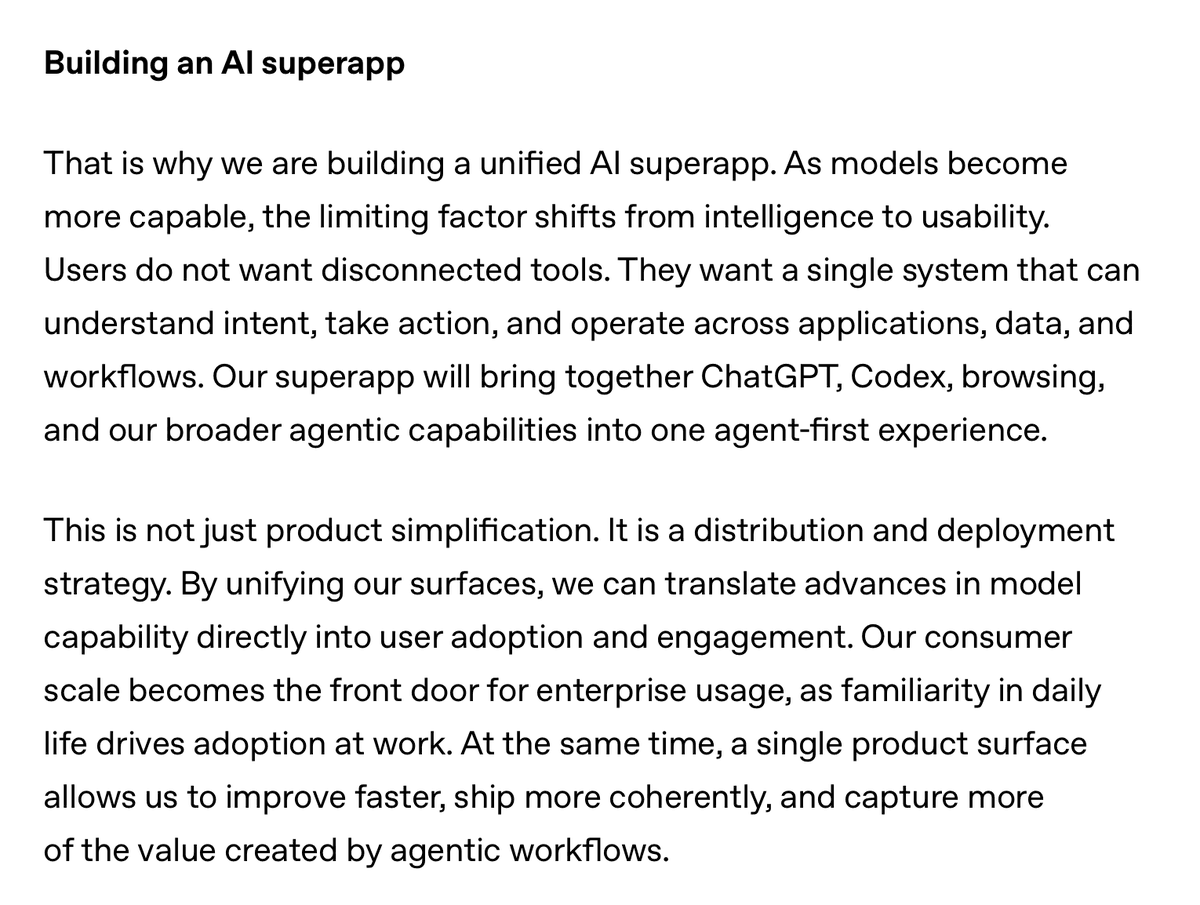
In a strategic announcement, OpenAI has articulated a vision for the future of its product ecosystem, moving away from a collection of discrete AI tools toward a single, integrated "AI superapp." The company stated that the future is not a suite of separate applications but a unified platform where core technologies like ChatGPT, Codex, browsing capabilities, and other agentic systems work cohesively as one.
What OpenAI Announced
The announcement, shared via social media, is a statement of product philosophy and strategic direction rather than a detailed technical launch. OpenAI's core argument is that the current paradigm of accessing different AI models or tools for different tasks—a chat interface here, a code-completion plugin there—is suboptimal. The proposed alternative is a single application experience that seamlessly blends these capabilities.
This would mean a user could, within one interface, transition from having a natural language conversation (ChatGPT), to generating and debugging code (Codex), to performing web-augmented research (browsing), all orchestrated by underlying "agentic systems" that can execute multi-step tasks. The goal is to reduce friction and context-switching for the end-user.
The Strategic Ambition: From Consumer Scale to Enterprise Core
More significant than the product vision is the stated strategic ambition behind it. OpenAI explicitly aims to "turn consumer scale into enterprise dominance." The wildly successful consumer adoption of ChatGPT, which reached 100 million weekly active users in late 2023, provides a massive foundation of user data, feedback, and brand recognition.
The company's play is to leverage this scale to position itself as "core infrastructure for the age of AI." For enterprises, the promise is a single, robust, and deeply integrated AI platform from a proven vendor, reducing the complexity of managing multiple AI API contracts and point solutions. This move directly challenges the strategy of offering best-of-breed, specialized models and tools from various providers, pushing instead for consolidation under the OpenAI ecosystem.
The Competitive and Technical Landscape
This vision places OpenAI in direct competition on multiple fronts:
- Integrated AI Platforms: Competitors like Google's Gemini ecosystem (spanning Workspace, Search, and Vertex AI) and Microsoft's Copilot stack (GitHub, Microsoft 365, Windows) are pursuing similar unification, often with deeper native integration into existing enterprise software suites.
- Best-of-Breed Providers: Companies like Anthropic (Claude for reasoning), Perplexity (search), and specialized coding assistants will argue that focused, superior models outperform a generalized "superapp."
- Open-Source & Self-Hosted: The thriving open-source model ecosystem (via Hugging Face, Meta's Llama, etc.) offers enterprises an alternative path to avoid vendor lock-in to any single "core infrastructure" provider.
Technically, building a true superapp requires solving significant challenges in model orchestration, context management across different modalities (text, code, web), and maintaining performance and reliability as complexity increases. It also implies a move further towards agentic workflows, where the AI can autonomously decide which tool or capability to use to accomplish a user's goal.
What This Means for Developers and Enterprises
For developers building on OpenAI's APIs, this signals a likely future where the platform offers more high-level, agentic APIs that bundle multiple capabilities, rather than just individual model endpoints. The economic and lock-in implications are substantial; becoming "core infrastructure" means becoming deeply embedded and difficult to replace.
Enterprises evaluating AI strategies must now consider the trade-off between the convenience and potential power of a unified OpenAI stack versus the flexibility and risk mitigation of a multi-vendor approach. OpenAI's bet is that the former will be overwhelmingly attractive.
gentic.news Analysis
This announcement is a logical, aggressive next step in OpenAI's evolution from a research lab to a dominant platform company, a trajectory we have been tracking closely. It follows the company's series of major model releases and platform expansions throughout 2024 and 2025, including the integration of advanced voice and video modalities into ChatGPT and the expansion of its custom GPT store. The vision of an "AI superapp" directly aligns with and accelerates the trend toward AI agentic workflows we highlighted in our analysis of OpenAI's "Strawberry" project and Google's Astra, where the AI moves from a reactive tool to a proactive assistant capable of complex task execution.
The strategy to convert consumer scale into enterprise dominance mirrors the playbooks of major tech platforms like Microsoft, Apple, and Google. However, it faces a formidable and well-entrenched competitor in Microsoft, a key investor and partner. Microsoft's own Copilot ecosystem, deeply woven into Azure, GitHub, and Office, represents an alternative, software-native path to the same goal of being enterprise AI infrastructure. This announcement may signal a subtle but significant shift in the OpenAI-Microsoft relationship, from pure partnership to increased co-opetition, as both vie to be the primary AI layer for businesses.
Furthermore, this move contradicts the emerging trend of specialization and decentralization in the AI market, where smaller, fine-tuned models often outperform larger generalist ones on specific tasks. OpenAI is betting that the convenience of a single, powerful, generalist platform will outweigh the performance benefits of a specialized toolkit for most enterprises—a bet that is not yet proven. Our previous coverage of Anthropic's focus on safety and reasoning and the rise of efficient open-source models shows the market is developing strong alternatives. OpenAI's success hinges on executing this technical integration flawlessly and continuing to demonstrate unmatched general capability across domains.
Frequently Asked Questions
What is an AI superapp?
An AI superapp is a conceptual single application that integrates multiple, currently separate AI capabilities—like conversational chat, code generation, web browsing, data analysis, and task automation—into one seamless user interface. Instead of switching between ChatGPT for conversation, a separate IDE plugin for coding, and a web search, a user would interact with one AI agent that can understand and utilize all these functions contextually.
How is this different from what ChatGPT can do now?
Currently, ChatGPT, especially with plugins or Advanced Data Analysis, can perform some multi-function tasks. However, the experience is often segmented. The "superapp" vision implies a deeper, more native integration where the boundaries between a language model, a code interpreter, a browsing agent, and an automation engine dissolve. The AI would more autonomously decide which capability to use to solve a problem without explicit user direction to switch modes.
Does this mean OpenAI's individual APIs (like GPT-4, Codex) will go away?
Not immediately, and likely not entirely for a long time. The announcement is a vision for a flagship product experience. Developers and enterprises will probably continue to have access to individual APIs for the foreseeable future. However, the strategic direction suggests OpenAI will increasingly promote and develop higher-level, unified APIs that bundle capabilities, making the superapp functionality available to developers building their own applications.
Who are OpenAI's main competitors in building an AI superapp?
OpenAI's primary competitors in this consolidated platform race are Google, with its Gemini models integrated into Workspace, Search, and Android, and Microsoft, with its Copilot ecosystem built into Windows, Office 365, and GitHub. Other competitors include Anthropic, which is focusing on secure, enterprise-ready agentic systems with Claude, and Amazon, which is integrating its Titan models and Claude through AWS Bedrock to offer a unified enterprise AI suite.