OpenAI has released its internal Agents software development kit (SDK) as an open-source project. The framework, which has already garnered over 18.9k stars on GitHub, is positioned as a clean, minimalist alternative to what the developer community describes as "bloated" agent frameworks.
The release marks a significant shift in OpenAI's strategy regarding its agent tooling, moving from a closed, API-centric approach to providing open-source infrastructure for multi-agent development.
Key Takeaways
- OpenAI has open-sourced its internal Agents SDK, a lightweight framework for building multi-agent systems.
- It features three core primitives, works with over 100 LLMs, and has gained 18.9k GitHub stars immediately.
What's New: A Minimalist Framework for Multi-Agent Systems
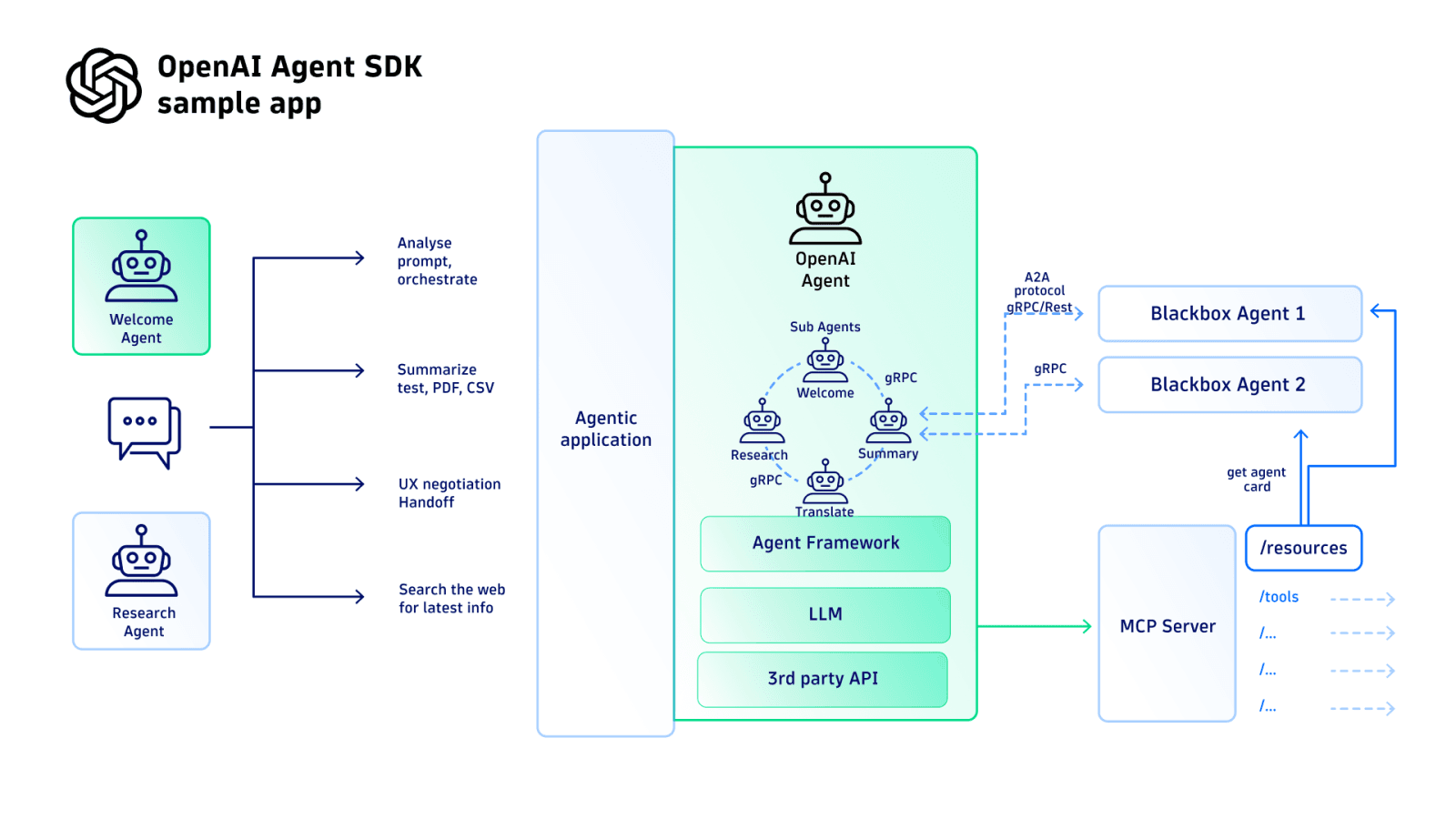
The SDK is built around three core primitives, designed to cover the essential components of agentic workflows:
- Agents: Defined as a combination of an LLM, tools, and guardrails.
- Handoffs: A mechanism to route tasks and context between different agents in a workflow.
- Tracing: Built-in debugging and observability to track every step of an agent's execution.
A key differentiator is its model-agnostic design. While developed internally at OpenAI, the SDK is engineered to work with over 100 different large language models, not just OpenAI's own GPT family. This positions it as a general-purpose orchestration layer.
Technical Details: Built for Simplicity and Control
The framework emphasizes developer experience with minimal boilerplate. As highlighted in the announcement, a "hello world" agent can be built in approximately four lines of code, while a multi-agent handoff scenario requires around twenty lines.
For state management, the SDK includes built-in session memory with support for SQLite (for local development and simple deployments) and Redis (for production-scale, distributed systems). This abstracts away the manual management of conversation history, a common pain point in agent development.
The open-source repository includes the core library, comprehensive documentation, and example projects to demonstrate workflows ranging from single agents to complex, multi-agent systems with sequential and conditional handoffs.
How It Compares: Positioning Against the Agent Framework Landscape
The release enters a crowded market of open-source agent frameworks, including LangChain, LlamaIndex, AutoGen, and CrewAI. OpenAI's offering distinguishes itself through a deliberate philosophy of minimalism and a focused API.
OpenAI Agents SDK OpenAI Minimalist primitives (Agent, Handoff, Trace) 100+ (Model-agnostic) LangChain LangChain, Inc. Comprehensive toolchain & integrations 100+ AutoGen Microsoft Conversational multi-agent systems Primarily OpenAI, some open models CrewAI CrewAI Inc. Role-based collaborative agents 100+By open-sourcing its internal toolkit, OpenAI provides a reference implementation that reflects its own engineering patterns for agentic AI. The immediate surge in GitHub stars suggests strong developer interest in an opinionated, production-ready framework from a leading AI lab.
What to Watch: Adoption and Ecosystem Development
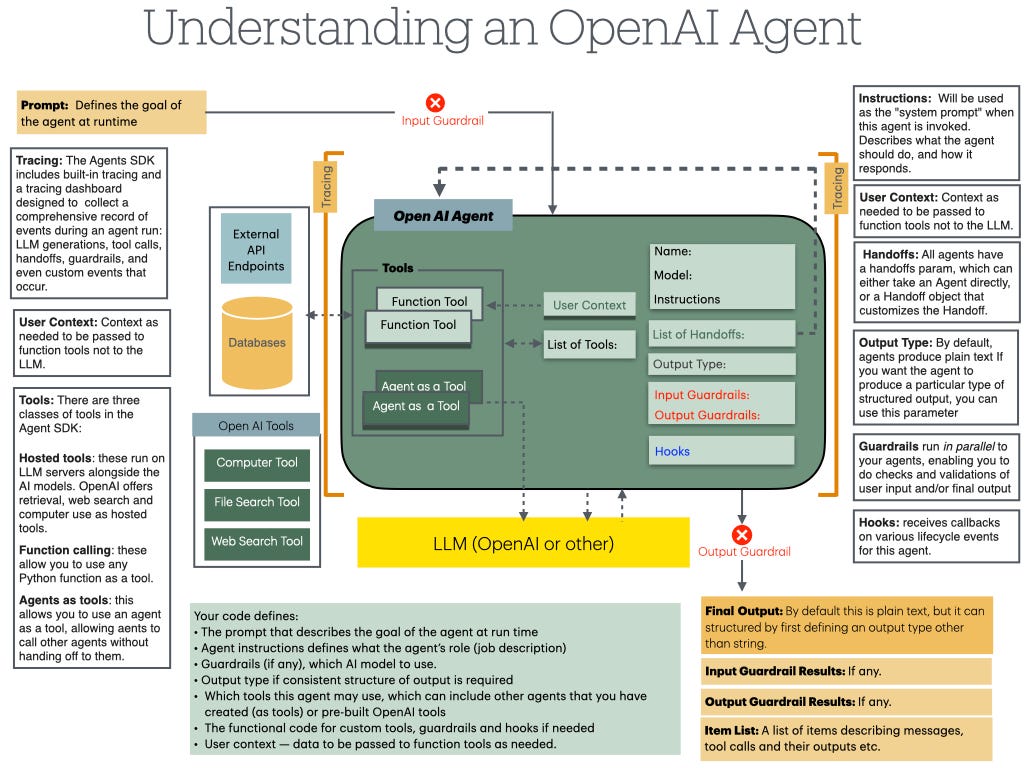
The long-term impact will depend on community adoption and the evolution of the ecosystem. Key questions include:
- Integration Depth: How well will it integrate with existing MLops tools for monitoring, evaluation, and deployment?
- Cloud Service Tie-in: While open-source, will OpenAI offer a managed cloud version or enhanced features through its API platform?
- Community Contributions: Will the minimalist core be extended by community-contributed tools, agents, and integrations, or will it remain a tightly curated project?
For developers, the SDK offers a streamlined path to experiment with multi-agent architectures, especially those already using OpenAI models. Its model-agnostic nature also lowers the barrier to testing different LLM backends within the same orchestration logic.
gentic.news Analysis
This move is a notable strategic pivot for OpenAI. Historically, the company's monetization has been tightly coupled with its proprietary API. Releasing a core piece of its agent infrastructure as open-source and model-agnostic software suggests a broader platform play. It aims to become the default orchestration layer for agentic AI, regardless of the underlying model provider. This can be seen as a defensive move against the rise of powerful open-weight models from entities like Meta (Llama) and Mistral AI, which are increasingly used in agentic workflows through other frameworks.
The timing is significant. The AI industry is in a consolidation phase for agent frameworks, with developers fatigued by complexity. OpenAI is betting that its credibility and this minimalist approach will attract developers who want "just the essentials" without the overhead of larger, more opinionated frameworks. This follows a pattern of AI labs open-sourcing key infrastructure—such as PyTorch (Meta) or JAX (Google)—to drive ecosystem growth and establish de facto standards.
However, it also creates a fascinating competitive dynamic. The SDK will directly compete with frameworks from partners and integrators in the OpenAI ecosystem. Its success could reshape the agent tooling landscape, potentially simplifying it but also centralizing design patterns around OpenAI's architectural preferences.
Frequently Asked Questions
What is the OpenAI Agents SDK?
The OpenAI Agents SDK is an open-source framework released by OpenAI for building applications using AI agents. It provides minimalist, core components for creating single or multi-agent systems that can use over 100 different large language models.
How is this different from LangChain or LlamaIndex?
The primary difference is philosophical and architectural. The OpenAI SDK is built around three minimal primitives (Agent, Handoff, Trace) and aims for extreme simplicity with very little boilerplate code. Frameworks like LangChain offer a much broader, more comprehensive set of tools and integrations for building LLM applications, which can lead to more complexity.
Do I need an OpenAI API key to use the Agents SDK?
No. A major feature of the open-sourced SDK is that it is model-agnostic. While it works seamlessly with OpenAI's models, it is designed to support LLMs from many providers, including open-weight models you might run locally.
What are the main use cases for this SDK?
The SDK is designed for building agentic AI applications where tasks are automated through one or more LLM-powered agents. Use cases include automated customer support workflows, multi-step research and data analysis, content generation pipelines, and complex coding assistants that hand off subtasks between specialized agents.