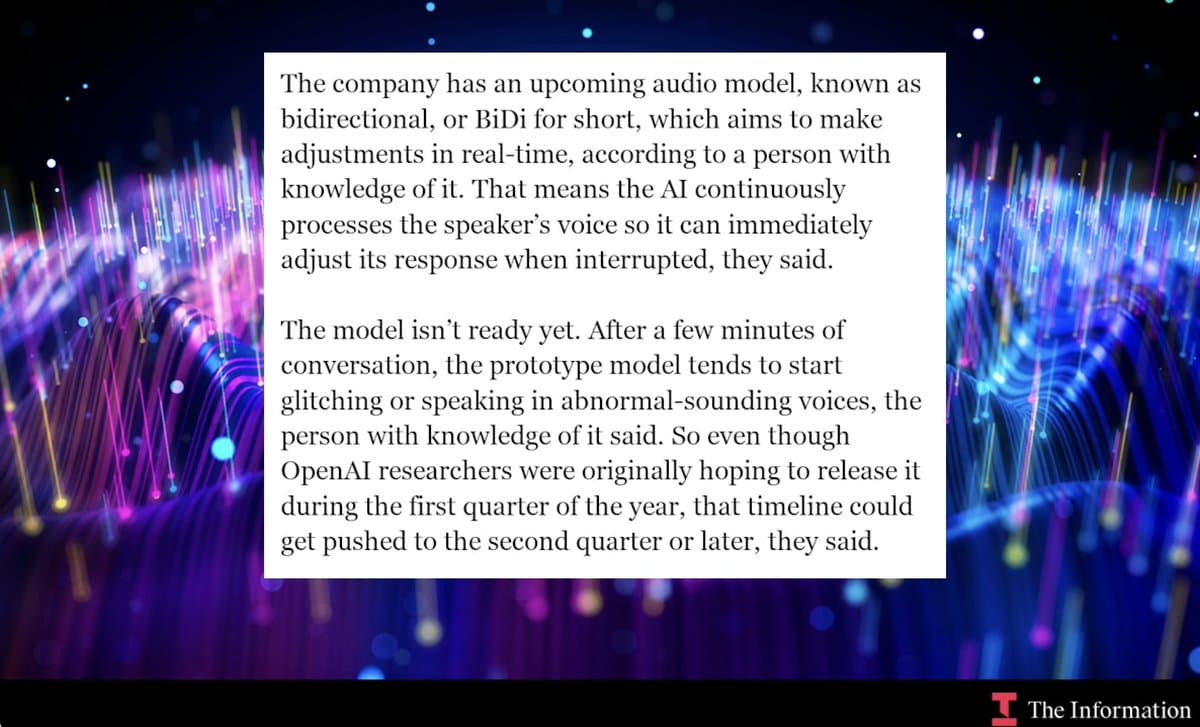
OpenAI is quietly developing a groundbreaking bidirectional (BiDi) audio model that promises to fundamentally transform how humans interact with artificial intelligence through voice. According to recent reports, this technology represents a significant leap beyond today's turn-based voice systems, potentially making AI conversations feel remarkably natural and fluid.
The Limitations of Current Voice AI
Today's voice assistants and conversational AI systems operate on a simple premise: they wait for users to finish speaking, process the complete utterance, and then generate a response. This turn-based approach creates the familiar robotic cadence of interactions with Siri, Alexa, or even OpenAI's own Voice Mode for ChatGPT. The systems cannot adjust mid-response, cannot handle interruptions gracefully, and generally lack the conversational fluidity that characterizes human dialogue.
This technological limitation creates what researchers call "conversational latency" - the awkward pauses and rigid structure that remind users they're speaking with a machine rather than a human. In practical applications, this leads to frustrating customer service experiences, inefficient voice-controlled interfaces, and limited adoption of voice technology for complex tasks.
How Bidirectional Audio Changes Everything
OpenAI's bidirectional audio model operates on a fundamentally different principle. Instead of waiting for complete utterances, the system continuously processes speech in real-time, allowing it to adapt instantly as conversations evolve. This means the AI can:
- Detect when users interrupt or change direction mid-sentence
- Adjust its responses dynamically based on new information
- Maintain conversational flow without artificial pauses
- Handle overlapping speech more naturally
Technically, this requires sophisticated audio processing that can parse partial utterances while simultaneously generating appropriate responses. The system must maintain context across fragmented inputs and outputs, a challenge that has eluded previous voice AI implementations.
Development Timeline and Current Status
According to sources familiar with the project, OpenAI had initially targeted a Q1 release for this technology but has encountered technical hurdles that have pushed the timeline to Q2 or later. The prototype reportedly "still glitches after a few minutes" of continuous conversation, suggesting that while the core bidirectional capability exists, stability and reliability remain significant challenges.
This delay is not surprising given the complexity of the technology. Real-time bidirectional audio processing requires substantial computational resources, sophisticated noise filtering, and robust error handling - all while maintaining the quality of responses users expect from OpenAI's models.
Practical Applications and Industry Impact
The implications of successful bidirectional audio technology are profound across multiple sectors:
Customer Support Transformation: Customer service bots could handle complex, multi-turn conversations without frustrating pauses or misunderstandings. This could dramatically reduce call center costs while improving customer satisfaction.
Voice Assistant Evolution: Smart speakers and voice assistants could become truly conversational partners rather than simple command processors. Users could have fluid discussions about scheduling, information retrieval, or creative tasks.
Accessibility Advancements: For users with disabilities who rely on voice interfaces, more natural conversation flows could significantly improve usability and independence.
Smart Device Integration: IoT devices could handle complex voice commands more reliably, from adjusting home environments to managing personal schedules.
Enterprise Applications: Internal business tools could incorporate voice interfaces for complex workflows like data analysis, report generation, or project management.
Technical Challenges and Ethical Considerations
Developing reliable bidirectional audio presents several significant challenges:
Computational Demands: Continuous audio processing requires substantial processing power, potentially limiting deployment to cloud-based solutions or high-end devices.
Privacy Concerns: Always-listening systems raise legitimate privacy questions that must be addressed through transparent data handling policies and robust security measures.
Error Propagation: In continuous conversation, misunderstandings could compound more rapidly than in turn-based systems, requiring sophisticated error correction mechanisms.
Cultural Adaptation: Natural conversation varies significantly across cultures and languages, presenting localization challenges for global deployment.
Competitive Landscape
OpenAI is not alone in pursuing more natural voice interfaces. Google has demonstrated similar capabilities with its Gemini models, while companies like Hume AI are focusing specifically on emotionally intelligent voice interactions. Apple and Amazon continue to invest heavily in their respective voice platforms, though neither has publicly demonstrated bidirectional capabilities at OpenAI's reported level.
The race toward natural voice AI represents a critical battleground in the broader AI competition, as voice remains one of the most intuitive interfaces for human-computer interaction.
The Future of Human-AI Interaction
If successfully deployed, bidirectional audio could represent the most significant advancement in voice interfaces since the introduction of digital assistants. The technology moves us closer to the science fiction ideal of computers that understand and respond to human speech as naturally as other humans do.
However, this advancement also raises important questions about the nature of human-machine relationships. As AI becomes more conversational, users may develop different expectations and attachments to these systems, potentially blurring lines between tool and companion.
For OpenAI, the bidirectional audio project represents both a technical challenge and a strategic opportunity. Voice interfaces could become a primary gateway to AI services, and mastering this modality could determine which companies lead the next phase of AI adoption.
Source: Based on reporting from @kimmonismus and analysis of current voice AI capabilities.