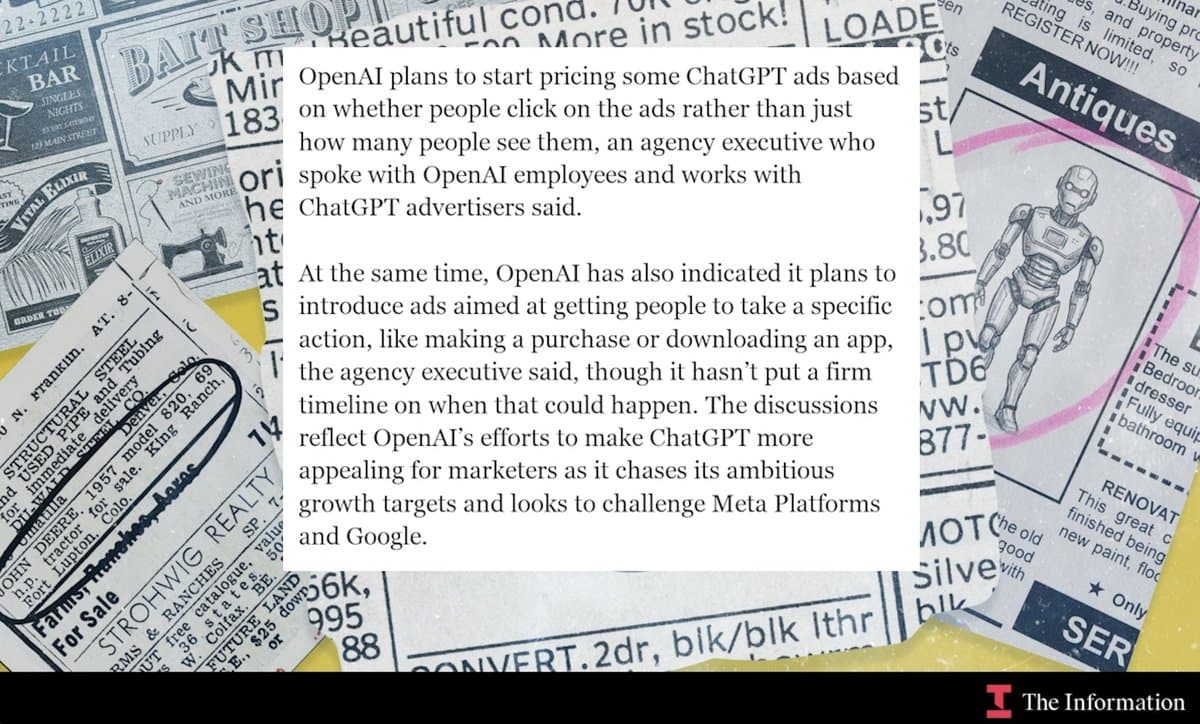
OpenAI is fundamentally restructuring its advertising strategy within ChatGPT, moving beyond experimental brand campaigns toward a full-scale performance marketing platform that could eventually compete with Google and Meta. According to industry reports, the company is transitioning from simple impression-based pricing to cost-per-click (CPC) models and exploring conversion-driven ads designed to trigger specific user actions like purchases or app installs.
Key Takeaways
- OpenAI is restructuring ChatGPT advertising, moving from impression-based pricing to cost-per-click and conversion-driven models.
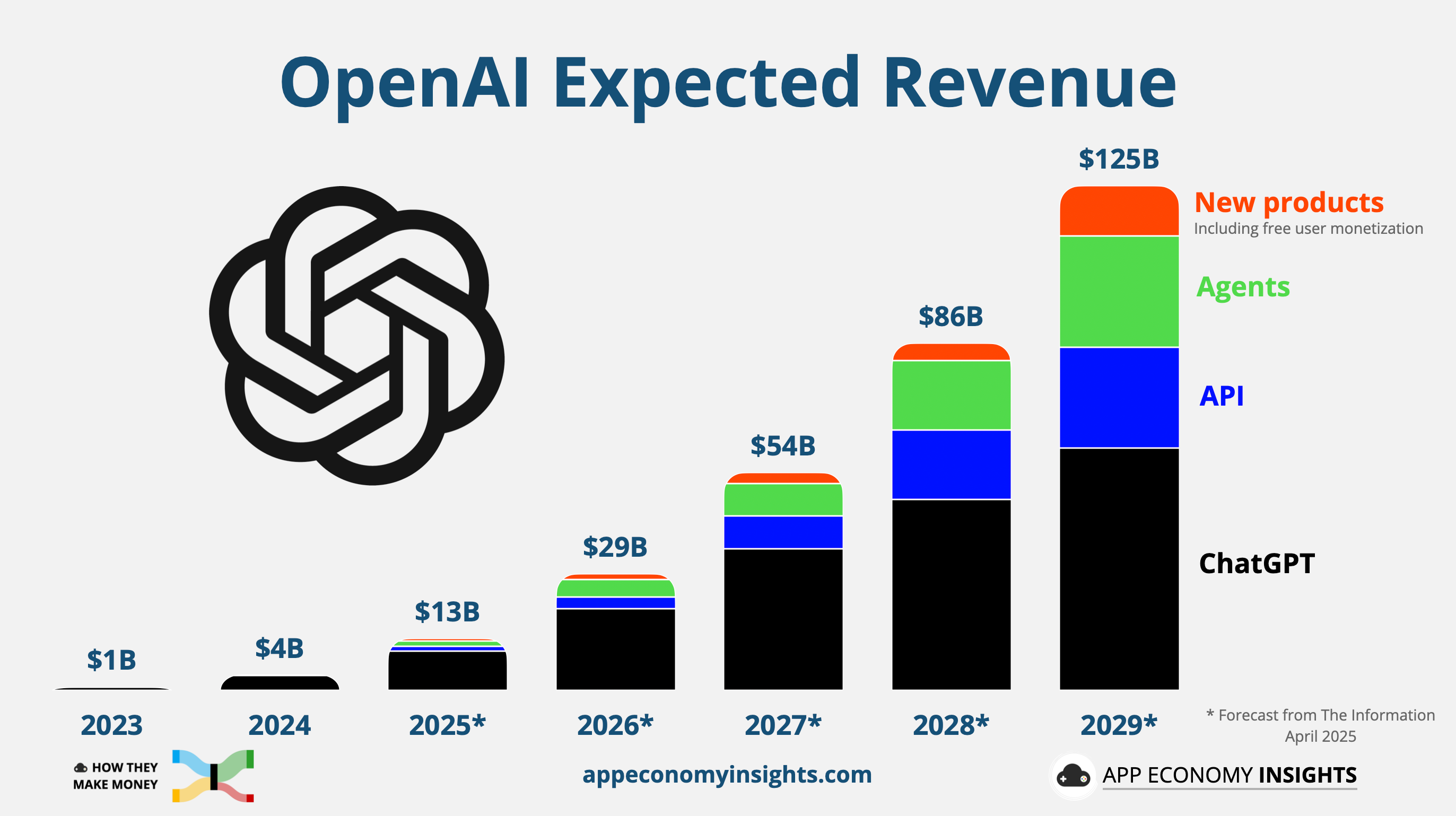
- This shift aims to compete directly with Google and Meta in intent-based advertising, targeting $2.4B revenue this year and $11B by 2027.
What's Changing: From Brand Awareness to Performance Marketing

The shift represents a significant strategic pivot. Initially, ChatGPT ads operated on a traditional CPM (cost-per-thousand impressions) model, similar to digital billboards—advertisers paid for visibility regardless of user engagement. Now, OpenAI is implementing:
- Cost-per-click (CPC) pricing: Advertisers pay only when users actively engage with ads
- Conversion-driven formats: Ads designed to trigger specific actions (purchases, sign-ups, installs)
- Intent-based targeting: Leveraging ChatGPT's unique position atop user queries to match ads with demonstrated intent
This transition moves ChatGPT advertising from "experimental brand visibility" to what industry analysts call "full-scale performance marketing"—the high-stakes arena where Google Search and Meta's platforms generate most of their revenue.
The Current Reality: Ambitious Targets Meet Market Realities
Despite ambitious revenue targets—$2.4 billion for 2026 and $11 billion by 2027—the ChatGPT ad market remains early and uneven. Several challenges have emerged:
Pricing Pressure: CPM rates have dropped significantly from initial targets around $60 to current ranges of $15–25, reflecting both market forces and advertiser caution.
Inventory Limitations: OpenAI is reportedly struggling to spend allocated advertiser budgets due to limited ad inventory within ChatGPT's interface, suggesting either conservative ad placement or lower-than-expected user engagement with ads.
Measurement Gaps: The core bottleneck remains attribution and control. Advertisers lack visibility into who sees their ads and whether those views convert to meaningful actions, making performance evaluation difficult.
Technical Implications: The Measurement Challenge
The success of OpenAI's advertising pivot hinges on solving measurement infrastructure—a non-trivial technical challenge in ChatGPT's conversational context. Unlike traditional search ads where clicks are straightforward events, ChatGPT interactions are multi-turn conversations where "conversion" might occur across multiple exchanges.
Key technical hurdles include:
- Attribution modeling: Determining which ad exposure led to which user action in a conversational flow
- Privacy-preserving measurement: Tracking effectiveness while maintaining ChatGPT's privacy standards
- Intent classification: Accurately categorizing user queries to match with relevant advertisers
- Ad relevance scoring: Ensuring ads enhance rather than disrupt the conversational experience
Competitive Landscape: Taking on Google and Meta
OpenAI's move positions ChatGPT as a potential competitor in the intent-driven advertising market dominated by:
Google Search ~$200B Pure intent capture (users typing queries) Meta Platforms ~$150B Social graph + interest targeting ChatGPT (Projected 2027) $11B Conversational intent + assistance contextChatGPT's unique advantage is its position at the "top of the intent funnel"—users often come with specific needs or questions, creating opportunities for highly relevant ad matching. However, Google has decades of experience in intent classification and auction mechanics, while Meta excels at cross-platform attribution.
What This Means for Advertisers
For brands and performance marketers, the ChatGPT advertising evolution presents both opportunity and uncertainty:
Early Advantages: First movers may benefit from lower costs and less competition during the platform's development phase.
Testing Imperative: The shift to performance-based pricing makes experimentation more feasible—advertisers can test with lower financial risk.
Creative Adaptation: Ad formats will need to evolve beyond traditional display units to integrate naturally within conversational flows.
Measurement Investment: Advertisers should prepare to develop new attribution frameworks specific to conversational AI contexts.
The Road Ahead: Can OpenAI Build an Ad Engine?
The fundamental question is whether OpenAI—a company built on AI research—can develop the sophisticated auction systems, measurement tools, and advertiser interfaces that power modern digital advertising. The technical challenges extend beyond AI into distributed systems, real-time bidding, and privacy-preserving analytics.
If successful, ChatGPT could become what analysts describe as "one of the most powerful ad platforms ever built" because it sits directly atop user intent with context that search engines can't access. But the $11 billion 2027 target suggests OpenAI needs to scale this business 5x in just two years—an aggressive timeline given current market adoption rates.
gentic.news Analysis
This advertising pivot follows OpenAI's broader monetization strategy that began with ChatGPT Plus subscriptions in February 2023 and the launch of the GPT Store in January 2024. The move toward performance advertising aligns with the company's need to diversify beyond enterprise API revenue, especially as inference costs remain high and competitive pressure increases from open-source alternatives and well-funded rivals like Anthropic and Google's Gemini.
Historically, OpenAI has approached business model development cautiously—the initial CPM-based ads were clearly experimental, testing advertiser interest without overcommitting engineering resources. The shift to CPC suggests confidence in both user engagement metrics and advertiser demand, though the reported CPM declines indicate the market isn't yet valuing ChatGPT inventory at premium rates.
What's particularly notable is the timing. With Google recently announcing enhanced Gemini integrations across its advertising stack and Meta advancing its AI-powered ad tools, OpenAI is entering a competitive space where measurement sophistication matters as much as AI capabilities. The company's success may depend less on ChatGPT's conversational excellence and more on its ability to build the unglamorous infrastructure of modern ad tech—attribution systems, auction mechanics, and advertiser dashboards.
This development also reflects a broader trend we've covered: AI companies transitioning from pure research organizations to diversified businesses. As we reported in November 2025, Anthropic similarly expanded its enterprise offerings beyond basic API access. The race is no longer just about model capabilities but about building sustainable revenue engines in increasingly crowded markets.
Frequently Asked Questions
What is cost-per-click (CPC) advertising in ChatGPT?
CPC means advertisers only pay when users actively click on or engage with ads within ChatGPT conversations. This differs from the initial CPM (cost-per-thousand impressions) model where advertisers paid for ad views regardless of engagement. CPC aligns costs more directly with user interest and action.
How does ChatGPT's ad targeting compare to Google Search?
Both platforms target based on user intent, but ChatGPT has access to richer conversational context—multiple turns of dialogue, clarifying questions, and nuanced requests that go beyond simple search queries. However, Google has more mature intent classification systems and vastly more historical data about user behavior across the web.
Why are CPM rates dropping for ChatGPT ads?
CPM rates have fallen from ~$60 to $15–25 due to several factors: limited advertiser demand for experimental placements, measurement challenges that make ROI hard to prove, inventory limitations within ChatGPT's interface, and typical early-market price discovery as platforms balance supply and demand.
When will conversion-driven ads be available in ChatGPT?
The source material indicates OpenAI is "exploring" conversion-driven formats, suggesting they're in development but not yet widely available. Given the technical challenges of attribution in conversational contexts, a full rollout might occur gradually through 2026 as measurement systems mature.