Three senior leaders instrumental in OpenAI's ambitious "Stargate" AI supercomputer initiative are departing the company together, according to a report. Peter Hoeschele, Shamez Hemani, and Anuj Saharan, who were central to the project's infrastructure development, are leaving to join a new, unnamed company. This move signals a significant shakeup within OpenAI's core infrastructure leadership team.
Concurrently, OpenAI is undergoing a major strategic pivot in how it secures the immense computational power required for next-generation AI. The company is moving away from plans to build and own its own massive data centers. Instead, it is now targeting an unprecedented $600 billion in rented compute capacity over the next five years.
The Strategic Pivot: From Builder to Renter

The scale of the planned compute expenditure—$600 billion over five years—is staggering. To put it in context, this figure is larger than the annual GDP of many countries and represents a fundamental shift in how one of the world's leading AI labs plans to secure its most critical resource.
This pivot suggests a recalculation of the capital efficiency and speed-to-market involved in building versus buying. Constructing exascale-class data centers, especially the envisioned Stargate supercomputer, requires immense upfront capital, years of lead time, and deep expertise in physical infrastructure, power procurement, and cooling—areas that are not OpenAI's core competency of AI research and model development.
The Leadership Exodus
The departure of Hoeschele, Hemani, and Saharan is directly tied to this strategic shift. These leaders were reportedly the architects and drivers of the Stargate initiative, which was envisioned as a $100 billion-plus project to build a series of AI supercomputers, with the first major installation potentially coming online around 2028. Their exit to a new venture, likely still in the AI infrastructure space, indicates that the expertise built for Stargate is now being redeployed externally.
Aggressive Scaling Targets Remain
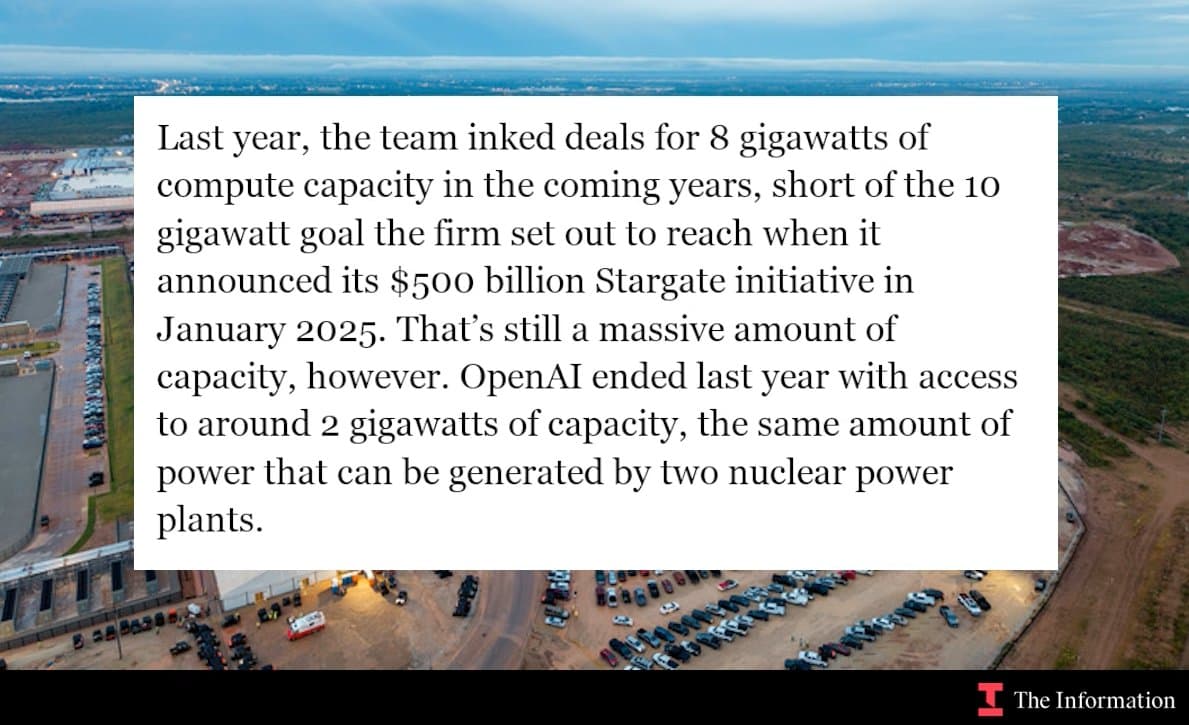
Despite the leadership change and strategic pivot, OpenAI's ambition for sheer scale has not diminished. The company reportedly aims to rapidly expand its compute capacity from approximately 2 gigawatts today to over 10 gigawatts by 2027. This five-fold increase in power draw—a proxy for computational capability—is a direct challenge to competitors like Anthropic and Google DeepMind, underscoring OpenAI's belief that scaling remains the primary path to more capable AI.
Achieving 10+ gigawatts through rental agreements would require forming monumental partnerships with existing cloud providers (like Microsoft Azure, its primary partner) and possibly specialized compute brokers or other hyperscalers. It transforms OpenAI from a builder into arguably the world's largest buyer of compute cycles.
Implications and Immediate Questions

This development raises several immediate questions:
- The Fate of Stargate: Is the Stargate project canceled, scaled back, or simply being redefined as a cluster of rented capacity rather than a self-built facility?
- The New Venture: What will the departing trio build? Their move suggests they see a significant opportunity in the AI infrastructure layer that OpenAI is now choosing to outsource.
- Partner Dynamics: How does this affect OpenAI's deep partnership with Microsoft? Does this $600B plan represent an exclusive commitment to Azure, or will OpenAI diversify its compute sourcing?
- Financial Model: A $600B spend implies a radical new financial model for OpenAI. It would necessitate generating correspondingly massive revenue from AI products and services, or securing even more extraordinary funding rounds.
gentic.news Analysis
This is a pivotal moment for OpenAI, reflecting the intense pressure and astronomical costs of the AI arms race. The departure of key infrastructure builders concurrent with a shift to a rental model is not a coincidence; it's a direct cause-and-effect. Building Stargate-scale infrastructure is a decades-long, industrial mega-project. Renting compute, while eye-wateringly expensive in aggregate, offers agility and shifts the execution risk and capital burden onto partners.
This news aligns with a broader trend we've covered at gentic.news: the stratification of the AI stack. In our analysis of Sierra's $1.5B fundraise for AI data centers, we noted the emergence of specialized infrastructure companies betting that AI labs will prefer to outsource their massive compute needs. The departure of OpenAI's Stargate team to start a new company likely validates this thesis. They are the experts who know the scale of the problem firsthand and are now positioning themselves as vendors, not internal builders.
Furthermore, this follows OpenAI's pattern of strategic pragmatism over ideological purity. The company famously pivoted from a non-profit to a "capped-profit" structure to secure capital. Now, it is pivoting from a vertical integration model (controlling its own silicon, servers, and data centers) to a horizontal one, focusing its resources on its core differentiator: AI model research and product development. The $600B number, while almost incomprehensible, frames the challenge as a financial and partnership problem rather than an engineering and construction one. The race to Artificial General Intelligence (AGI) may be won by the lab with the best models and the most scalable checkbook, not necessarily the one that owns the most bricks-and-mortar data centers.
Frequently Asked Questions
What was OpenAI's Stargate project?
Stargate was the internal codename for OpenAI's ambitious initiative to design and build a series of AI supercomputers, potentially costing over $100 billion. It was envisioned as a critical step to secure the unprecedented computational power needed for training future, more powerful generations of AI models like a potential GPT-5 or beyond.
Why are the Stargate leaders leaving OpenAI?
The senior leaders (Peter Hoeschele, Shamez Hemani, and Anuj Saharan) are departing because OpenAI is shifting its strategy away from building its own data centers. Since their expertise was in large-scale physical infrastructure construction, their roles became redundant or misaligned with the new direction of renting massive compute capacity from external providers.
What does a $600 billion compute spend mean?
A $600 billion commitment to rented compute over five years is an unprecedented scale of expenditure in the technology industry. It suggests OpenAI believes the key to achieving more advanced AI is securing orders-of-magnitude more computational power, and that the fastest way to get it is by becoming the world's largest customer of cloud computing services rather than building its own.
How does this affect OpenAI's partnership with Microsoft?
This pivot likely deepens OpenAI's dependence on Microsoft Azure, its primary cloud partner. Securing hundreds of billions of dollars in compute would require a hyperscale partner capable of delivering it. However, it could also give OpenAI leverage to negotiate with other providers (like Google Cloud or AWS) or work with specialized AI infrastructure firms, potentially altering the dynamics of its exclusive partnership with Microsoft.