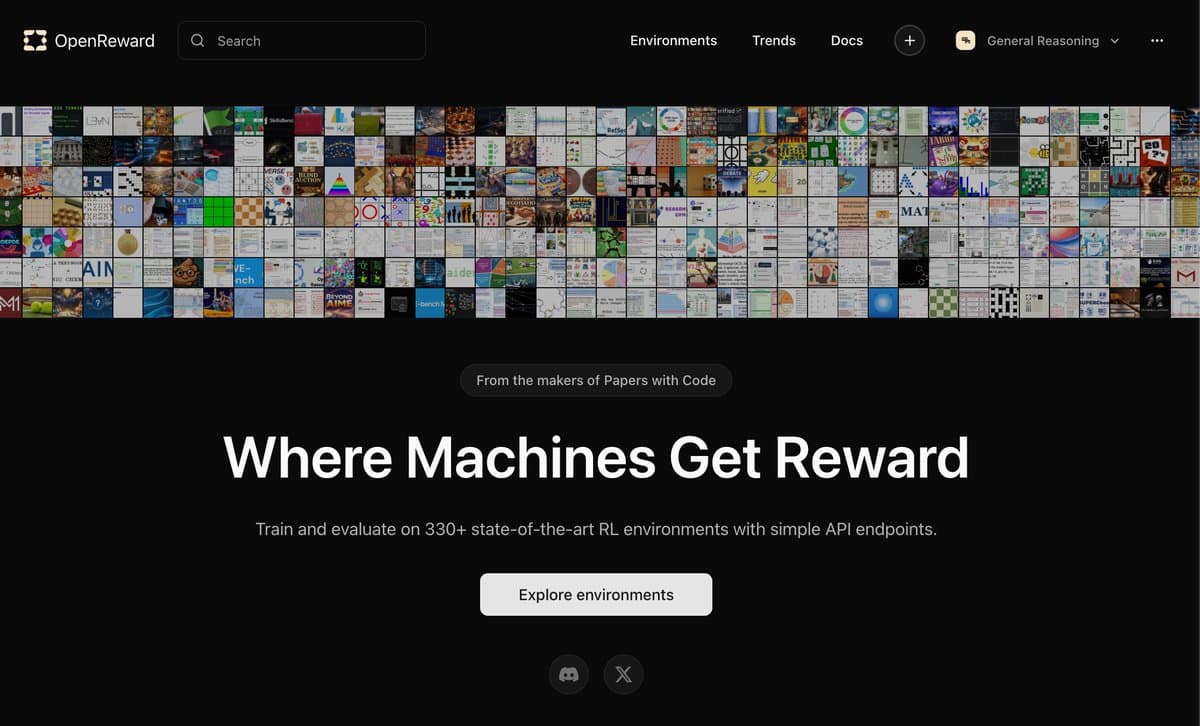
A new, focused infrastructure tool has entered the AI development stack. OpenReward, announced by developer Ross Taylor, is a minimalist product designed specifically to serve reinforcement learning (RL) environments at scale. The announcement positions it as a solution to a common bottleneck in RL research and application development: the efficient, parallelized execution of environment simulations.
What Happened
Ross Taylor announced the release of OpenReward via social media, describing it as a product that "does one thing really well: serve RL environments at scale." The announcement was subsequently shared by AI researcher Omar Sanseviero, amplifying its reach within the technical community. The core proposition is a dedicated service that abstracts away the infrastructure complexity of running numerous, potentially complex, environment instances concurrently—a critical requirement for effective RL training where throughput directly impacts experiment speed and model quality.
The Problem OpenReward Aims to Solve
Reinforcement learning involves an agent learning by interacting with an environment. Training performant models requires running millions or billions of these interactions. In practice, this means executing the environment's step function—which simulates the world's response to an agent's action—as quickly and efficiently as possible. Researchers and engineers often build custom, ad-hoc systems for this, which can be brittle, difficult to scale, and divert focus from core algorithm development.
OpenReward appears to be a standalone service that handles this workload. By providing a dedicated interface for environment serving, it could allow teams to treat the environment as a scalable microservice, separating the concerns of simulation logic from the training loop infrastructure. This is analogous to how model serving (e.g., with TensorFlow Serving or Triton Inference Server) decouples inference from application code.
Context & Technical Implications
The launch of OpenReward reflects a maturation phase in the ML tooling ecosystem. As RL moves from research labs to production systems in areas like robotics, gaming, and industrial control, the need for robust, scalable infrastructure becomes paramount. While major frameworks like OpenAI's Gym (and its successor, Gymnasium) and DeepMind's dm_env provide environment APIs, they typically leave the scaling and deployment architecture to the user.
A dedicated environment server could offer several potential benefits:
- Throughput Optimization: Implemented in a high-performance language (like Rust or C++), it could minimize latency per environment step.
- Resource Management: Efficiently manage CPU/GPU resources across thousands of parallel environment instances.
- Stateful Environments: Handle the persistence and management of environment state for long-running or complex simulations.
- Standardization: Provide a consistent RPC or gRPC interface for environments, making it easier to swap them out or run A/B tests.
The minimalist philosophy suggests OpenReward will have a narrow, well-defined API, avoiding the feature bloat of larger ML platforms. Its success will likely depend on its performance characteristics, ease of integration with popular RL frameworks (like Ray RLlib, Stable-Baselines3, or CleanRL), and operational simplicity.
What We Don't Know Yet
The initial announcement is light on technical specifics. Key details not yet public include:
- The exact architecture and communication protocol (e.g., gRPC, HTTP).
- Supported environment types (e.g., classic control, Atari, custom).
- Performance benchmarks (steps/second, latency, scaling limits).
- Licensing model (open-source, source-available, or commercial).
- Deployment options (cloud, on-premise, Kubernetes).
These details will be critical for practitioners to evaluate its fit for their workflows.
gentic.news Analysis
The release of OpenReward is a signal of infrastructure specialization within the AI stack. It follows a pattern we've observed where successful research paradigms create demand for dedicated operational tools. This mirrors the trajectory of model training, which spawned a vast ecosystem of tools for distributed training (like PyTorch's FSDP, DeepSpeed), experiment tracking (Weights & Biases, MLflow), and now, increasingly, for deployment and serving.
Ross Taylor, the developer behind OpenReward, is a known entity in the applied AI space. His previous work, including contributions to the practical side of ML, suggests OpenReward is likely born from firsthand experience with RL scaling pains. This launch aligns with a broader trend of developers and researchers productizing their internal tools to solve common, painful infrastructure problems—a trend we've covered in tools like Weights & Biases, Dagster, and Prefect.
For the RL community, a robust, open environment server could lower the barrier to entry for large-scale experiments and smooth the path to production. If OpenReward delivers on its promise of simplicity and scale, it could become a standard component in the RL toolkit, much like Redis is for caching. However, its adoption will hinge on community trust and demonstrated superiority over in-house solutions. The next step will be for the team to publish benchmarks and case studies showing tangible improvements in researcher productivity or training efficiency.
Frequently Asked Questions
What is OpenReward?
OpenReward is a new software product designed specifically to serve reinforcement learning (RL) environments as a scalable service. It handles the execution of environment simulations (the "step" function) at high throughput, allowing RL training pipelines to focus on algorithm logic rather than infrastructure.
How is OpenReward different from OpenAI Gym?
OpenAI Gym (and Gymnasium) is a standard API and collection of environments for developing and testing RL algorithms. OpenReward is an infrastructure tool that would run those environments. Think of Gym as the definition of the environment interface, and OpenReward as a high-performance server that executes many instances of environments defined with that interface in parallel.
Who should use OpenReward?
OpenReward is targeted at researchers and engineering teams running large-scale RL experiments or deploying RL systems to production. It is most valuable for workloads that require running thousands of environment instances concurrently to achieve sufficient training sample throughput, such as in robotics simulation, game AI, or algorithmic trading.
Is OpenReward open source?
As of the initial announcement, the licensing model for OpenReward has not been specified. The announcement describes it as a "product," which could imply a commercial, source-available, or open-core model. Clarity on licensing and availability is a key piece of information the community will await.