What Happened
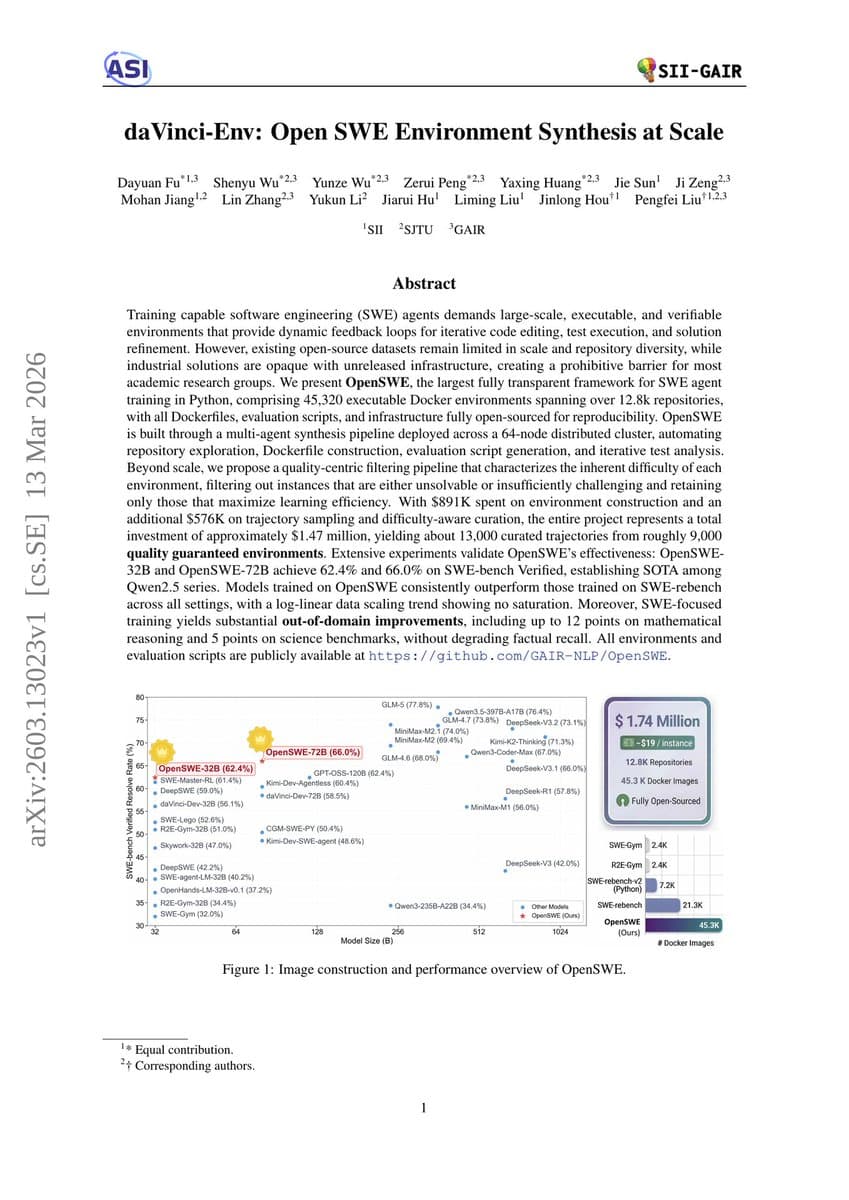
Researchers have released OpenSWE, a framework providing 45,000+ executable environments specifically designed for training software engineering (SWE) agents. According to the announcement, the framework achieves 66% on SWE-bench Verified through "quality-centric filtering of multi-agent synthesized environments."
The key technical contribution is the creation of a massive, executable dataset that allows AI agents to practice real-world software engineering tasks in isolated, reproducible environments. Unlike static code datasets, these environments include the full context needed to test code changes: dependencies, build systems, test suites, and runtime requirements.
Technical Details
The framework uses Docker infrastructure that has been fully open-sourced, ensuring complete reproducibility. Each environment corresponds to a specific software engineering task or problem, allowing agents to:
- Clone repositories
- Install dependencies
- Run tests
- Make and verify code changes
- Submit patches
The 66% score on SWE-bench Verified represents a significant benchmark result for automated software engineering systems. SWE-bench is a standard evaluation framework that tests AI systems on real GitHub issues from popular open-source repositories.
Context
Training effective software engineering agents requires more than just code completion—it demands understanding of build systems, testing frameworks, dependency management, and the full software development lifecycle. Previous approaches often lacked executable environments, limiting their ability to validate code changes in realistic contexts.
OpenSWE addresses this gap by providing thousands of ready-to-run environments that mirror real software projects. The "quality-centric filtering" mentioned in the announcement suggests the team used multi-agent systems to generate potential environments, then filtered them based on quality metrics to ensure they're useful for training.
This release follows increasing interest in AI-powered coding assistants that go beyond simple autocomplete to handle complex software engineering tasks like bug fixing, feature implementation, and code review.