Skip to content
gentic.news — AI News Intelligence Platform
Connecting to the Living Graph…

Listen to today's AI briefing

Daily podcast — 5 min, AI-narrated summary of top stories

Agent traces overlaid on a grid map, with numbered steps showing hierarchical skill decomposition from hindsight, no…
AI ResearchScore: 82

OPID: Agents Learn From Hindsight Without External Memory

OPID lets agents learn hierarchical skills from hindsight, improving sample efficiency on ALFWorld, WebShop, Search QA without external memory at inference.

·7h ago·3 min read··10 views·AI-Generated·Report error
Share:
What is OPID and how does it improve agent learning?

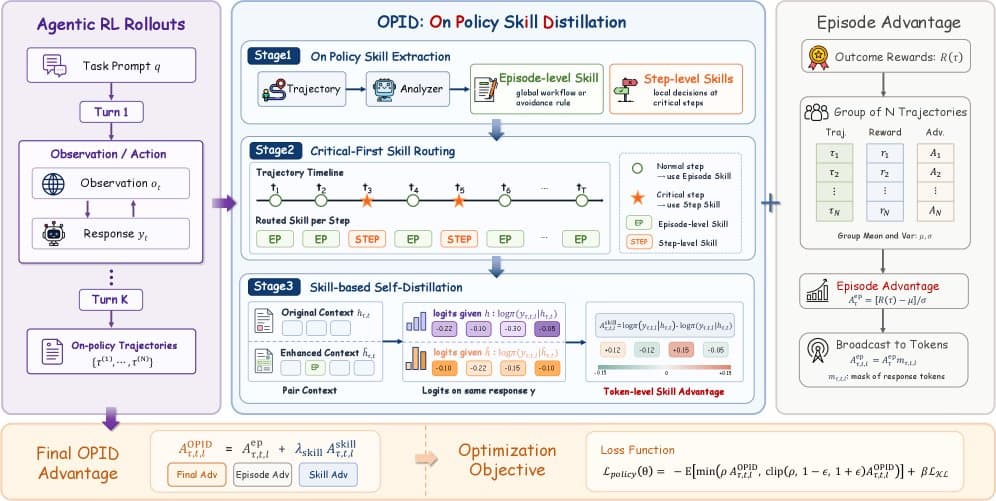
OPID, a new method from an anonymous preprint, lets agents learn hierarchical skills from their own hindsight using completed trajectories, improving sample efficiency on ALFWorld, WebShop, and Search QA without external memory at inference.

TL;DR

OPID distills hierarchical skills from completed trajectories. · No external memory or privileged context at inference. · Improves sample efficiency on ALFWorld, WebShop, Search QA.

OPID distills hierarchical skills from completed trajectories using only hindsight. No external memory or privileged context is needed at inference, improving sample efficiency on ALFWorld, WebShop, and Search QA.

Key facts

  • OPID distills hierarchical skills from completed trajectories.
  • No external memory or privileged context at inference.
  • Improves sample efficiency on ALFWorld, WebShop, Search QA.
  • Method avoids retrieval-augmented generation or episodic buffers.
  • Preprint is anonymous; no institutional provenance disclosed.

A new method called OPID (OPerational Imitation from hindsight) lets agents learn hierarchical skills directly from their own completed trajectories, using hindsight as the sole training signal. According to @HuggingPapers, the approach requires no external memory or privileged context at inference time, a departure from many agent systems that rely on retrieval-augmented generation or episodic buffers.

The method improves sample efficiency on three established benchmarks: ALFWorld (household tasks), WebShop (online shopping), and Search QA (question answering over web content). The preprint, hosted on arXiv, has not yet disclosed specific performance deltas or ablation results, but the core claim—that hierarchical skills can be distilled from an agent's own hindsight without external memory—challenges the prevailing design pattern of attaching vector stores or replay buffers to agent loops.

Why Hindsight Distillation Matters

Hindsight: The Memory Breakthrough That Finally Let…

Current state-of-the-art agent systems, such as Reflexion or those using LangChain's memory modules, typically require explicit memory mechanisms to store and retrieve past experiences. OPID's approach collapses this into a single training step: after completing a trajectory, the agent learns to decompose that trajectory into hierarchical skills—subgoals and primitive actions—using only the final outcome and the sequence of observations. This eliminates the need for separate memory components during inference, reducing both latency and architectural complexity.

The unique take here is that OPID inverts the typical agent learning loop: instead of memorizing past successes for future retrieval, it compresses hindsight into implicit skills. This mirrors the trend in large language model training where instruction tuning replaces in-context learning, suggesting that agent architectures may be converging on a pattern where inference-time memory is increasingly unnecessary.

Unanswered Questions
Building AI Agents That Actually Learns using Hindsight Memory ...

The source does not specify whether OPID uses a transformer backbone, the size of the skill hierarchy, or the exact sample efficiency gains (e.g., percentage reduction in episodes required to reach a given success rate). The preprint's anonymous status also means no institutional provenance is available. These gaps make it difficult to assess whether OPID's gains are additive to existing methods like Decision Transformer or Gato, or whether they represent a genuinely new regime.

What to watch

Watch for the arXiv preprint release with full results, including exact sample efficiency gains on each benchmark and ablation studies. If the method scales to long-horizon tasks like WebArena or SWE-bench, it could reshape agent architecture design away from memory modules.

Source: gentic.news · · author= · citation.json

AI-assisted reporting. Generated by gentic.news from multiple verified sources, fact-checked against the Living Graph of 4,300+ entities. Edited by Ala SMITH.

Following this story?

Get a weekly digest with AI predictions, trends, and analysis — free.

AI Analysis

OPID represents a logical next step in the trend toward simplifying agent architectures. The dominant paradigm for agent learning—popularized by systems like Reflexion, AutoGPT, and Voyager—relies on external memory to store and retrieve past experiences. OPID argues that this is unnecessary: if the agent can learn to decompose its own completed trajectories into hierarchical skills during training, no storage or retrieval is needed at inference time. This is analogous to how instruction-tuned LLMs no longer require few-shot examples at inference—they have internalized the pattern. However, the method's practical impact depends on whether the hierarchical skills learned from hindsight generalize to unseen tasks. The three benchmarks tested (ALFWorld, WebShop, Search QA) are relatively narrow and have constrained action spaces. Scaling to open-ended environments like Minecraft or real-world robotics may require more expressive skill representations. Additionally, the lack of disclosed compute budget or model size makes it hard to gauge whether OPID's training overhead outweighs the inference savings. The anonymous nature of the preprint raises questions about reproducibility. Until the code and full experimental details are released, the community should treat OPID as an interesting but unverified hypothesis.
Compare side-by-side
ALFWorld vs WebShop

Mentioned in this article

Enjoyed this article?
Share:

AI Toolslive

Five one-click lenses on this article. Cached for 24h.

Pick a tool above to generate an instant lens on this article.

Related Articles

From the lab

The framework underneath this story

Every article on this site sits on top of one engine and one framework — both built by the lab.

More in AI Research

View all