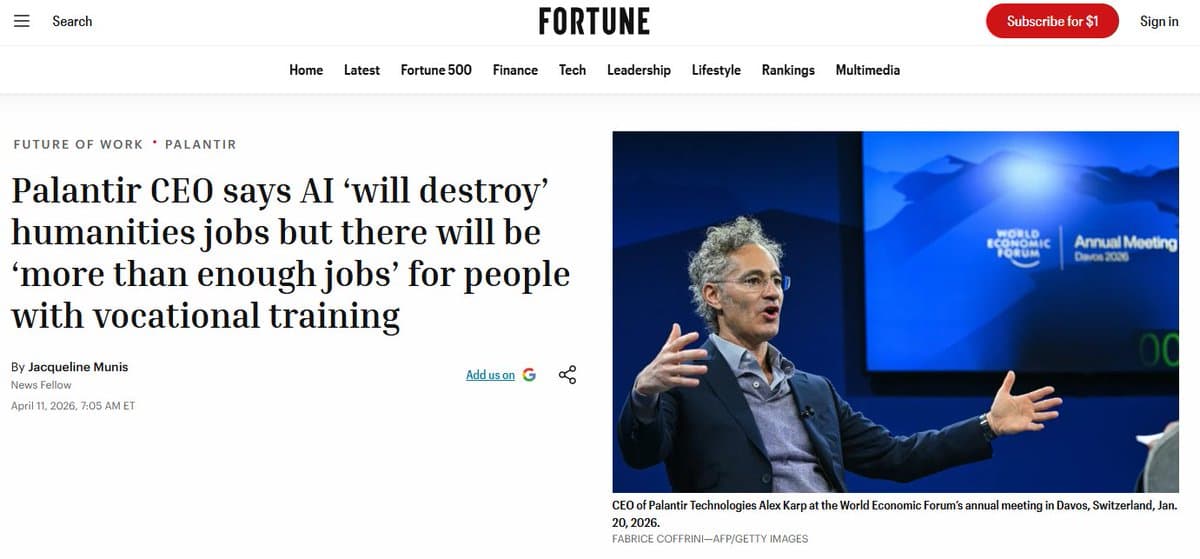
Palantir Technologies CEO Alex Karp has issued a stark warning about the impact of artificial intelligence on the workforce, specifically targeting broad, non-specialized academic degrees. In recent comments, Karp argued that AI will "destroy humanities jobs," fundamentally reshaping the value proposition of traditional education in an automation-driven economy.
Key Takeaways
- Palantir CEO Alex Karp warns AI will 'destroy humanities jobs,' arguing broad degrees lose value while vocational skills and neurodivergent traits become key advantages.
- He insists there will still be 'more than enough jobs,' just redistributed toward practical roles.
The Core Argument: From Generalists to Specialists

Karp's central thesis is that the economic utility of broad liberal arts and humanities degrees will rapidly diminish as AI automates tasks that rely on general knowledge synthesis and communication. Instead, he posits that future employment advantages will flow toward two areas:
- Vocational and Technical Training: Hands-on, practical skills that are difficult to automate and directly applicable to specific industries (e.g., advanced manufacturing, specialized healthcare, infrastructure maintenance).
- Unique Cognitive Traits: He specifically highlighted neurodivergence as a potential key advantage, suggesting that atypical problem-solving approaches and deep, narrow focus—traits often associated with conditions like autism—may become highly valuable in an AI-augmented workplace.
Despite this disruptive outlook, Karp insists the result will not be mass unemployment but a significant redistribution of labor. He claims there will still be "more than enough jobs," but they will be concentrated in "practical, skill-based roles." This vision contrasts sharply with a more holistic view of education that emphasizes critical thinking, creativity, and ethical reasoning—capabilities many educators and industry leaders argue are precisely what a humanities foundation provides and what will be crucial for governing AI itself.
The Counter-Narrative: Enduring Value of the Humanities
The source note mentions that "other leaders push back and highlight the enduring value of creativity and liberal arts thinking." This reflects an ongoing, heated debate within the tech industry. Critics of Karp's purely utilitarian view argue that:
- AI excels at optimization within constraints but struggles with open-ended creativity, ethical nuance, and understanding human context—the hallmarks of a humanities education.
- The challenges posed by AI—bias, governance, societal impact—require deep humanistic thinking, not just technical skill.
- Reducing education to immediate job training risks creating a workforce ill-equipped for the long-term societal shifts technology causes.
A Persistent Skepticism: Can Job Creation Keep Pace?

The source concludes with a skeptical note: "However, be that as it may, I still don't see how enough new jobs can be created." This captures the core anxiety underlying all automation debates: the historical precedent that technology creates new jobs may not hold if AI's cognitive automation is as broad and deep as predicted. The question of whether "vocational" job creation can match the scale of "humanities" job destruction remains unanswered and is the central point of contention.
gentic.news Analysis
Alex Karp's comments are not made in a vacuum; they reflect the evolving and often contradictory stance of a major defense and intelligence AI contractor. Palantir's entire business model, especially with its AIP (Artificial Intelligence Platform), is built on automating complex analysis and decision-making processes for governments and large enterprises—precisely the kind of work that would employ many analysts with broad, research-focused backgrounds. Karp's warning can be seen as a direct extrapolation of his company's product roadmap.
This utilitarian perspective aligns with a broader trend among certain Silicon Valley leaders who view education through a lens of immediate technical ROI. However, it stands in direct contrast to positions held by other AI pioneers. For instance, our previous coverage on [gentic.news article about an AI ethicist or leader emphasizing ethics] highlighted arguments that mitigating AI risks requires more, not less, humanistic training. Furthermore, the push for "neurodivergent advantages" is a double-edged sword: while it recognizes unique cognitive strengths, it risks instrumentalizing neurodiversity purely for economic productivity rather than inclusion.
Ultimately, Karp's prediction is less a forecast and more a prescription. By declaring humanities jobs as destined for destruction, he is advocating for a societal pivot toward the kind of technically specialized, tool-oriented workforce that would be the primary user base for platforms like Palantir's. The real debate is whether we should allow the capabilities of a technology to dictate the entire structure of human value and education.
Frequently Asked Questions
What did Alex Karp actually say about AI and jobs?
Palantir CEO Alex Karp stated that artificial intelligence will "destroy humanities jobs," arguing that broad, non-specialized university degrees will lose economic value. He believes future advantages will shift to vocational training and unique cognitive traits like neurodivergence, but maintains that "more than enough" practical, skill-based jobs will be created.
Why would neurodivergence be an advantage in an AI-driven economy?
Karp suggests that cognitive traits often associated with neurodivergence, such as deep, systemic thinking, pattern recognition in complex data, and atypical problem-solving approaches, could become highly valuable. These traits might complement AI systems by providing novel insights or excelling in areas where AI is less effective, such as navigating unstructured problems or thinking outside trained parameters.
Is the tech industry unified in believing humanities degrees will be worthless?
No, Karp's view represents one side of a significant debate. Many other leaders and ethicists argue that skills fostered by humanities—critical thinking, ethical reasoning, creativity, and understanding of human context—will be more critical than ever. They are seen as essential for guiding AI development responsibly, managing its societal impact, and performing tasks that AI cannot, such as genuine artistic creation or moral judgment.
What is the main criticism of Karp's viewpoint?
The primary criticism is that it is reductively utilitarian and potentially short-sighted. Critics argue it mistakes the current capabilities of AI for its ultimate potential and undervalues the role of humanistic thinking in shaping a future worth living in. The worry is that focusing solely on vocational skills for an AI-augmented workplace addresses the symptom (job displacement) but not the cause (who controls and defines the purpose of the technology).