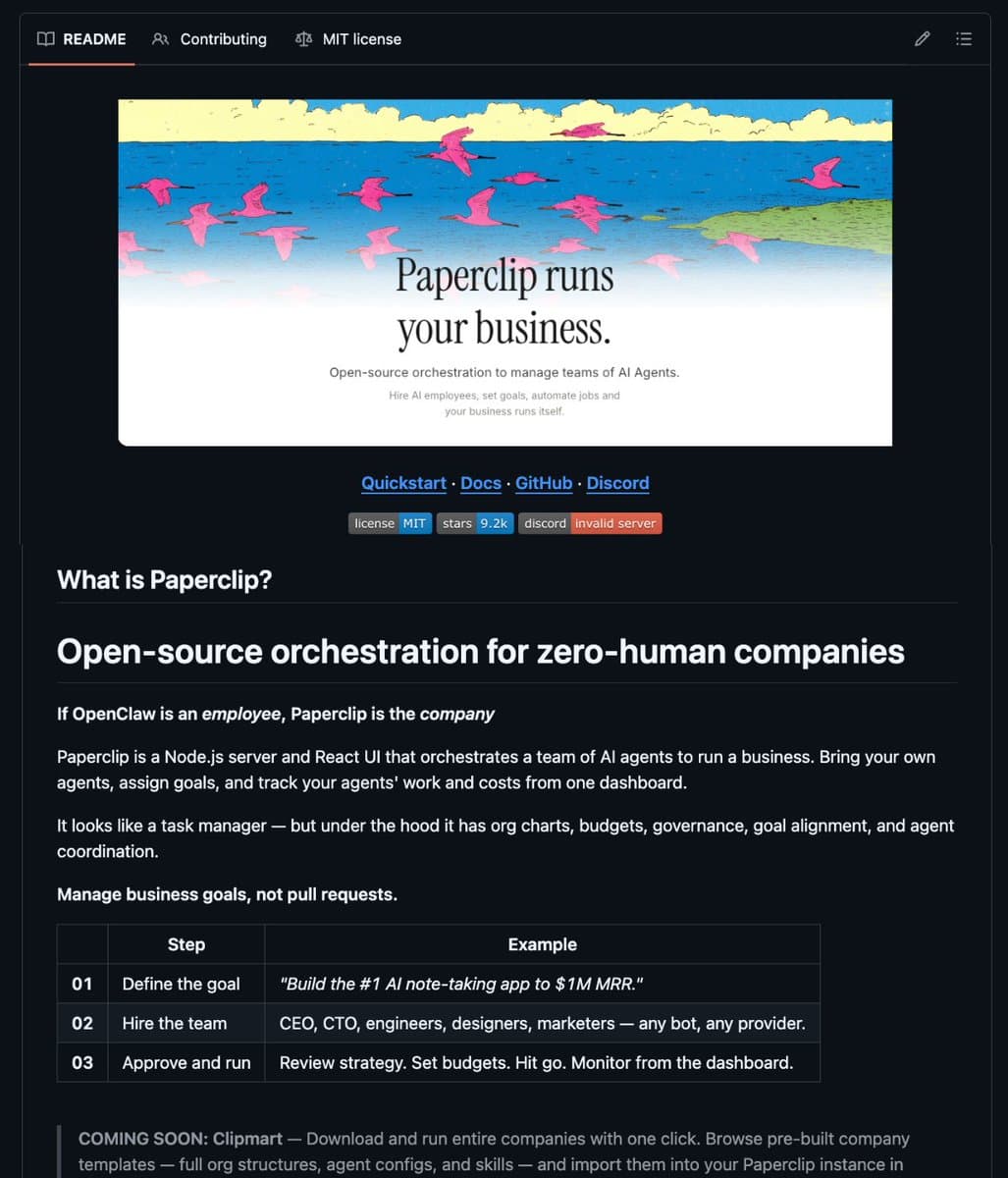
A new open-source project called Paperclip has emerged as what developers are calling "the operating system for zero-human companies." Released under the permissive MIT license and already garnering 1.4K stars on GitHub, Paperclip represents a significant leap toward fully autonomous organizational structures powered by artificial intelligence.
What Paperclip Actually Does
Paperclip functions as a company layer that sits on top of AI agents, transforming individual AI tools into structured organizational entities. As described by developer @hasantoxr, "If OpenClaw is an employee, Paperclip is the entire company." The platform allows users to integrate various AI agents—including Claude Code, Codex, Cursor, and OpenClaw—into a coherent organizational framework with real reporting lines.
The system provides traditional corporate structures for AI operations:
- Organizational charts and titles for AI agents
- Budget allocation with monthly limits per agent
- Goal-setting mechanisms for autonomous operation
- Full ticket systems with tool-call tracing
- Immutable audit logs for complete transparency
The Technical Architecture
Paperclip's architecture enables continuous operation through heartbeat mechanisms, allowing agents to run 24/7 while remaining monitorable from mobile devices. This addresses a common frustration in AI development: instead of managing "20 Claude Code tabs open with no idea what's happening," developers can deploy Paperclip once and monitor everything through a single dashboard.
The budgeting system represents a particularly innovative feature. When agents reach their allocated monthly budget limits, they automatically stop operations, preventing runaway costs—a critical concern for businesses implementing AI at scale.
The Open-Source Advantage
Paperclip's MIT license and open-source nature lower barriers to entry for organizations experimenting with autonomous operations. The rapid community adoption (1.4K stars in early stages) suggests strong developer interest in this approach to AI management.
The platform's design philosophy appears to prioritize practical implementation over theoretical perfection, focusing on solving immediate pain points in AI agent management while providing extensible architecture for future development.
Implications for Business Operations
Paperclip represents more than just another AI tool—it's a fundamental reimagining of how organizations might operate with minimal human intervention. By providing structure, accountability, and financial controls for AI agents, the platform moves autonomous operations from experimental concepts toward practical implementation.
Small businesses and startups could potentially leverage Paperclip to automate routine operations at unprecedented scales, while larger organizations might use it to manage specialized AI teams within existing structures. The immutable audit logs and tool-call tracing address critical concerns about transparency and accountability in AI decision-making.
The Road Ahead
While Paperclip shows remarkable promise, the concept of "zero-human companies" raises important questions about oversight, ethical considerations, and the role of human judgment in automated systems. The platform's success will likely depend not just on its technical capabilities but on how well it addresses these broader concerns.
The rapid community response suggests Paperclip has tapped into a significant unmet need in the AI development ecosystem. As the project evolves, its impact on how businesses structure their AI operations could be substantial, potentially accelerating the adoption of autonomous systems across industries.
Source: @hasantoxr on X/Twitter (https://x.com/hasantoxr/status/2030604968416412144)