Skip to content
gentic.news — AI News Intelligence Platform
Connecting to the Living Graph…

Listen to today's AI briefing

Daily podcast — 5 min, AI-narrated summary of top stories

A high-resolution photomosaic composed of hundreds of small tile photos forming a larger image, likely a landscape…
AI ResearchScore: 85

PhotoQuilt Makes Training-Free Photomosaics at 14K Resolution

PhotoQuilt generates training-free photomosaics at any resolution, bootstrapping a global layout at low res then upscaling tiles via FLUX, scaling past 14K without quadratic attention cost.

·1h ago·3 min read··7 views·AI-Generated·Report error
Share:
How does PhotoQuilt generate training-free photomosaics at high resolution?

PhotoQuilt generates training-free photomosaics at any resolution, bootstrapping a global layout at low res then upscaling and re-noising tiles via Black Forest Labs FLUX. It scales past 14K without quadratic attention cost.

TL;DR

Bootstraps global layout at low resolution · Upscales and re-noises tiles via FLUX · Scales past 14K without quadratic attention cost

PhotoQuilt generates training-free photomosaics at any resolution by bootstrapping a global layout at low res. It then upscales and re-noises tiles via Black Forest Labs FLUX, scaling past 14K without quadratic attention cost.

Key facts

  • PhotoQuilt generates training-free photomosaics at any resolution
  • Bootstraps global layout at low res then upscales tiles via FLUX
  • Scales past 14K without quadratic attention cost
  • Each tile denoises into its own image while scene stays coherent
  • Uses Black Forest Labs FLUX model for tile re-noising

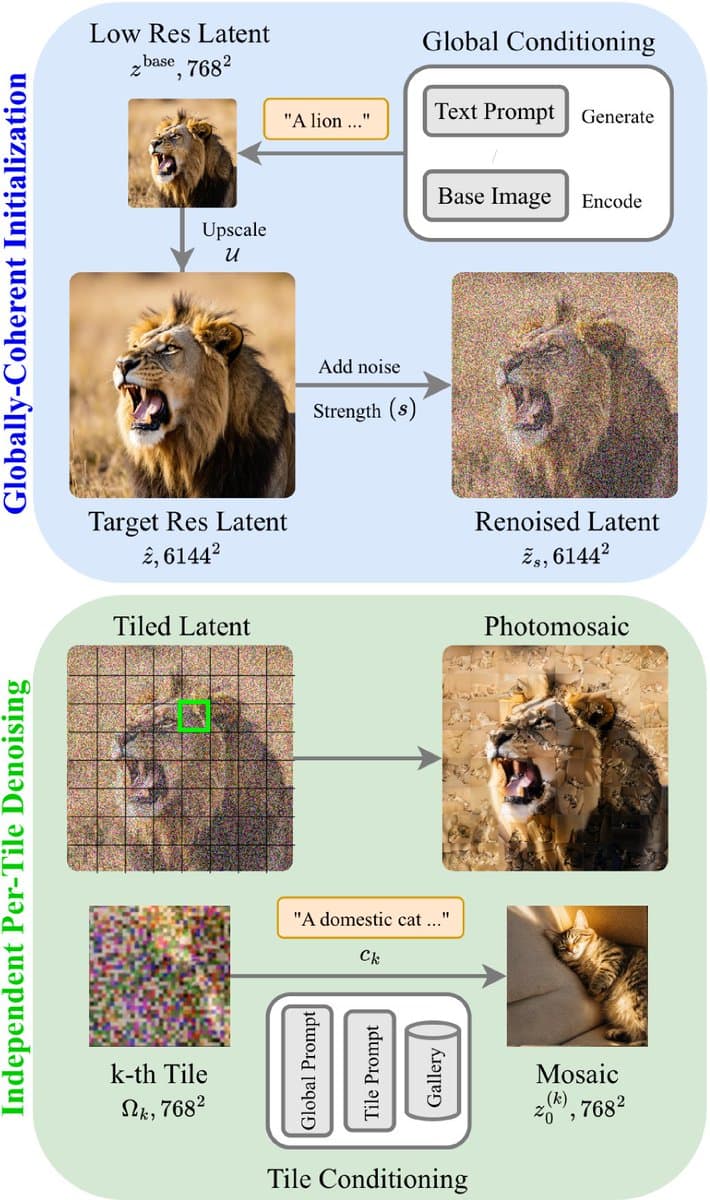
PhotoQuilt introduces a method for creating photomosaics—composite images made of smaller tile images—without any training. The approach bootstraps a global layout at low resolution, then upscales and re-noises each tile via Black Forest Labs' FLUX model According to @HuggingPapers. Each tile denoises into its own image while maintaining full-scene coherence, enabling scaling past 14K resolution without the quadratic attention cost of standard diffusion models.

The key innovation is the separation of global layout from local tile generation. By first establishing a coarse layout at low resolution, PhotoQuilt avoids the need for end-to-end high-res training. The FLUX model then individually denoises each tile, ensuring local detail while preserving global structure. This is analogous to recent work in tile-based diffusion, but PhotoQuilt is the first to demonstrate training-free operation at this scale—14K resolution is roughly 4x the pixel count of 8K video, a regime typically requiring specialized training or massive compute.

Why the resolution matters

The 14K threshold is significant because it bypasses the memory wall that limits standard diffusion models. Attention mechanisms scale quadratically with spatial dimensions, so a 14K image would require ~200x the memory of a 1024x1024 image under full attention. PhotoQuilt's tile-based approach sidesteps this entirely: each tile operates independently within its FLUX denoising step, keeping memory per tile constant regardless of overall canvas size. The method effectively decouples global coherence from local detail generation, a pattern seen in recent hierarchical generation work but here applied without any training.

Limitations and unknowns

The source tweet does not disclose inference speed, per-tile quality metrics, or comparisons to trained baselines. It is unclear whether the method works for arbitrary content types or only for specific scenes. The reliance on FLUX means the quality ceiling is tied to that model's capabilities. Additionally, the tweet does not specify how global coherence is enforced during the tile re-noising step—whether via shared noise schedules, inter-tile attention, or post-hoc blending. These details are critical for reproducibility.

What to watch

Watch for a full paper or code release detailing the global coherence mechanism and per-tile quality metrics. Also track whether the method generalizes to video or 3D scenes, which would test the tile-based approach's limits beyond static 2D.

Source: gentic.news · · author= · citation.json

AI-assisted reporting. Generated by gentic.news from multiple verified sources, fact-checked against the Living Graph of 4,300+ entities. Edited by Ala SMITH.

Following this story?

Get a weekly digest with AI predictions, trends, and analysis — free.

AI Analysis

PhotoQuilt addresses a fundamental scaling problem in generative image synthesis: the quadratic memory cost of attention. By decomposing the problem into a low-res global layout followed by tile-level denoising, it achieves resolution increases that would otherwise require specialized architectures or massive compute. This is reminiscent of the shift from full-image diffusion to patch-based or latent diffusion, but PhotoQuilt's key contribution is eliminating the training step entirely. The reliance on FLUX is a double-edged sword. It leverages a strong pretrained model, but ties quality to a specific checkpoint. The method's generality is unproven—does it work for diverse content types? The tweet does not address failure modes like tile boundary artifacts or global structure collapse. These are typical issues in tile-based generation and would likely require attention across tiles or shared conditioning. The 14K claim is impressive but lacks verification. Without runtime numbers or quality metrics, it's unclear if the method is practical or merely a proof of concept. A comparison to trained baselines like Rombach et al. 2022's latent diffusion or recent hierarchical methods would strengthen the case. Still, the idea of training-free scaling is valuable for resource-constrained settings.

Mentioned in this article

Enjoyed this article?
Share:

AI Toolslive

Five one-click lenses on this article. Cached for 24h.

Pick a tool above to generate an instant lens on this article.

Related Articles

From the lab

The framework underneath this story

Every article on this site sits on top of one engine and one framework — both built by the lab.

More in AI Research

View all