What Happened
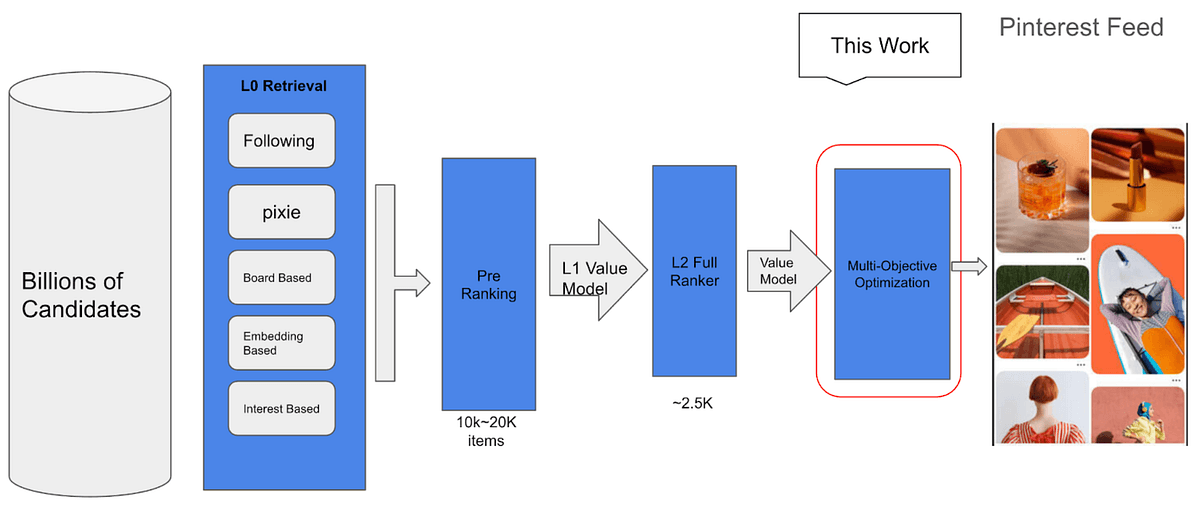
Pinterest's engineering team has published a comprehensive technical blog detailing the multi-year evolution of the multi-objective optimization (MOO) layer within their Home Feed recommendation system. This final layer sits after retrieval, pre-ranking, and ranking, and is responsible for constructing the final slate of Pins a user sees. The post chronicles a journey from 2021 to late 2025, moving through three major algorithmic phases to better balance short-term engagement, long-term user satisfaction, and content quality.
The core challenge addressed is the "tyranny of the immediate." Early systems optimizing purely for clicks or saves can create visually repetitive, homogenous feeds. While this may boost day-one metrics, Pinterest's data shows it leads to negative long-term effects, including reduced session time and user retention by the second week. The MOO layer's job is to inject diversity and quality considerations into the final feed composition.
Technical Details
V1: Determinantal Point Process (DPP)
Launched in 2021, their first-generation system used DPP, a probabilistic model widely adopted in industry for diversification. DPP is parameterized by a kernel matrix L, where diagonal elements Lᵢᵢ represent an item's relevance score, and off-diagonal elements Lᵢⱼ represent the similarity between items i and j. Pinterest used learned embeddings (like GraphSAGE) and categorical taxonomies to compute these similarities. An ablation study removing DPP showed a >2% reduction in user time spent per impression after one week, proving its critical role in sustaining engagement.
V2: Sliding Spectrum Decomposition (SSD)
By early 2025, Pinterest migrated to Sliding Spectrum Decomposition (SSD), a position-adaptive method introduced in a 2021 arXiv paper. Unlike DPP, which considers the entire slate globally, SSD operates on a sliding window of items. It performs a local spectral decomposition to identify latent "spectra" (e.g., topics, styles) within the window and adjusts rankings to promote under-represented spectra.
Key advantages over DPP:
- Lower Computational Complexity: SSD avoids the expensive Cholesky decomposition of a full similarity matrix required by DPP, leading to lower serving latency.
- Implementation Simplicity: The algorithm is built from standard linear algebra operations, making it easy to implement in PyTorch. This avoids numerical instability issues common with DPP.
- Local Adaptability: Its windowed approach allows for more granular, position-sensitive diversity control.
The migration to a PyTorch-based SSD implementation enabled faster iteration and the incorporation of more features for evaluating Pin similarity.
Unified Soft-Spacing Framework
Building on SSD's flexibility, Pinterest introduced a "soft-spacing" framework in mid-2025. This framework adds a configurable penalty to the utility score of items belonging to a sensitive set R (e.g., content with elevated quality risk) if similar items have recently appeared in the feed. The penalty is inversely weighted by distance, discouraging clustering without resorting to hard filters that can create empty slots and degrade user experience.
By late 2025, this was abstracted into a config-based framework, allowing product teams to easily define new quality or business rules (e.g., limiting repetitive ads, spacing out content from a single creator) and have them integrated into the optimization objective.
Infrastructure Evolution
A significant parallel evolution occurred in system infrastructure. The initial DPP system was embedded as a sequence of nodes within the monolithic Home Feed backend, making experimentation difficult. The shift to SSD involved migrating much of the diversification logic into PyTorch models served on the company's centralized model-serving clusters. This decoupled the MOO layer from backend dependencies, enabling faster A/B testing, safer rollouts, and more agile development.
Retail & Luxury Implications
While Pinterest is a visual discovery platform, not a traditional retailer, the technical challenges and solutions they describe are directly analogous to those faced by luxury e-commerce and content platforms.
1. The Diversity-Engagement Trade-off is Universal: A luxury feed showing only handbags or only products from a single brand will fatigue users, regardless of initial click-through rates. Pinterest's empirical finding—that diversity loss hurts long-term engagement within weeks—is a critical lesson. Retailers must measure session depth, return visits, and time-to-purchase, not just immediate clicks.
2. Beyond Product Similarity: Pinterest uses GraphSAGE embeddings and taxonomies to measure similarity. For luxury, the "similarity" matrix must be far richer: brand affinity, price tier, color, style (e.g., classic vs. avant-garde), occasion (work vs. gala), and sustainability attributes. Optimizing a feed requires balancing across these many dimensions, not just avoiding visual repetition.
3. Quality and Brand Safety as an Optimization Objective: Pinterest's "soft-spacing" framework is a blueprint for managing brand-sensitive content. A luxury retailer could use it to gently deprioritize outlet items or last-season products in a primary feed, or to ensure a high-end brand's products are not placed immediately adjacent to a diffusion line. It moves quality control from a blunt, pre-filtering step to a nuanced part of the ranking objective.
4. The Infrastructure Mandate for Agility: Pinterest's move to a decoupled, model-serving architecture highlights a key operational insight. To run live experiments on feed composition—testing new diversity rules, promotional blends, or seasonal adjustments—retailers need a flexible serving layer that is separate from core transaction systems. This enables the rapid iteration required to respond to trends and business needs.
The core takeaway is that modern recommendation is a constrained optimization problem. The objective isn't just "predict the next click." It's: "Construct a slate that maximizes a weighted blend of immediate engagement, long-term satisfaction, brand presentation, and business goals, given thousands of candidate items." Pinterest's technical blog provides a real-world roadmap for solving it.