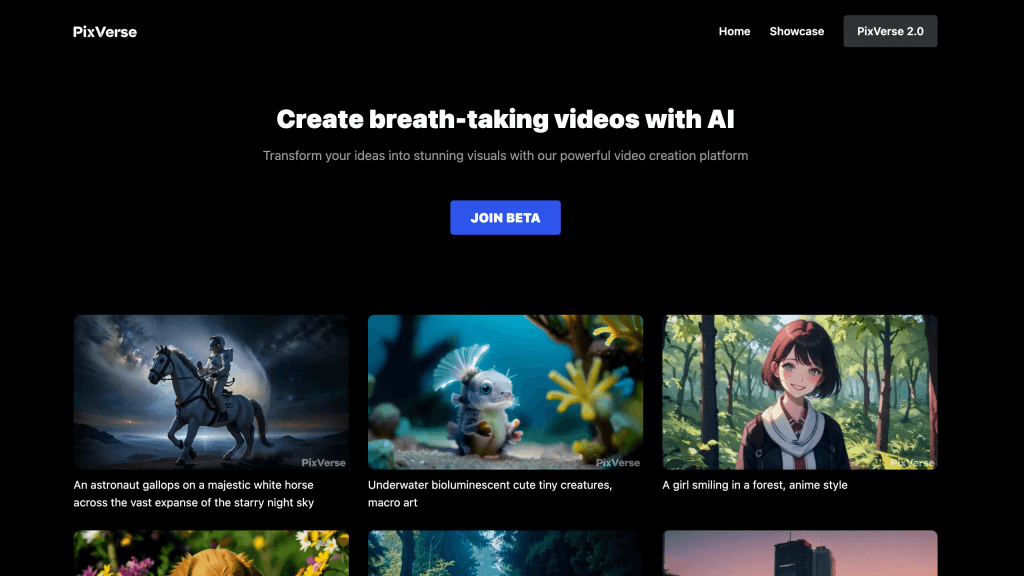
AI video generation startup PixVerse has released its V6 model, a significant upgrade that enables users to generate 15-second, 1080p resolution videos with synchronized audio directly from text prompts. The announcement, made via social media, positions V6 as a tool to eliminate "every excuse for bad video content."
What's New
PixVerse V6 introduces three concrete improvements over previous iterations:
- Extended Duration: Video outputs are now up to 15 seconds long. This is a substantial increase from the typical 2-4 second clips common in earlier text-to-video models, allowing for more complete narrative snippets.
- Enhanced Resolution: Videos are generated in 1080p (1920x1080) resolution, a step up from the 720p or lower resolutions often associated with AI-generated video, improving clarity and professional utility.
- Integrated Audio: The model generates full audio synchronized with the video. This includes potential ambient sound, sound effects, or a soundtrack, moving beyond silent clips and reducing the need for separate audio editing.
The core workflow remains text-to-video: a user inputs a descriptive prompt, and the model generates a corresponding short film.
Technical Details & Context
While the announcement tweet did not include technical specifications like model architecture, training data, or compute requirements, the stated output capabilities place V6 firmly in the competitive landscape of high-fidelity, longer-duration AI video generators.
The move to 15-second clips aligns with industry trends. As we covered in our analysis of Stable Video 3D's release last quarter, the race is intensifying to move beyond ultra-short clips. PixVerse's update directly challenges other platforms like Runway's Gen-2 and Pika Labs, which have also been pushing duration limits.
For practitioners, the key implication is workflow simplification. The combination of longer duration, higher resolution, and baked-in audio means a single AI generation step can produce a more finished asset, potentially reducing the need for multi-step editing, upscaling, and sound design in basic content creation.
Limitations & What to Watch
The announcement, while promising, lacks published benchmark comparisons, systematic quality evaluations, or details on access and pricing. Key questions for early adopters will be:
- Prompt Adherence & Coherence: Does video and audio quality remain consistent across the full 15 seconds, or do artifacts and logical inconsistencies increase over time?
- Access Model: Will V6 be available via a free tier, credits, or a subscription? How does its cost-per-second compare to competitors?
- Control & Consistency: Are features like character consistency, motion control, or style referencing supported, or is it primarily a one-shot text-to-video tool?
Early user-generated samples will be the true test of whether V6's output matches the marketing promise of killing excuses for "bad video content."
gentic.news Analysis
PixVerse's V6 launch is a tactical move in the rapidly commoditizing text-to-video space. The emphasis on 15-second, audio-inclusive clips targets a specific user pain point: the need to create short-form social media or marketing content quickly without assembling assets from multiple tools. This isn't about competing with Sora or Luma Dream Machine on pure cinematic simulation; it's about utility for content creators.
This aligns with a trend we identified in our coverage of Kling AI's video model – a focus on practical, shareable durations. The AI video market is segmenting. On one end, research labs push the boundaries of physics simulation and long-form coherence. On the other, applied platforms like PixVerse are optimizing for the viral content loop: ideate, generate, post. V6's integrated audio is particularly shrewd, as adding sound has been a persistent friction point.
Looking at the competitive map, PixVerse is not a first-mover but is executing a clear feature-play. Its challenge will be maintaining differentiation as Runway, Pika, and even Midjourney (with its rumored video project) inevitably match or exceed these duration and quality specs. For now, V6 gives PixVerse a compelling entry in the feature checklist comparison that mid-market creators will use to choose a platform.
Frequently Asked Questions
How do I access PixVerse V6?
As of the initial announcement, specific access details were not provided. Typically, PixVerse operates through its web platform and possibly a Discord community. Users should check the official PixVerse website or social channels for updates on whether V6 is available to all users, is in a beta rollout, or requires a specific subscription tier.
How does PixVerse V6 compare to Runway Gen-2 or Pika 1.0?
Based on the announced specs, V6's 15-second, 1080p with audio output appears competitive on paper. Runway and Pika have also been extending video length. A direct comparison requires side-by-side testing on the same prompts to evaluate coherence, visual quality, and prompt adherence. V6's integrated audio generation could be a differentiating convenience factor if it produces quality results.
Is the audio in PixVerse V6 AI-generated speech, music, or sound effects?
The announcement states "Full audio" but does not specify its nature. It likely encompasses AI-generated ambient soundscapes, sound effects matching the action, and possibly musical scores. It is less likely to include coherent AI-generated speech/dialogue for characters, as that is a separate and complex challenge (text-to-speech synced to lip movements).
What are the main limitations of AI video models like V6?
Current limitations, even with advanced models, include: maintaining consistent characters and objects across scenes ("character coherence"), simulating complex physics accurately, generating precise human hand movements and facial expressions, and following complex, multi-clause prompts without missing elements. Video length beyond 10-20 seconds often leads to increased drift or surreal transformations.