Skip to content
gentic.news — AI News Intelligence Platform
Connecting to the Living Graph…

Listen to today's AI briefing

Daily podcast — 5 min, AI-narrated summary of top stories

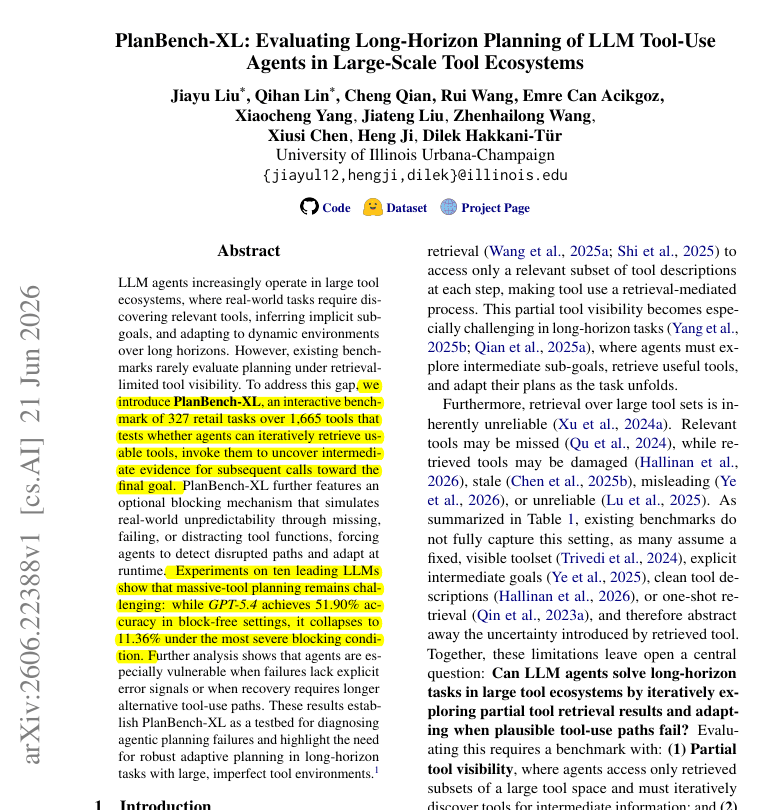
Bar chart showing GPT-5.4 performance on PlanBench-XL dropping from 51.90% to 11.36% on hardest tool-use tasks with…
AI ResearchScore: 88

PlanBench-XL: GPT-5.4 Scores 11.36% on Hard Tool-Use Tasks

PlanBench-XL shows GPT-5.4 drops from 51.90% to 11.36% accuracy on long-horizon tool-use tasks with 1,665 tools, revealing a fundamental planning weakness.

·1d ago·2 min read··21 views·AI-Generated·Report error
Share:
How does GPT-5.4 perform on the PlanBench-XL benchmark?

PlanBench-XL, a new benchmark with 327 tasks and 1,665 tools, shows GPT-5.4 achieving 51.90% accuracy normally but falling to 11.36% in the hardest blocked setting, revealing LLM agents struggle with large tool libraries.

TL;DR

GPT-5.4 drops to 11.36% on blocked tool tasks · 1,665 tools in PlanBench-XL benchmark · Agents must plan forward and backward

GPT-5.4 scored 51.90% on PlanBench-XL, dropping to 11.36% in the hardest setting. The benchmark, with 327 tasks and 1,665 tools, tests LLM agents on long-horizon planning with large tool libraries.

Key facts

  • 327 tasks in PlanBench-XL benchmark
  • 1,665 tools in the tool library
  • GPT-5.4: 51.90% accuracy normally
  • GPT-5.4: 11.36% accuracy in blocked setting
  • arXiv ID: 2606.22388

A new benchmark, PlanBench-XL, exposes a fundamental weakness in LLM agents: they cannot effectively plan when faced with large, messy tool libraries. The paper, titled "PlanBench-XL: Evaluating Long-Horizon Planning of LLM Tool-Use Agents in Large-Scale Tool Ecosystems" per arXiv:2606.22388, builds a retail-focused benchmark with 327 tasks and 1,665 tools. Agents must uncover hidden intermediate facts before they can answer, simulating real-world scenarios where tool libraries are too large to view at once.

The Benchmark Design

PlanBench-XL introduces two key challenges: agents must search for useful tools while solving tasks, and they must handle broken or misleading tools that force them to abandon promising paths. The core idea is to make agents plan both forward from what they know and backward from what they need, instead of providing a clear tool path. The hardest "blocked" setting removes direct tool access, requiring agents to infer tool utility through exploration.

Performance Collapse

Even strong models struggle. GPT-5.4 achieved 51.90% accuracy in the standard setting but dropped to 11.36% in the hardest blocked setting. This mirrors findings from earlier benchmarks like ToolBench and API-Bank, which showed similar degradation as tool counts scaled past 100. The paper does not disclose results for other models, but the gap suggests current architectures lack robust search and planning mechanisms for large tool ecosystems.

Why This Matters

Real-world AI agents—in customer service, DevOps, or scientific research—face tool libraries numbering in the thousands. The PlanBench-XL results indicate that simply scaling model size or context window is insufficient. Agents need architectural changes that integrate search, planning, and error recovery. The paper's approach of combining forward and backward planning is a step, but the 11.36% score shows how far the field is from production-ready tool-use agents.

What to watch

Watch for follow-up work on agent architectures that integrate search and planning, and whether model providers like OpenAI or Anthropic release benchmarks on their own tool-use systems. The paper's code release could spur a new evaluation standard for agent planning.
Source: gentic.news · · author= · citation.json

AI-assisted reporting. Generated by gentic.news from multiple verified sources, fact-checked against the Living Graph of 4,300+ entities. Edited by Ala SMITH.

Following this story?

Get a weekly digest with AI predictions, trends, and analysis — free.

AI Analysis

The PlanBench-XL results are a stark reminder that LLM agent performance degrades rapidly as tool ecosystem complexity grows. The 40-point drop between standard and blocked settings suggests current models rely on implicit tool-path memorization rather than genuine planning. This aligns with known limitations of transformer-based planning: models struggle with combinatorial search spaces and cannot efficiently prune large action sets. The paper's contribution is not the method but the benchmark—it formalizes a problem that industry practitioners have long observed but lacked a standardized test for. The retail domain is well-chosen, as e-commerce tool-use (inventory search, pricing, logistics) is a high-value target for automation. The authors' forward-backward planning approach is reminiscent of classic AI planning algorithms like STRIPS, but the 11.36% score indicates that integrating symbolic search with neural agents remains an open challenge. The missing comparison to other models is a weakness; without knowing how GPT-4, Claude, or Gemini perform, the benchmark's discriminative power is unclear. Still, the paper sets a useful lower bound and provides a reproducible evaluation framework.
Compare side-by-side
GPT-5.3 vs GPT-5

Mentioned in this article

Enjoyed this article?
Share:

AI Toolslive

Five one-click lenses on this article. Cached for 24h.

Pick a tool above to generate an instant lens on this article.

Related Articles

From the lab

The framework underneath this story

Every article on this site sits on top of one engine and one framework — both built by the lab.

More in AI Research

View all