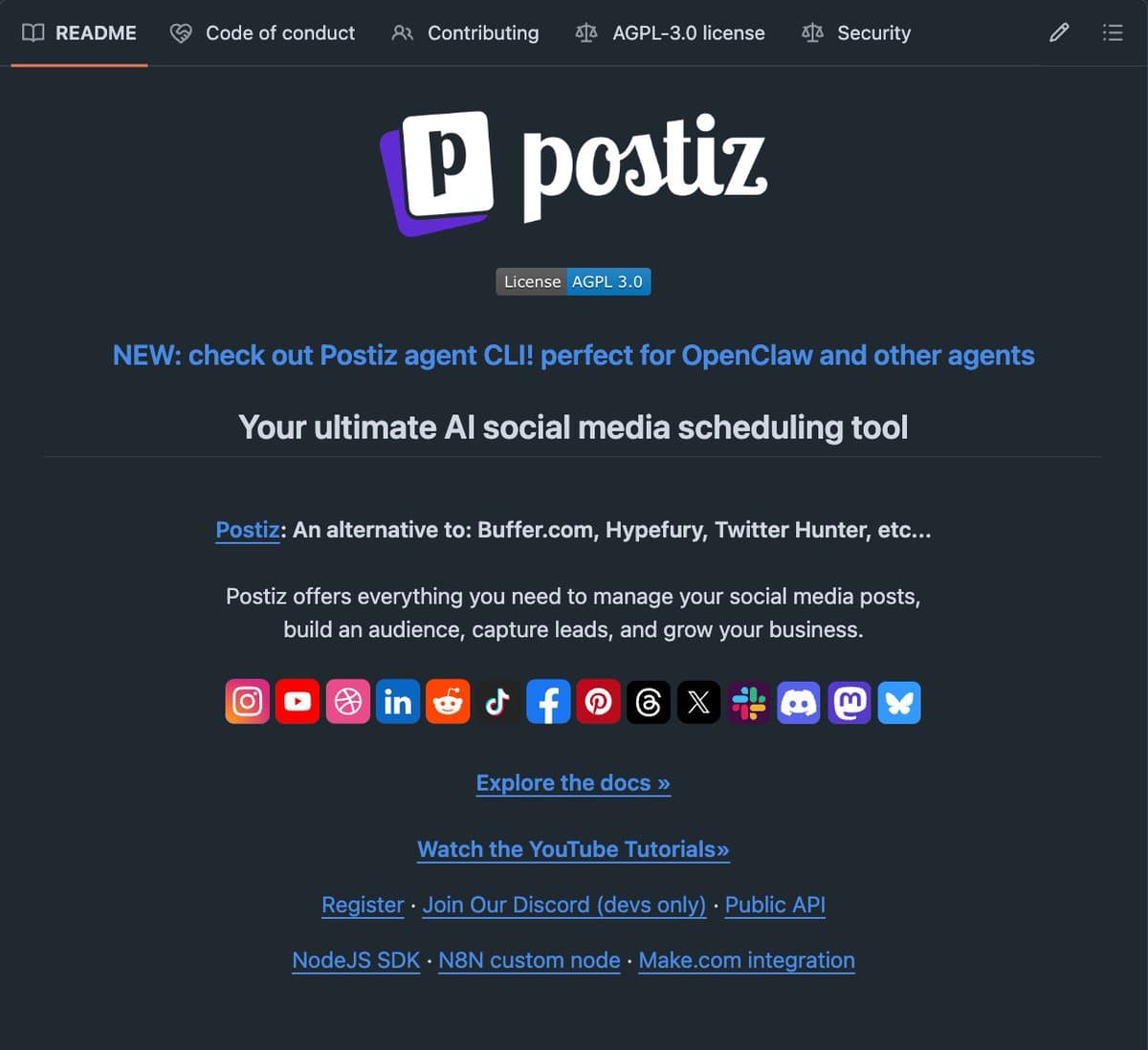
A new open-source project is taking direct aim at the established—and expensive—social media management SaaS market. Postiz, a self-hostable platform, bundles AI content generation, multi-platform scheduling, analytics, and automation into a single dashboard, offering a zero-cost alternative to tools like Buffer, Hootsuite, and Sprout Social.
The core proposition is stark: replace recurring monthly fees with a one-time self-hosting setup. Where Buffer charges per social channel and Hootsuite's professional plan starts at $199 monthly, Postiz's source-available model places the entire feature set into the user's hands for the cost of infrastructure.
Key Takeaways
- Postiz, an open-source AI social media platform, offers scheduling, content creation, and analytics across 25+ platforms.
- Its self-hosted version is free, challenging paid tools like Buffer ($6/channel) and Hootsuite ($199/month).
What's New: A Full-Stack, Open-Source Alternative

Postiz is not a minimal clone. According to its Product Hunt and GitHub documentation, it positions itself as a "social media command center" with a broad feature set typically gated behind enterprise SaaS tiers:
- Multi-Platform Scheduling: Supports over 25 platforms including X, Instagram, LinkedIn, TikTok, YouTube, Reddit, Facebook, Threads, and niche networks like Bluesky and Mastodon.
- Integrated AI Content Creation: Includes an AI text generator for post copy and a built-in Canva-like design editor for creating images.
- Comprehensive Analytics: A unified dashboard for tracking performance across all connected platforms.
- Workflow & Automation: Features team collaboration tools (member invites, review/approval workflows) and automation triggers (e.g., auto-post/comment upon hitting engagement milestones).
- API & Extensibility: Offers a full public API for integration with automation platforms like n8n, Make.com, or Zapier.
The project is licensed under AGPL-3.0 and has gained significant traction, with 28,000+ stars on GitHub, 5,000+ forks, and "millions of Docker downloads," according to the source. It also achieved the #1 Product of the Day, Week, and Month on Product Hunt.
The Core Differentiator: Self-Hosted, No Feature Gates
The most significant claim is that the self-hosted version contains every feature of the paid hosted version with no premium-tier lockouts. This means no paywalls for analytics, team seats, or platform connections—a direct challenge to the tiered pricing models of its competitors.
Buffer $6/month per channel ~$360/year (5 channels) Hootsuite $199/month (Professional) ~$2,388/year Sprout Social $249/month (Standard) ~$2,988/year Postiz (Self-Hosted) $0 / Self-hosted Infrastructure cost onlyPricing comparison based on figures cited in the source announcement.
The trade-off is clear: users exchange the convenience and maintenance of a managed SaaS for full control, data ownership, and the elimination of recurring license fees, assuming the technical overhead of deployment and upkeep.
Technical Details & Practical Considerations
For engineers and technical teams, the appeal lies in the stack's openness. The AGPL license allows for inspection, modification, and deployment on private infrastructure. The availability of a full public API enables deep customization and integration into existing martech workflows.
However, "free" here means free as in freedom (and beer), not free from effort. The total cost of ownership shifts from a monthly subscription to the time and expertise required for:
- Deployment & Hosting: Setting up and maintaining the Docker containers or equivalent deployment on a cloud/VPS.
- Updates & Security: Managing updates, security patches, and dependencies.
- Platform API Maintenance: Handling the inevitable changes and authentication renewals for the 25+ integrated social platform APIs.
This model is inherently more attractive to developers, IT-enabled marketing teams, and privacy-conscious organizations than to non-technical small business owners.
gentic.news Analysis
This launch is a notable data point in two converging trends: the democratization of AI-powered SaaS functionality through open-source and the increasing pressure on traditional SaaS business models.
Postiz follows a playbook seen in other segments: take a complex, expensive SaaS product (like social media management), rebuild it with modern AI capabilities integrated from the start, and release it under an open-source license to drive rapid adoption and community contribution. We've observed similar dynamics in areas like analytics (with tools like PostHog challenging Mixpanel/Amplitude) and marketing automation. The AGPL license is a strategic choice—it ensures the core project remains open while potentially creating a market for commercial support, hosted services, or enterprise extensions, a common path for open-source companies like GitLab and Sentry.
Technically, the integration of AI for both text and image creation within the workflow is table stakes for any modern content tool. The more challenging engineering feat is the robust, maintainable integration with two dozen distinct social media APIs, each with its own rate limits, authentication quirks, and policy changes. The project's GitHub traction suggests a community is forming to shoulder this maintenance burden.
For practitioners, Postiz represents a viable, high-control option, but it's not a direct drop-in replacement for everyone. The decision matrix hinges on a team's technical bandwidth versus its budget and need for vendor-supported reliability. Its emergence, however, is a clear signal to incumbents that their feature sets are no longer defensible solely by closed code, and that pricing must be justified by superior ease-of-use, support, and stability.
Frequently Asked Questions
Is Postiz really completely free?
Yes, the software itself is free to use, modify, and self-host under the AGPL-3.0 license. You will, however, need to pay for and manage your own server or cloud hosting infrastructure to run it. There is also a paid hosted version offered by the creators for those who prefer a managed service.
What are the main technical requirements to self-host Postiz?
Based on its popularity as a Dockerized application, you will need a server (like a Linux VPS) capable of running Docker containers. You will also need to configure environment variables, set up a database (likely PostgreSQL), and obtain and manage API keys for each social media platform you wish to connect. Basic DevOps knowledge is required for setup and ongoing maintenance.
How does the AI content generation work in Postiz?
The source announcement states it includes an AI text generator for post content and a built-in design editor for images. While specific model details aren't provided, this typically involves integrating with an LLM API (like OpenAI's GPT or a local model) for text and potentially using libraries or APIs for image generation and template-based design. The quality and cost of these AI features will depend on the underlying models and APIs configured by the user.
Can Postiz truly replace Hootsuite or Sprout Social for an enterprise?
It can replicate the core technical functionality, but for large enterprises, the switch involves more than just features. Enterprises often pay for guaranteed uptime (SLAs), dedicated support, security certifications, and seamless integration with other enterprise software. While a technically proficient team could build this around Postiz, the incumbent SaaS tools sell a complete, supported package. Postiz is a stronger fit for tech-native companies and mid-market teams with in-house DevOps resources.