Key Takeaways
- The article presents CI/CD, monitoring, rollback, and scaling patterns for AI agent production deployments from a SaaS practitioner.
- It emphasizes treating multi-agent workflows as atomic units, using OpenTelemetry tracing, and implementing circuit breakers for resilience.
What Happened

A senior AI engineer at a mid-size SaaS company published a detailed guide on production deployment patterns for AI agent systems, drawing from real-world experience shipping conversational assistants, data-extraction pipelines, and multi-step reasoning loops. The article covers four critical areas: CI/CD pipeline design, monitoring and observability, rollback and recovery strategies, and scaling patterns.
Technical Details
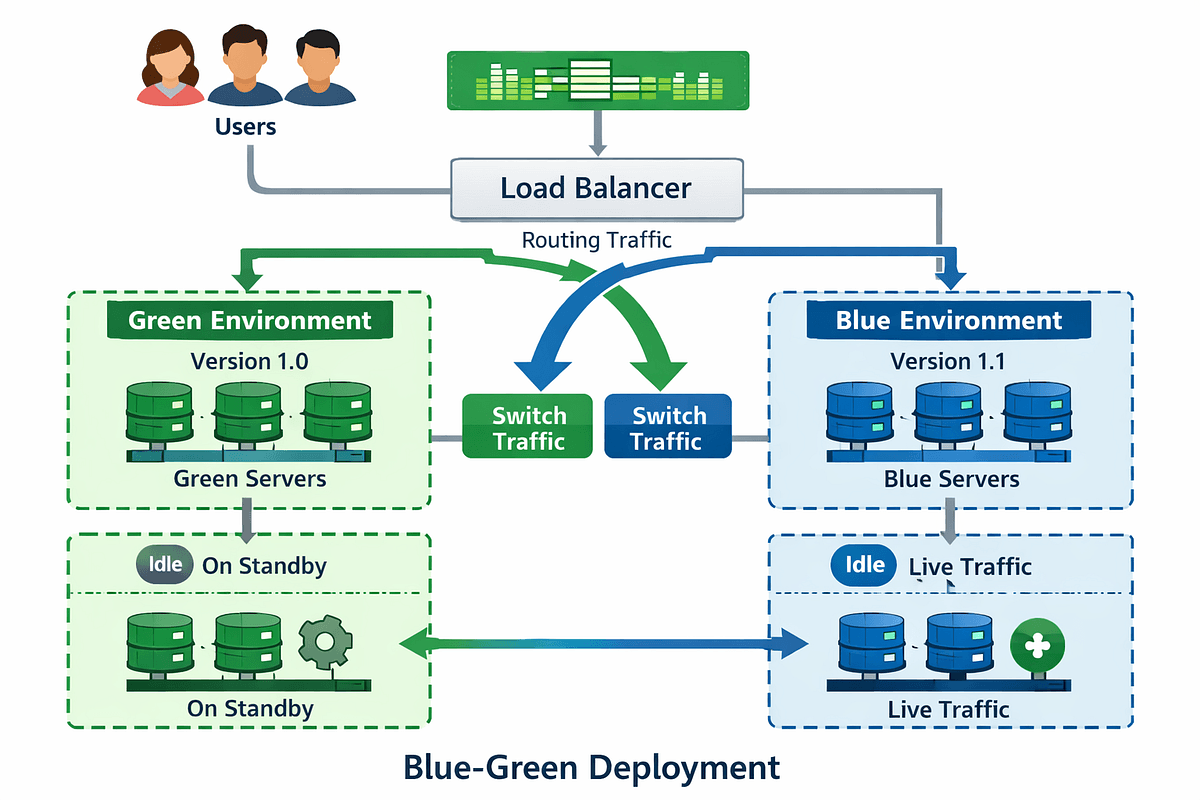
The guide emphasizes treating multi-agent workflows as a single deployable unit. The author uses a directed acyclic graph (DAG) encoded as a JSON manifest, stored in the same repository as the code. A CI job validates that updated manifests still reference existing Docker images and that new images pass unit tests. Atomic deployment uses a blue-green style swap where the entire graph is redeployed under a new service name, with traffic switched via a load balancer. This approach enabled zero-downtime releases for a chatbot processing 12,000 requests per minute.
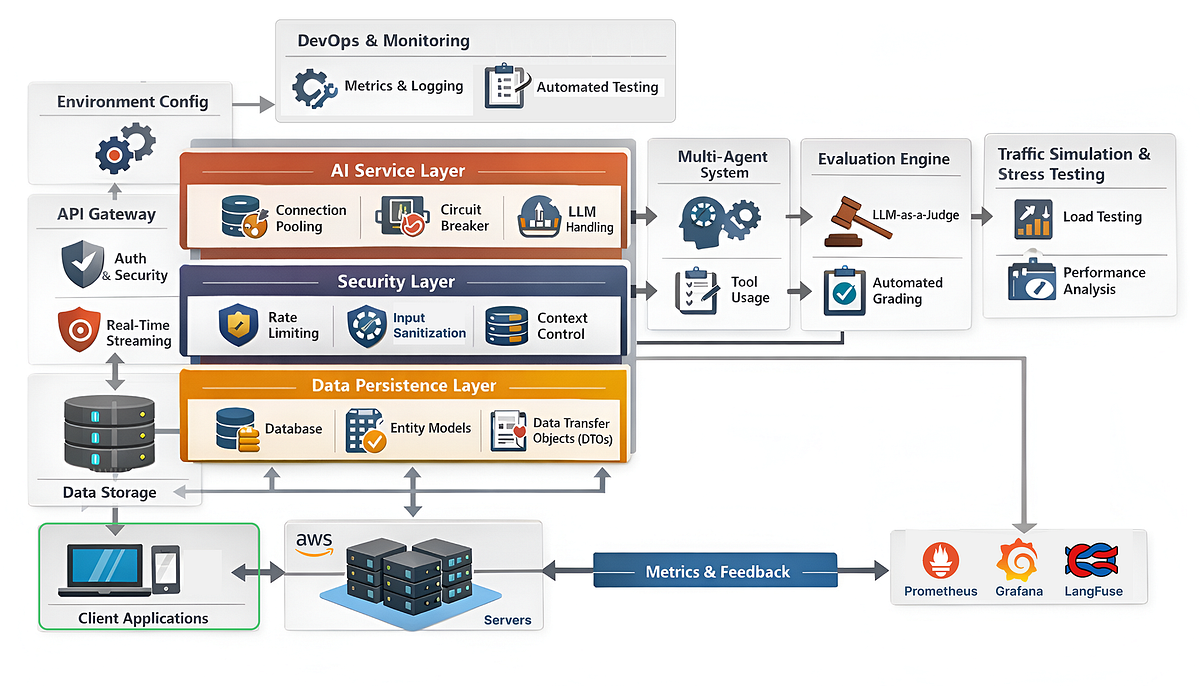
For monitoring, the team integrated OpenTelemetry into each agent container, instrumenting tool adapters with custom span attributes capturing the agent’s prompt, retrieved context, and final response. This allowed querying a Grafana dashboard to see exactly which step produced an out-of-bounds value. The author caught a subtle bug where an agent was feeding HTML markup into a markdown renderer, causing downstream parsing errors—something that would have appeared as only a generic 500 error without detailed tracing.
Rollback strategies include persisting intermediate state of each workflow step in a durable store (e.g., DynamoDB). Every step checks the version of its input before proceeding; if the persisted state hash doesn’t match, it aborts and returns a structured error. The orchestrator triggers a rollback to the last known good snapshot. Agents are designed to be idempotent, so re-executing the same tool with the same input yields the same output, enabling safe retries without duplicate side effects. An automatic circuit breaker trips after three consecutive failures and redirects requests to a fallback agent that returns a safe default response.
Scaling patterns are differentiated by agent statefulness. Stateless reasoning agents (e.g., question-answering) run behind a Kubernetes Horizontal Pod Autoscaler, with 10–20 pods during peak hours. Stateful planners (e.g., trip-itinerary planner) maintain conversation history and mutable task queues, requiring dedicated nodes with more CPU and memory, plus sticky session affinity in the service mesh. The author notes that choosing the wrong model once led to overscaling a planner, racking up $2,300 in unnecessary EC2 costs in a single month.
Resource isolation uses explicit CPU and memory requests and limits for every container, plus namespace-level ResourceQuota objects that cap total CPU and GPU resources per business domain, preventing a surge in one domain from crippling another.
Retail & Luxury Implications
AI agents are increasingly deployed in retail for customer service, personal shopping assistants, inventory management, and dynamic pricing. The patterns described are directly applicable to luxury retail environments where reliability, traceability, and graceful failure handling are critical—a chatbot that loops indefinitely or returns incorrect product recommendations damages brand trust.
- CI/CD for multi-agent workflows: Retailers running conversational commerce agents (e.g., product advisor, checkout assistant, returns handler) can use the blue-green deployment pattern to update individual agents without breaking the customer experience.
- Tracing agent decisions: Luxury brands investing in AI-driven personal stylists need full observability into why a particular recommendation was made, especially for regulatory compliance (e.g., GDPR right to explanation).
- Circuit breakers: During high-traffic events like Black Friday or a new collection launch, a circuit breaker can prevent a failing agent from cascading into a full system outage.
- Scaling patterns: Stateless agents (e.g., product search) can scale horizontally during peak demand, while stateful agents (e.g., multi-turn conversation with context) require vertical scaling with sticky sessions.
Business Impact
The author provides concrete data points: zero-downtime releases for a 12,000 requests/minute chatbot, and a $2,300 cost overrun from choosing the wrong scaling model. For retailers, the cost of downtime during peak sales periods can be orders of magnitude higher. Implementing these patterns reduces operational risk.
Implementation Approach
- Complexity: Medium. Requires DevOps expertise in CI/CD (GitLab CI, AWS ECS), containerization (Docker), and orchestration (Kubernetes).
- Effort: 2–4 weeks for a small team to instrument tracing and implement blue-green deployment for an existing agent system.
- Prerequisites: Existing containerized agents, a durable state store (DynamoDB, Redis), and a Kubernetes or ECS cluster.
Governance & Risk Assessment
- Maturity: The patterns are battle-tested in SaaS production but not yet widely adopted in retail. Expect 6–12 months before becoming mainstream in luxury.
- Privacy: Tracing agent decisions captures user prompts and contexts, which may contain PII. Retailers must ensure compliance with GDPR and CCPA when implementing OpenTelemetry spans.
- Bias: Circuit breakers that fall back to safe defaults could introduce systematic bias if the default responses are not carefully designed.
gentic.news Analysis
This article fills a critical gap in the AI agent ecosystem. While most coverage focuses on agent capabilities (e.g., ByteDance finding agents double learning speed every 3 months, or Klarna’s fight for top of wallet in agentic commerce), the operational reality of running these systems at scale is rarely discussed. The patterns here are foundational—any retailer deploying customer-facing AI agents should treat this as required reading.
The emphasis on idempotent design and circuit breakers is particularly relevant for luxury retail, where a single hallucinated product recommendation or checkout error can erode customer trust. The author’s cost example ($2,300/month from wrong scaling) also underscores that operational mistakes have real P&L impact, not just technical debt.
However, the article is light on GPU-specific resource management for large language models running locally, and doesn’t address multi-cloud or edge deployment scenarios that might be relevant for global luxury brands. These remain open questions for the field.
Source: pub.towardsai.net