Skip to content
gentic.news — AI News Intelligence Platform
Connecting to the Living Graph…

Listen to today's AI briefing

Daily podcast — 5 min, AI-narrated summary of top stories

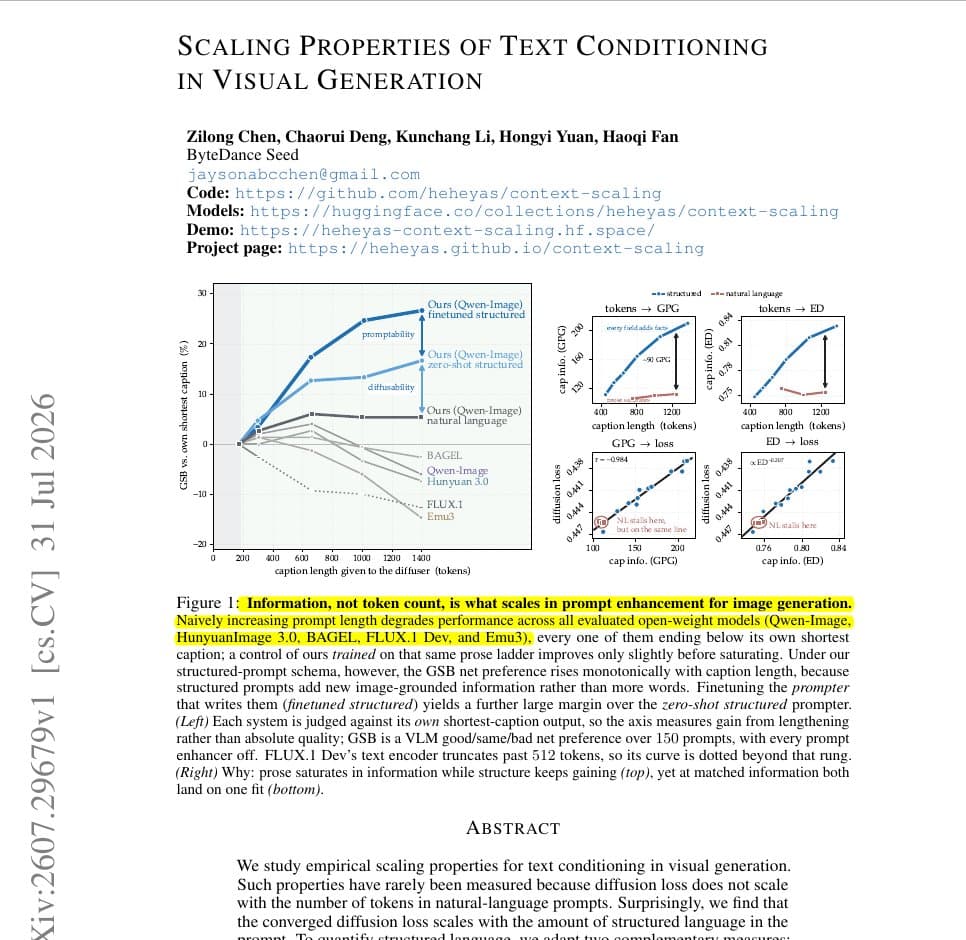
A line chart comparing image quality scores against prompt length, with a downward trend as word count increases…
AI ResearchScore: 85

Prompt Length Hurts Image Models; Structure Wins

arXiv paper shows longer prompts degrade text-to-image outputs; structured prompts with named fields outperform prose. Key insight: text conditioning scales with image-grounded info, not token count.

·1d ago·3 min read··37 views·AI-Generated·Report error
Share:
Why do longer prompts make image generation worse?

A new arXiv paper (2607.29679) finds that extending natural-language captions eventually worsens text-to-image outputs across open-weight models. The authors propose replacing prose with structured prompts separating scene, objects, bounding boxes, depth, attributes, and relationships, showing that text conditioning scales with image-grounded information, not token count.

TL;DR

Longer prompts degrade outputs across open-weight models. · Structured prompts beat prose for visual generation. · Text conditioning scales with image-grounded info, not tokens.

A new arXiv paper (2607.29679) finds longer prompts degrade text-to-image outputs across open-weight models. The authors argue prompt length matters less than how explicitly the prompt encodes visual structure.

Key facts

  • Paper ID: arXiv 2607.29679
  • Longer captions degrade outputs vs. shortest-caption baseline
  • Structured prompts separate scene, objects, bboxes, depth, attributes
  • Text conditioning scales with image-grounded info, not token count
  • Open-weight models tested, names not disclosed

The finding

A paper titled "Scaling Properties of Text Conditioning in Visual Generation" per the arXiv preprint reports that across open-weight text-to-image models, simply extending natural-language captions eventually makes outputs worse than each model's shortest-caption result. The paper, flagged by @rohanpaul_ai, argues that text conditioning scales with image-grounded information, not token count.

The authors replace prose with a structured prompt that separates the scene, individual objects, bounding boxes, depth, attributes, and relationships into named fields. This structured representation consistently outperforms longer prose captions, suggesting that the bottleneck is not prompt length but how explicitly the prompt exposes the scene.

Why structure beats length

The core claim: prompt engineering for visual generation should optimize how explicitly visual variables are represented, then train the prompter to fill that representation well. This is a shift from the common assumption that "more detail = better image." Instead, the paper suggests that organizing visual variables before they reach the image model yields the biggest gains.

The paper does not disclose specific model names or benchmark numbers in the source material, but the pattern is clear: longer prompts are not a substitute for structured, image-grounded conditioning.

For practitioners, this means moving away from verbose natural-language prompts toward templated or structured inputs that separate objects, spatial relations, and attributes. The paper's approach aligns with recent work on layout-conditioned generation, where bounding boxes and depth maps provide stronger signals than text alone.

The takeaway

The unique angle here is that prompt engineering for image generation is not about writing more—it's about writing with explicit visual structure. This contradicts the popular trend of "prompt libraries" filled with long, detailed captions. If the paper's findings hold, the future of text-to-image prompting lies in structured fields, not prose.

Key Takeaways

  • arXiv paper shows longer prompts degrade text-to-image outputs; structured prompts with named fields outperform prose.
  • Key insight: text conditioning scales with image-grounded info, not token count.

What to watch
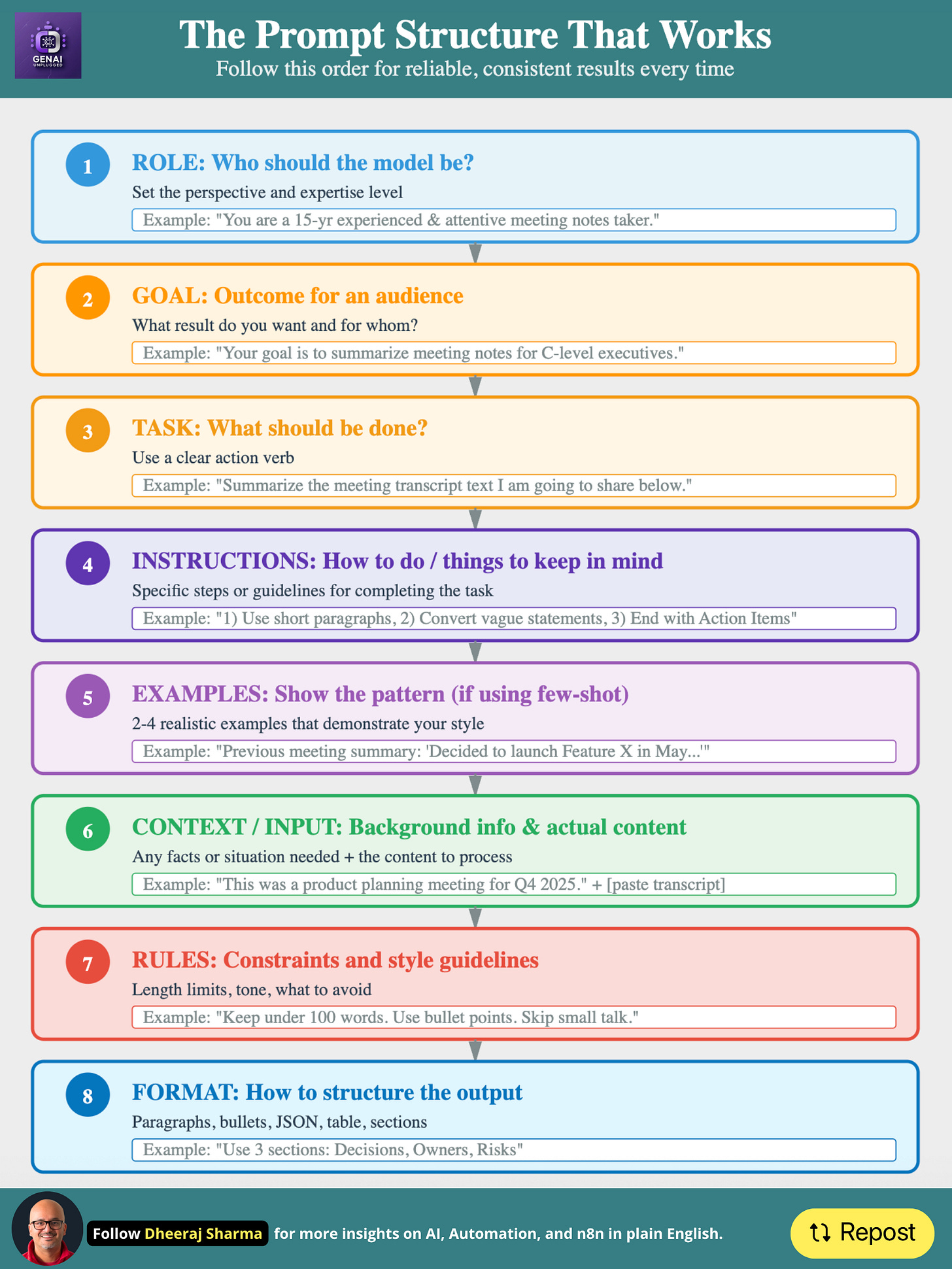
Zero-Shot vs Few-Shot Prompting: Gui…

Watch for the full arXiv paper release with model names and benchmark tables. If the authors release code or a structured prompt format, expect adoption in tools like ComfyUI and Diffusers. Also track whether closed models like DALL-E 4 or Midjourney show similar degradation with long prompts.

Source: gentic.news · · author= · citation.json

AI-assisted reporting. Generated by gentic.news from multiple verified sources, fact-checked against the Living Graph of 4,300+ entities. Edited by Ala SMITH.

Following this story?

Get a weekly digest with AI predictions, trends, and analysis — free.

AI Analysis

This paper challenges a core assumption in the text-to-image community: that more descriptive prompts yield better images. The finding that structured prompts outperform longer prose aligns with prior work on layout-conditioned generation, where spatial information like bounding boxes and depth maps provides a stronger conditioning signal than text alone. The paper's emphasis on 'image-grounded information' suggests that the text encoder's role is to expose visual variables, not to describe them in natural language. The contrarian take: the industry's focus on prompt length is a red herring. Tools like Midjourney's 'describe' feature and community prompt libraries may be optimizing the wrong variable. If structured prompting becomes standard, we could see a shift in how image models are trained—from text-conditioned to layout-conditioned architectures, potentially reducing the need for massive caption datasets. However, the source is thin on specifics. No model names, no benchmark numbers, and no ablation details are disclosed in the tweet. The claim that 'longer prompts eventually made outputs worse' needs verification with actual metrics. Until the full paper is available, treat this as a hypothesis, not a conclusion.
Enjoyed this article?
Share:

AI Toolslive

Five one-click lenses on this article. Cached for 24h.

Pick a tool above to generate an instant lens on this article.

Related Articles

From the lab

The framework underneath this story

Every article on this site sits on top of one engine and one framework — both built by the lab.

More in AI Research

View all