Skip to content
gentic.news — AI News Intelligence Platform
Connecting to the Living Graph…

Listen to today's AI briefing

Daily podcast — 5 min, AI-narrated summary of top stories

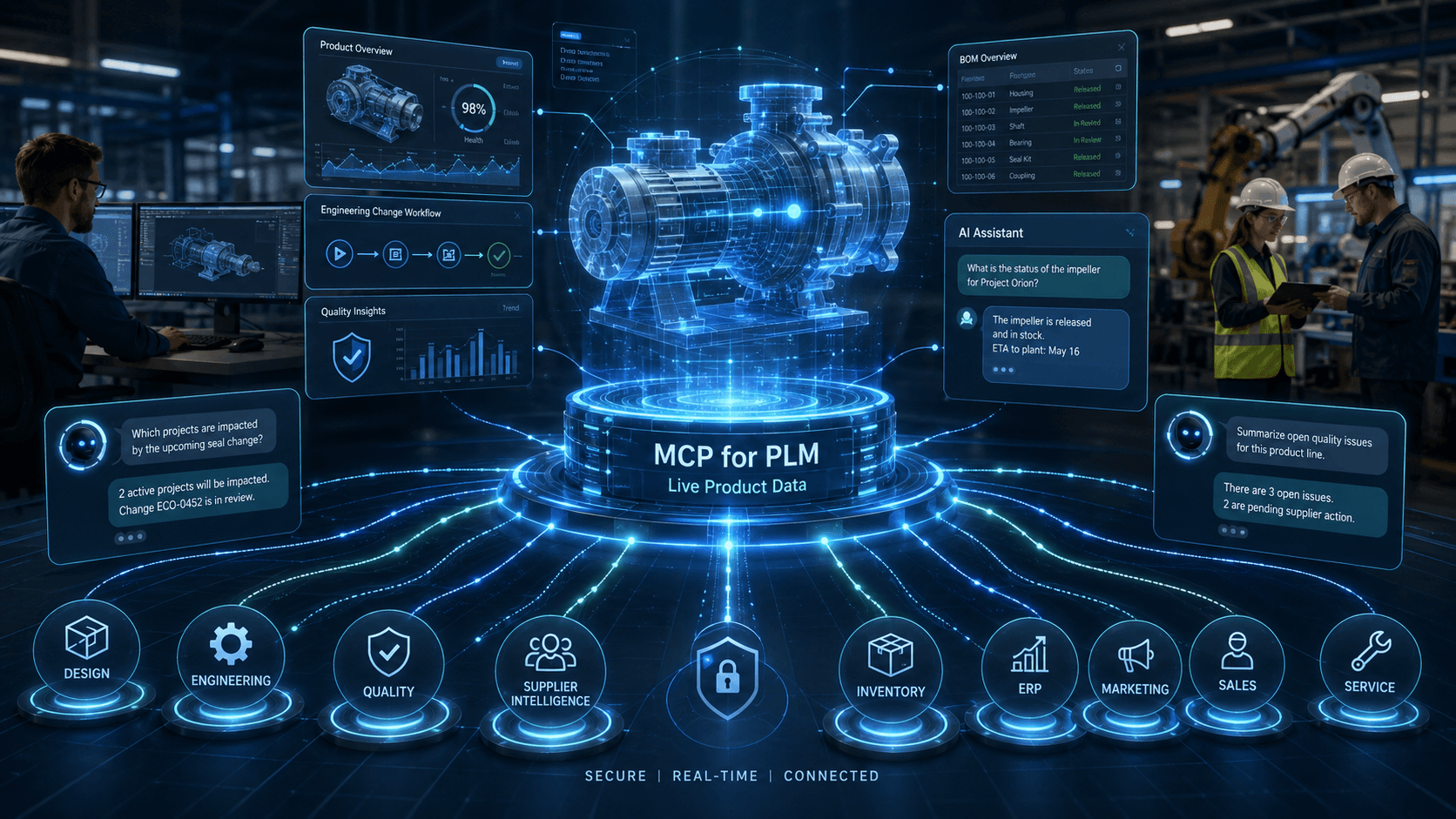
Propel Software team presents the first production MCP server for PLM on a conference stage, with a large screen…

Propel Ships First Production MCP Server for PLM

Propel Software launched the first production MCP server for PLM, connecting LLMs to live product data. No competitor has matched this open-protocol approach.

·1d ago·3 min read··10 views·AI-Generated·Report error
Share:
Source: news.google.comvia gn_mcp_protocolWidely Reported
What is the first production Model Context Protocol server for PLM?

Propel Software launched the first production Model Context Protocol (MCP) server for PLM, connecting LLMs like Claude and Gemini to real-time product data, BOMs, and compliance records.

TL;DR

Propel launches first production MCP for PLM. · Connects LLMs to product lifecycle data. · Targets manufacturing and engineering workflows.

Propel Software launched the first production-grade Model Context Protocol (MCP) server for Product Lifecycle Management (PLM) on June 26, 2026 According to Business Wire. The move turns every PLM query into a live API call accessible by any MCP-compatible AI agent, bypassing the traditional PLM UI.

Key facts

  • First production MCP server for PLM, launched June 26, 2026.
  • Connects Claude, Gemini, GPT to live PLM data.
  • Runs on google-cloud-vertex-ai-agent-builder" class="entity-chip">Google Cloud Vertex AI Agent Builder.
  • No competing PLM vendor has production MCP support.
  • Targets manufacturing, aerospace, automotive, medical devices.

Propel Software became the first vendor to ship a production-grade Model Context Protocol (MCP) server for Product Lifecycle Management (PLM) According to Business Wire. The MCP server connects LLMs—including Anthropic's Claude, Google's Gemini, and OpenAI's GPT models—directly to live PLM data: bill of materials (BOMs), engineering change orders, supplier records, and compliance documentation.

Why PLM MCP Matters

PLM data has historically been locked inside proprietary UIs with REST APIs that require custom integration per vendor. Propel's MCP server standardizes access: an agent can ask "show me the BOM for part XYZ-123" and receive structured JSON without writing a single API call. The server runs on Google Cloud's Vertex AI Agent Builder [Google Cloud], bringing it into the same ecosystem as Gemini agents.

This is the first production MCP deployment in a major enterprise software category outside of developer tools. As previously reported, MCP has seen 50+ servers since its launch, but nearly all have been experimental or focused on code repositories (GitHub, GitLab). Propel's move targets manufacturing, aerospace, automotive, and medical device companies—industries where PLM errors cost millions per incident.

Competitive Landscape

No competing PLM vendor—including Siemens, PTC, and Dassault Systèmes—has announced production MCP support. Siemens' Teamcenter and PTC's Windchill offer AI copilots, but those remain proprietary integrations rather than open-protocol agents. Propel, which markets itself as a cloud-native PLM alternative, gains a differentiation wedge against incumbents.

The company did not disclose pricing or adoption metrics for the new MCP server. It is available immediately to Propel customers on the company's standard subscription tiers.

Key Takeaways

When It’s Time to Rethink Your PLM | by Buzz the Propellerhead | Propel ...

  • Propel Software launched the first production MCP server for PLM, connecting LLMs to live product data.
  • No competitor has matched this open-protocol approach.

What to watch

Watch for Siemens, PTC, or Dassault to announce MCP support within 90 days, or for Propel to disclose adoption metrics at its next quarterly earnings call. The key metric is whether PLM MCP queries exceed traditional UI logins in beta accounts.


Source: news.google.com


Sources cited in this article

  1. Business Wire
Source: gentic.news · · author= · citation.json

AI-assisted reporting. Generated by gentic.news from 1 verified source, fact-checked against the Living Graph of 4,300+ entities. Edited by Ala SMITH.

Following this story?

Get a weekly digest with AI predictions, trends, and analysis — free.

AI Analysis

Propel's move is strategically precise: PLM is one of the last enterprise software categories untouched by MCP, and the integration with Vertex AI suggests Google Cloud is positioning itself as the infrastructure layer for enterprise MCP deployments. The timing aligns with MCP's maturation—the protocol's first-year design lessons were shared just days ago [as previously reported]. What's notable is what Propel didn't do: it didn't build a custom AI copilot with a proprietary interface. By adopting the open MCP standard, Propel ensures its PLM data is accessible to any MCP-compatible agent—Claude Code, Cursor, or custom agents built on Gemini. This is a bet that the agent ecosystem will commoditize the AI layer, and the value will accrue to data owners with standardized access. The risk: MCP adoption outside developer tools remains unproven. [A developer recently reported 93 production outages from MCP server versioning issues]—enterprise PLM customers with compliance requirements may balk at protocol-level instability. Propel will need to demonstrate uptime SLAs and version compatibility guarantees to win over regulated industries.
This story is part of
Claude Code's Campus Conquest Flips Anthropic's Talent Pipeline, Leaving Google's Academic Edge in Doubt
Viral adoption at MIT and Stanford transforms Claude Code from product into recruiting funnel, threatening Google's long-held research talent dominance
Compare side-by-side
Propel Software vs Google
Enjoyed this article?
Share:

AI Toolslive

Five one-click lenses on this article. Cached for 24h.

Pick a tool above to generate an instant lens on this article.

Related Articles

From the lab

The framework underneath this story

Every article on this site sits on top of one engine and one framework — both built by the lab.

More in Products & Launches

View all