The Experiment: Testing Algorithmic Adaptability
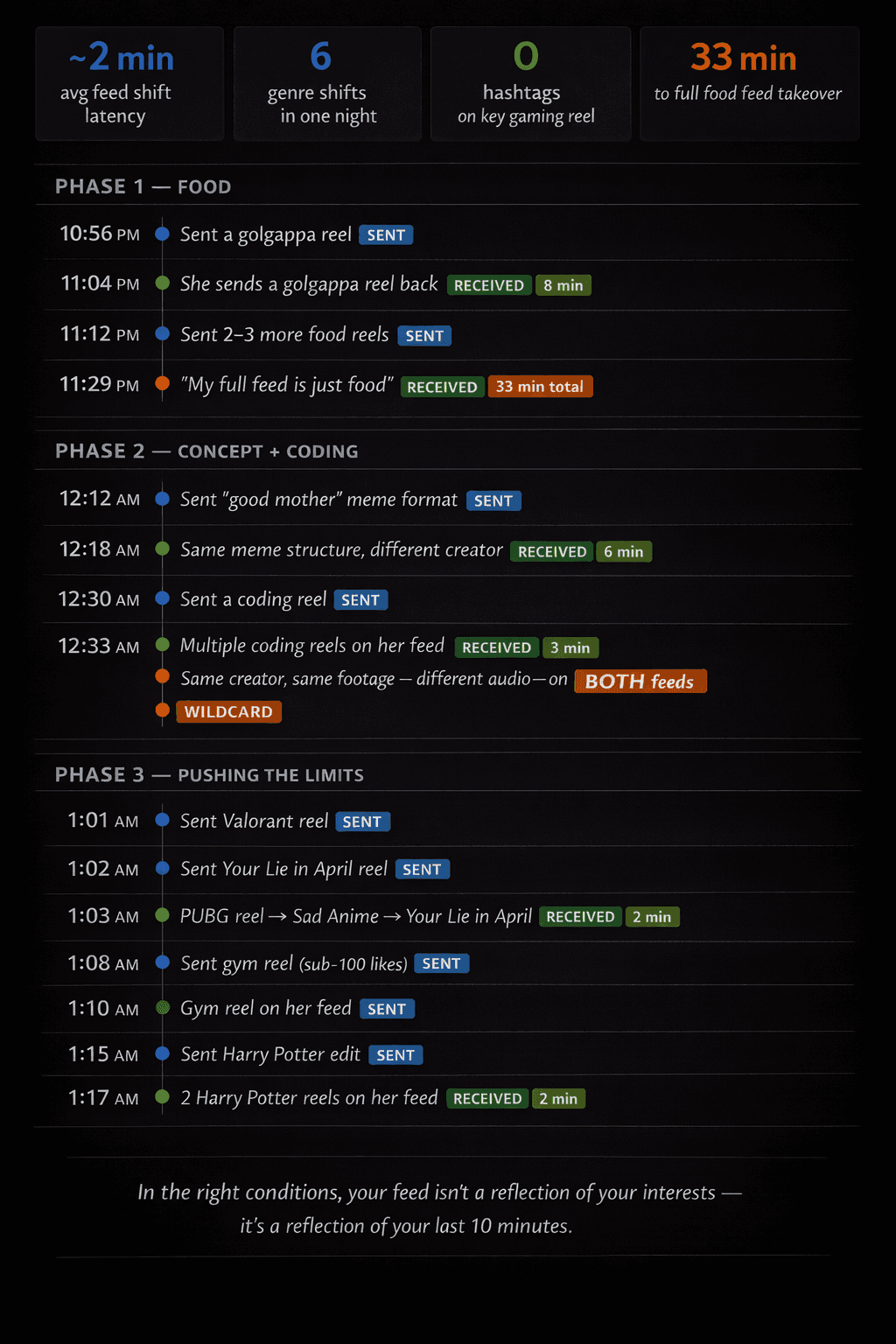
The source presents a personal case study examining how quickly Instagram's Reels recommendation system responds to shifts in user interest. The author conducted a "late-night experiment" to observe the platform's algorithmic adaptation speed when user engagement patterns change abruptly.
While specific methodological details aren't provided in the snippet, the core finding is clear: Instagram's recommendation engine demonstrates remarkable responsiveness, with significant shifts in content recommendations occurring within a surprisingly short timeframe—reportedly less than 30 minutes after the user's behavior changed.
Why This Matters for Retail & Luxury
For luxury and retail brands investing heavily in social commerce and content marketing, this rapid adaptability has profound implications:
Content Strategy Implications: Brands can't rely on static content calendars. The algorithm's quick response means that content performance feedback loops are incredibly tight. A successful piece of content can immediately influence what similar content gets shown to that user and potentially their network.
Audience Segmentation in Real-Time: The system isn't just categorizing users into broad interest buckets—it's tracking micro-shifts in attention. A user who typically engages with handbag content but suddenly starts liking watch videos could be signaling a new purchasing interest, and the algorithm picks this up almost immediately.
Testing and Optimization Speed: Creative testing that might have taken weeks to yield insights in traditional digital advertising can now show directional signals within hours on platforms like Instagram Reels. This enables much faster iteration on what resonates with target audiences.
Business Impact: The Need for Agile Content Operations
The primary business impact isn't in the speed itself, but in what it demands from brand teams:
Reduced Planning Horizons: While seasonal campaigns and hero assets remain important, the content that fills the gaps between these major initiatives must be more responsive and experimental. The algorithm rewards freshness and relevance, not just production quality.
Data-Driven Creative Decisions: Creative teams need access to near-real-time performance data to understand what's working. A video format, aesthetic style, or messaging angle that gains traction should be quickly identified and leveraged.
Resource Allocation: Brands may need to shift resources from lengthy production cycles toward more agile content creation capabilities. This doesn't mean sacrificing quality for luxury brands, but rather developing efficient processes for producing premium content that can respond to trending topics and audience signals.
Implementation Approach: Building Algorithm-Aware Strategies

For retail AI practitioners, this case study suggests several tactical adjustments:
Monitoring Engagement Velocity: Beyond tracking overall engagement rates, teams should monitor how quickly new content gains traction. Rapid early engagement signals strong algorithmic alignment and should trigger amplification efforts.
Sequential Content Testing: Given the algorithm's responsiveness, brands can implement structured testing sequences—releasing variations of content in close succession to quickly identify winning formats before audience attention shifts again.
Cross-Platform Pattern Recognition: While this study focuses on Instagram, similar rapid adaptation likely occurs on TikTok, YouTube Shorts, and other short-form video platforms. Developing unified insights across these platforms creates competitive advantage.
Integration with First-Party Data: The ultimate goal should be connecting these platform signals with first-party customer data. When a user shows rapid interest shifts on social platforms, how does this correlate with browsing behavior on owned channels or purchase intent signals?
Governance & Risk Assessment
Algorithmic Dependence Risk: Over-reliance on any single platform's algorithm creates vulnerability to sudden policy changes or algorithmic shifts. Brands should maintain diversified content distribution strategies.
Content Quality vs. Virality Tension: The pressure to produce content that quickly gains algorithmic favor could potentially conflict with brand safety and quality standards, particularly for luxury houses where brand perception is paramount.
Privacy Considerations: While users knowingly engage with these platforms, brands should be transparent about how they use engagement data to personalize experiences across touchpoints.
Maturity Assessment: This rapid adaptation represents a mature implementation of real-time recommendation systems. Brands working with similar technology for their owned channels (apps, websites) should benchmark their systems against this standard of responsiveness.
gentic.news Analysis
This case study provides empirical validation of trends we've been tracking in recommender system evolution. The rapid adaptation observed aligns with broader industry movement toward real-time personalization systems that can detect and respond to micro-signals in user behavior.
This follows our recent coverage of advanced techniques in user sequence modeling, particularly the "IAT: Instance-As-Token Compression for Historical User Sequence Modeling" research we covered on April 13. That technical paper addressed the computational challenges of processing long user histories—a prerequisite for the kind of rapid adaptation demonstrated in this Instagram case study. The ability to efficiently compress and analyze user interaction sequences enables platforms to detect pattern shifts without expensive recomputation of entire user profiles.
Similarly, this real-world observation complements the findings from the "New arXiv Study Finds No Saturation Point for Data in Traditional Recommender Systems" that we reported on April 9. That research suggested that more data continues to improve recommendation quality, and this Instagram example shows how real-time data streams—not just historical data—contribute to that continuous improvement. The algorithm isn't just working from a static user profile; it's incorporating the most recent interactions to immediately adjust its understanding of user interests.
For luxury retail specifically, this creates both opportunity and challenge. The opportunity lies in reaching potential customers with highly relevant content at the precise moment their interests shift toward your product category. The challenge is operational: maintaining brand consistency and quality while operating at the speed these platforms demand. The most successful brands will be those that develop hybrid strategies—maintaining their core brand narrative while developing agile content capabilities that can capitalize on these rapid algorithmic feedback loops.
Looking forward, we expect to see increased investment in real-time recommendation capabilities across retail-owned channels, not just social platforms. The technical architectures that enable this rapid adaptation on Instagram Reels will increasingly become table stakes for luxury e-commerce apps and personalized shopping experiences.