RedNote's 3B-Parameter Multimodal OCR Model Ranks Second to Gemini 3 Pro on Document Parsing Benchmarks

RedNote's 3B-Parameter Multimodal OCR Model Ranks Second to Gemini 3 Pro on Document Parsing Benchmarks

RedNote has released a 3-billion parameter multimodal OCR model that converts text, charts, diagrams, and tables into structured formats like Markdown and HTML. It reportedly ranks second only to Google's Gemini 3 Pro on OCR benchmarks.

Ggentic.news Editorial·6h ago·2 min read·8 views·via @HuggingPapers
Share:

What Happened

RedNote has released a multimodal Optical Character Recognition (OCR) model called Multimodal OCR. According to an announcement highlighted by the X account @HuggingPapers, the model contains 3 billion parameters and is designed to parse complex documents containing mixed content.

What the Model Does

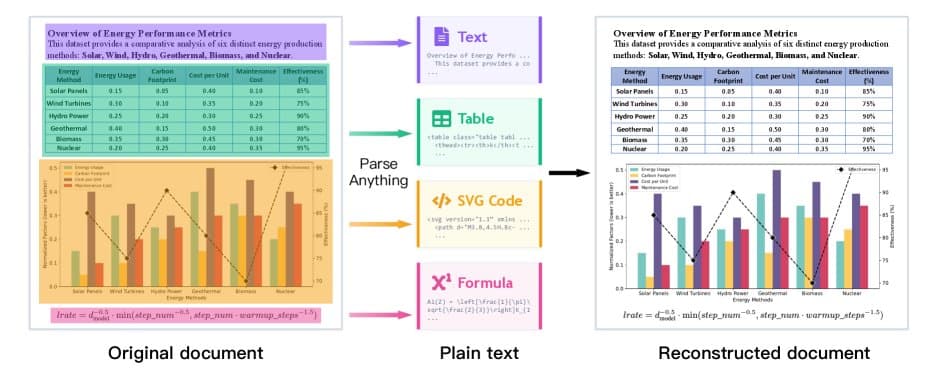
The core function of the model is to convert visual document elements into structured, machine-readable formats. Specifically, it can process:

  • Text
  • Charts
  • Diagrams
  • Tables

The output is not plain text but structured formats suitable for further processing or web display, including:

  • Markdown
  • HTML
  • SVG (Scalable Vector Graphics)
  • LaTeX

This suggests the model goes beyond traditional text extraction to understand the semantic and structural roles of different elements on a page, reconstructing them in a format that preserves their original intent.

Reported Performance

The announcement makes a specific performance claim: the model ranks second only to Gemini 3 Pro on OCR benchmarks. Google's Gemini 3 Pro is a significantly larger, state-of-the-art multimodal model. This positioning implies that RedNote's specialized 3B model is competitive with or surpasses other generalist and specialist models in document understanding tasks, though the specific benchmarks and scores were not detailed in the source.

Context & Availability

The model appears to be publicly released. The source includes a link (https://t.co/055ezUJ1A6), which likely points to the model page on a platform like Hugging Face or a dedicated release announcement, where further technical details, usage examples, and access information would be available.

AI Analysis

The release of RedNote's model points to a clear trend in AI: the move from generalist multimodal models toward efficient, task-specific architectures. A 3B-parameter model claiming competitive performance with a behemoth like Gemini 3 Pro suggests heavy optimization for the document parsing domain. This likely involves a vision encoder fine-tuned on a massive, high-quality corpus of document images paired with their structured ground-truth representations (Markdown, HTML, etc.). For practitioners, the key detail is the output format. Generating clean, structured HTML or LaTeX from a chart or diagram is a significantly harder problem than simple text recognition. It requires the model to understand graphical primitives, spatial relationships, and data encoding. If the model delivers on this, it could automate large portions of data extraction from reports, academic papers, and technical documentation, moving beyond the brittle, rule-based systems common today. The benchmark claim warrants scrutiny. 'OCR benchmarks' is broad. It's crucial to see if this refers to traditional text-accuracy metrics (like Word Error Rate on scanned documents) or newer, holistic 'document understanding' benchmarks that evaluate structure recovery. The real test will be its performance on complex real-world documents with irregular layouts, low quality, or handwritten elements, which are the typical failure points for current systems.
Original sourcex.com

Trending Now

More in Products & Launches

View all