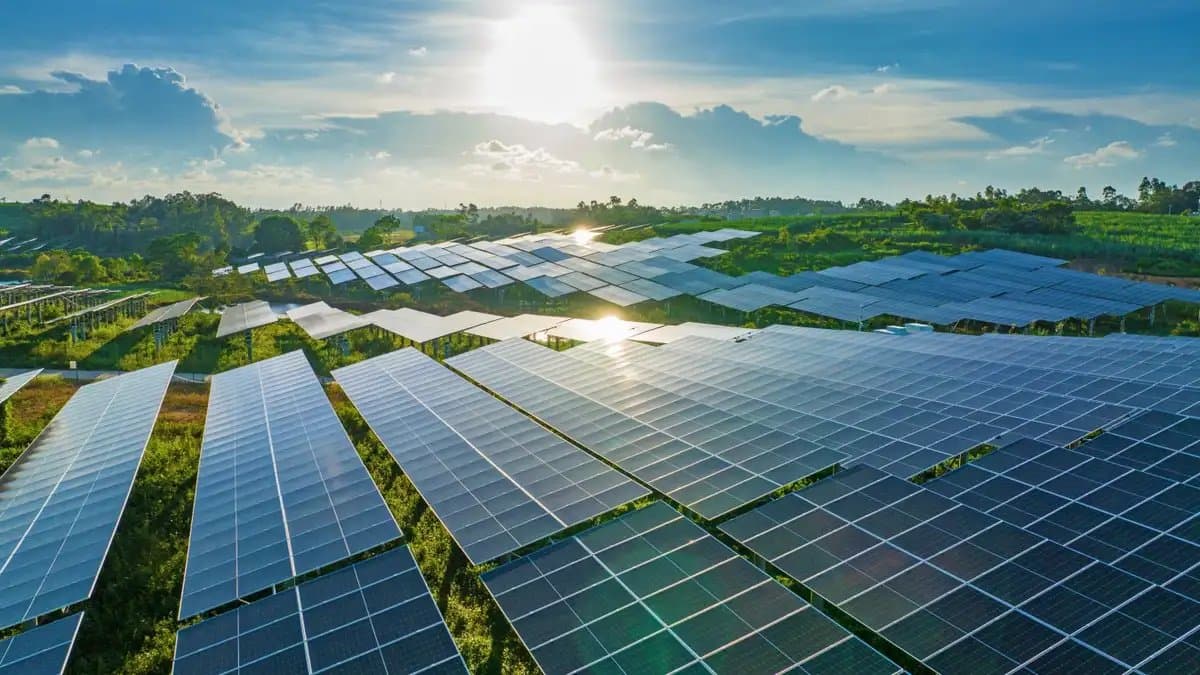
March 2026 — Renewable energy sources now account for nearly half of the world's installed electricity generation capacity, according to data reported by Reuters. In 2025, renewables surged to 49.4% of global capacity, adding a record 692 gigawatts (GW) in a single year to reach a total of 5,149 GW.
The growth represents a 15.5% annual increase, bringing the world significantly closer to the COP28 goal of tripling renewable capacity by 2030. The expansion was overwhelmingly led by solar power, which alone contributed 511 GW of new capacity.
What the Data Shows
The figures highlight a dramatic acceleration in the global energy transition, with solar emerging as the dominant technology. The 511 GW of new solar capacity added in 2025 represents nearly 74% of all new renewable capacity for the year.
This growth trajectory puts the world on a path to potentially meet the ambitious target set at the COP28 climate summit in late 2023, where nearly 200 countries agreed to triple global renewable energy capacity by 2030.
The AI-Energy Nexus
The source commentary explicitly links this energy transition to technological demands: "We need more global solar capacity to power the AI revolution." This statement reflects a growing recognition within the tech industry that the exponential growth of artificial intelligence—particularly large language models and AI training clusters—is creating unprecedented electricity demand.
Data centers powering AI models require massive amounts of reliable, low-cost electricity. The sustainability of AI's expansion is increasingly tied to the availability of clean energy sources that can scale rapidly without corresponding increases in carbon emissions.
Solar as the Primary Driver
With 511 GW of new capacity in 2025, solar has clearly become what the source describes as "the main engine of the energy transition." This represents the largest annual addition of any electricity generation technology in history.
The solar industry's rapid scaling demonstrates how manufacturing improvements, cost reductions, and policy support have converged to make photovoltaic technology the default choice for new electricity capacity in most global markets.
gentic.news Analysis
This renewable energy milestone arrives at a critical juncture for the AI industry. As we reported in February 2026, major AI companies including Google, Microsoft, and Amazon have made aggressive commitments to power their data centers with 100% renewable energy by 2030. The 692 GW of new renewable capacity added in 2025 represents a substantial portion of what will be needed to meet those commitments while accommodating AI's explosive growth.
The timing is particularly significant given the recent surge in AI compute demand. According to our coverage of OpenAI's Sora 2.0 launch in January 2026, training next-generation multimodal models requires energy consumption that scales roughly with the cube of parameter count. Without corresponding growth in clean energy, the AI industry risks becoming a major contributor to global carbon emissions just as climate targets become more urgent.
The solar industry's ability to deliver 511 GW in a single year suggests that renewable scaling may finally be keeping pace with technological demand. However, challenges remain in grid integration, storage, and transmission infrastructure—all areas where AI itself is increasingly being deployed for optimization solutions. This creates a symbiotic relationship where AI both drives electricity demand and helps manage the complex grids needed to deliver renewable energy reliably.
Frequently Asked Questions
How much renewable energy was added in 2025?
According to the Reuters data, 692 gigawatts (GW) of new renewable energy capacity was added globally in 2025. This represents a 15.5% annual growth rate, bringing total renewable capacity to 5,149 GW.
What percentage of global electricity capacity is now renewable?
Renewables now account for 49.4% of global installed electricity generation capacity. This represents nearly half of all capacity worldwide, though actual electricity generation percentages may differ due to capacity factors (how often renewable sources actually produce power).
How much of the new renewable capacity was solar?
Solar power contributed 511 GW of the 692 GW total added in 2025, representing approximately 74% of all new renewable capacity. This makes solar by far the dominant technology in the current energy transition.
What is the connection between renewable energy and AI development?
AI training and inference require massive amounts of electricity in data centers. As AI models grow larger and more complex, their energy demands increase exponentially. Renewable energy sources like solar provide a scalable, low-carbon solution to power this growth without corresponding increases in greenhouse gas emissions, making the AI industry's expansion more sustainable.