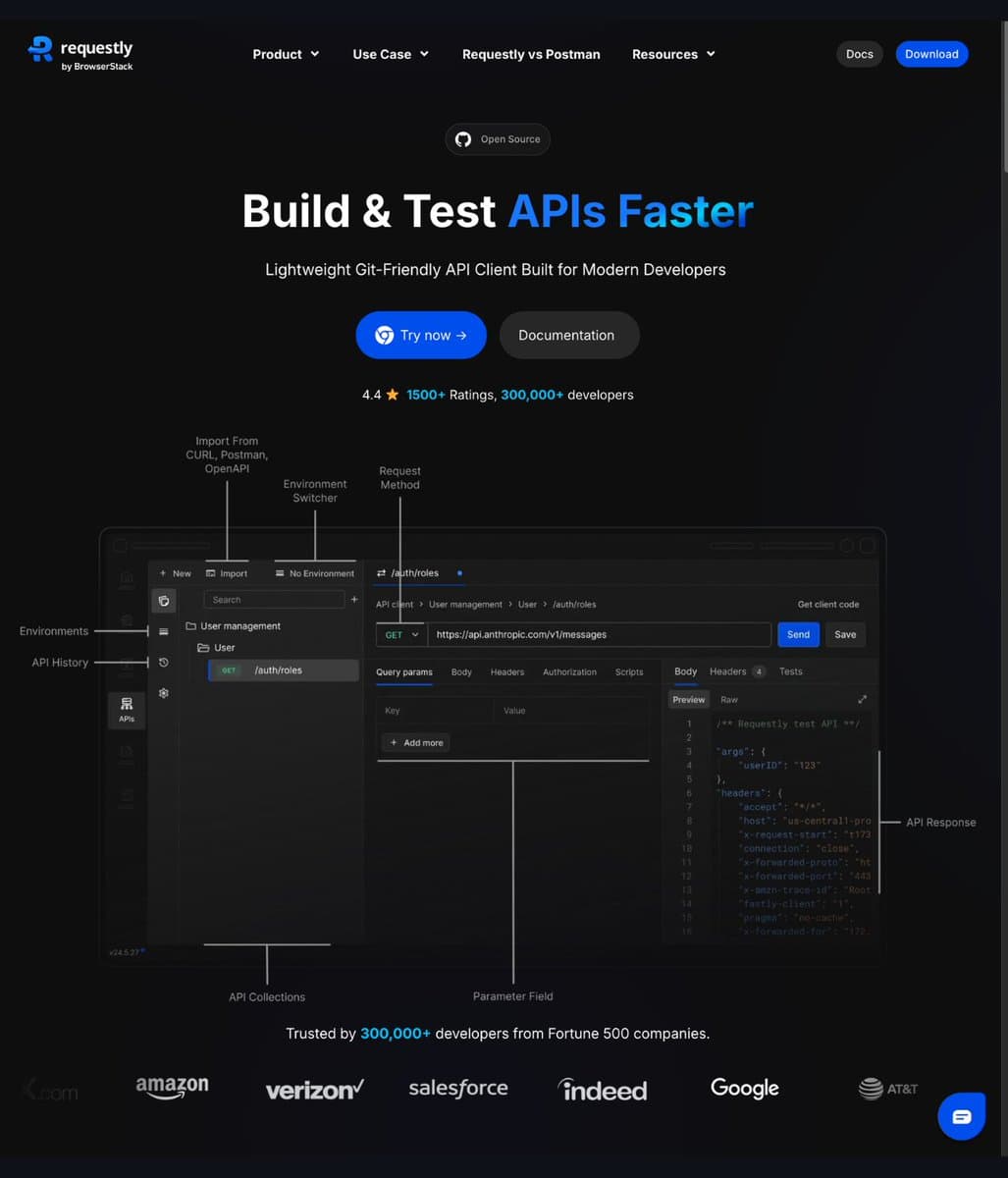
A new AI-powered API development tool called Requestly is taking direct aim at the collaboration headaches endemic to platforms like Postman and Insomnia. Announced via a developer showcase on X, Requestly's core innovation is a Git-native workflow that automatically synchronizes an entire team's API collections, environments, and documentation through version control.
The problem Requestly solves is familiar to any engineering team building or consuming APIs: collections become stale, environment variables (like base URLs) drift between team members, and documentation falls out of sync with actual implementation. Individual Postman setups diverge, leading to "it works on my machine" failures during integration.
What Requestly Actually Does
Requestly is not just another API client. It's a collaboration layer built directly into the API development workflow. According to the announcement, its key features are:
- Git-Based Synchronization: All API collections, environments, tests, and documentation are stored as code in a Git repository (like GitHub or GitLab). When a developer makes a change—adding a new endpoint, updating a request header, or modifying an environment variable—it's committed and pushed. Teammates pull the changes automatically.
- Elimination of Configuration Drift: The tool explicitly solves the "which base URL are you on?" problem by ensuring all team members are using the same, centrally managed environment configurations.
- Live Documentation: Because the collection definitions are the source of truth in Git, documentation generated from them is always current. There is no separate, manually updated wiki that can become "stale."
- AI-Powered Features: While the initial announcement is light on specifics, the tool is described as "AI-powered," suggesting capabilities like intelligent request generation, test creation, or error analysis could be integrated.
The Developer Workflow
The showcased workflow integrates directly into a standard development cycle:
- A developer works on a feature that requires API changes.
- They update or create new requests in the Requestly client, which is linked to their project's Git repo.
- These changes are committed alongside the feature code.
- Teammates pull the latest code; their Requestly client automatically updates with the new API definitions.
- Frontend, backend, and QA engineers are all immediately working against the same, updated API interface.
This model treats API contracts as first-class citizens in the codebase, applying the same rigor of version control and peer review that is standard for application code.
Technical Positioning & Competitive Context
Requestly enters a crowded market dominated by Postman, which popularized the API client but has faced criticism for moving toward a closed, cloud-centric model and cumbersome team collaboration. Open-source alternatives like Insomnia and Bruno have gained traction by offering local-first, file-based storage, but often lack robust built-in synchronization.
Requestly's differentiator is its opinionated integration of Git as the sync engine. It doesn't build its own proprietary cloud sync; it leverages the existing, battle-tested infrastructure teams already use for code. This makes it appealing for security-conscious enterprises and teams already steeped in DevOps/GitOps practices.
Key Comparison:
Postman Proprietary Cloud Workspace Via Postman Cloud Ecosystem, monitoring, public API network Insomnia Local file (can sync to cloud) Git (manual) or paid sync Design, open-source, local-first Bruno Local files/folders Git (manual) Privacy, simplicity, file-based Requestly Git Repository (Automatic) Automatic via Git Eliminating configuration drift, CI/CD integrationgentic.news Analysis
Requestly's launch is a targeted strike at the most persistent weakness in the API toolchain: state synchronization. This move aligns with a broader industry trend we've covered extensively, where developer tools are increasingly adopting infrastructure-as-code (IaC) and GitOps principles. Just as Terraform codified cloud infrastructure and Flux automated Kubernetes deployments, Requestly attempts to codify and automate the API contract.
This development follows a pattern of Postman alternatives gaining ground. We previously covered Bruno's rise as a privacy-focused, file-based challenger and Insomnia's acquisition and subsequent pivot. Requestly takes a different tack, competing not on privacy or design alone, but on automated workflow integrity. Their bet is that teams will value "never being out of sync" more than any single feature of an incumbent.
The mention of AI is notable but currently vague. In this context, AI is most likely to be applied to generating tests from traffic, suggesting request parameters, or auto-documenting endpoints—tasks that benefit from a complete, up-to-date collection history, which Git provides perfectly. If Requestly successfully leverages its Git-native data model to train collection-specific AI agents, it could create a defensible moat.
The competitive response will be telling. Postman has vast resources and could implement a similar Git sync feature, but it might conflict with its cloud workspace business model. Insomnia or Bruno could enhance their existing Git integrations to be more seamless. Requestly's success will depend on executing this single, focused value proposition flawlessly and building a community before the giants move.
Frequently Asked Questions
What is Requestly and how is it different from Postman?
Requestly is an API client designed for team collaboration. Its core difference is that it automatically synchronizes all API collections, environments, and documentation through Git (like GitHub). Unlike Postman, which uses its own cloud workspace for sync, Requestly uses your existing Git repository as the single source of truth, eliminating the problem of stale collections or mismatched environment variables between team members.
How does Requestly's Git sync work?
Requestly stores your API workspace (collections, environments, variables) as structured files (likely YAML or JSON) within your project's Git repository. When you make a change in the Requestly client, it writes to these files and you commit them like any other code change. When your teammates pull the latest code, their Requestly client detects the updated files and automatically refreshes their local workspace. This ensures everyone is always using the exact same API definitions.
Is Requestly free or open-source?
The initial announcement does not specify pricing or licensing. Given its positioning as a professional team tool, it likely will follow a freemium model (free for individuals/small teams, paid for advanced collaboration features for larger organizations). It is not announced as an open-source project like Bruno or Insomnia.
Can I import my existing Postman collections into Requestly?
While not explicitly stated in the launch announcement, it is a near certainty that Requestly will support importing collections from Postman (via the standard v2.1 JSON format) and potentially other clients like Insomnia. This is a basic requirement for any new API client seeking adoption from existing teams.
What are the potential downsides of a Git-synced API client?
The main trade-off is complexity. It deeply couples your API exploration tool to your code repository and requires team buy-in on Git workflow. It may be overkill for very small teams or ad-hoc API testing. There's also a potential for merge conflicts if two developers edit the same collection simultaneously, though the tool would need intelligent merge resolution to handle this.